5 Signs Your Transport Data Quality Is Quietly Costing You Money

Bad transport data rarely announces itself. There's no alarm when a position update is three hours stale or a CO2 figure rests on an average. Instead, poor data quality leaks money slowly — through wrong ETAs, disputed invoices, manual rework, and emissions numbers you can't defend. This piece names five symptoms you can spot without a data team, explains what each one costs, and shows the common root cause: data scattered across systems that were never designed to talk to each other.
Why "data quality" sounds boring and isn't
Most transport teams don't think they have a data-quality problem. They have a "the ETA was wrong again" problem, a "we spent the afternoon reconciling a detention charge" problem, a "the auditor pushed back on our CO2 number" problem. These feel like separate operational headaches. They're usually the same underlying issue wearing different costumes.
The reason it stays hidden is that data quality has no single owner and no single bill. The cost is spread across dispatchers, finance, sustainability, and customer service as small frictions that nobody adds up. But they do add up — and in a thin-margin business like road freight, they add up to real money. Here are the five signs worth looking for.
Sign 1: Your ETAs are precise but frequently wrong
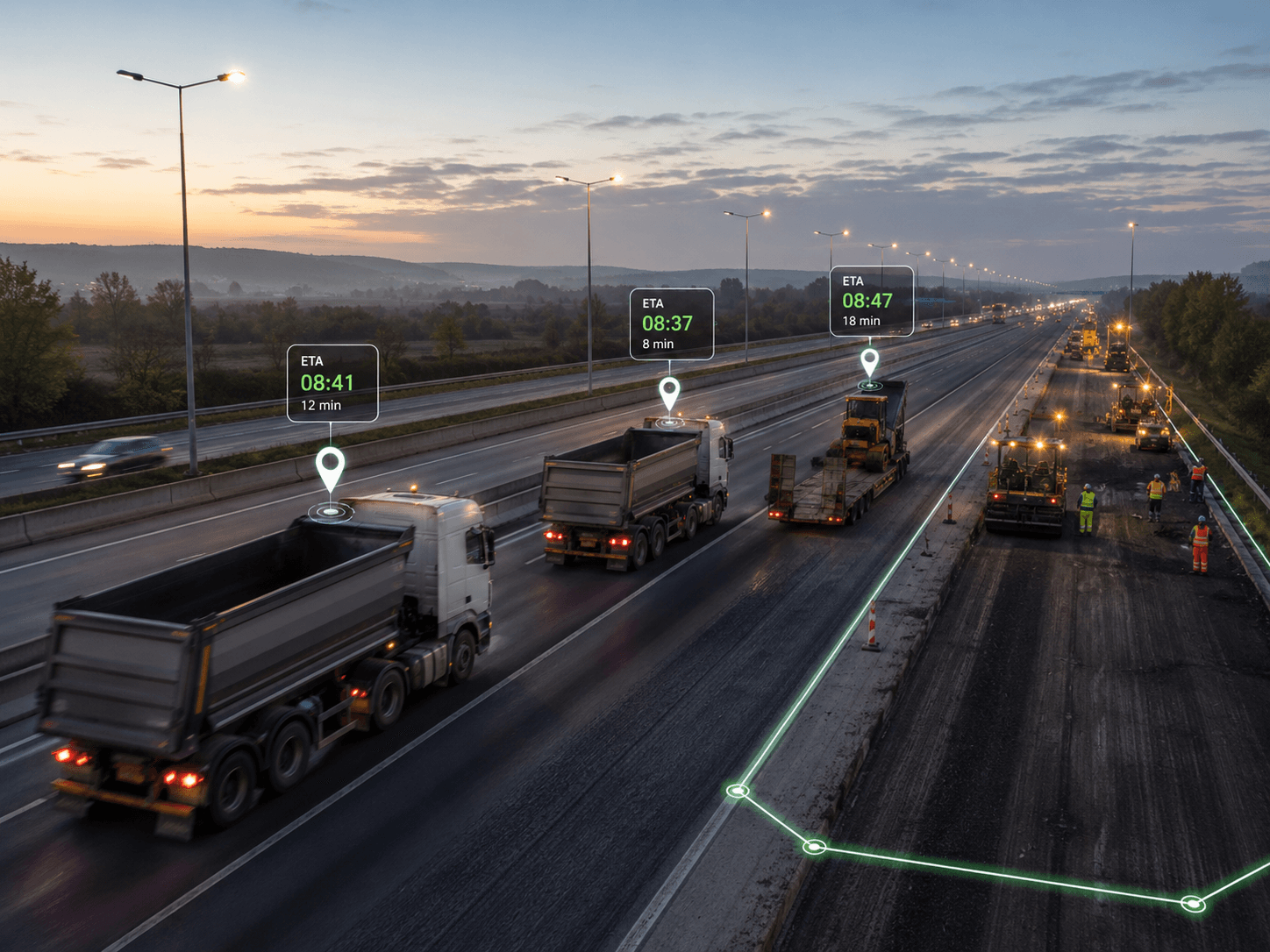
The symptom: the system confidently says "arrival 14:20," people plan around it, and the truck shows up at 16:00 — again. Crews stand idle, dock slots are missed, and customers stop trusting your notifications.
The data cause: ETAs are only as good as the position data feeding them. If updates are infrequent, missing on subcontracted legs, or arrive in inconsistent formats, the prediction is guessing between fixes. A precise-looking ETA built on sparse data is false confidence.
What it costs: idle labour at the dock, missed slots that push the next job back, detention exposure, and the slow erosion of customer trust that eventually shows up in lost renewals.
Sign 2: You spend real hours reconciling invoices and charges
The symptom: finance and operations regularly argue with carriers or customers about what actually happened — when a truck arrived, how long it waited, whether a detention charge is valid. Each dispute is a manual investigation.
The data cause: the data needed to settle the argument is scattered. The TMS says one thing, the telematics another, the paper POD a third, and none of them reconcile automatically. When there's no single trusted record of events, every disagreement becomes a forensic exercise.
What it costs: hours of skilled staff time per week, paid disputes you can't disprove, and strained carrier and customer relationships. As one common pattern goes, gaps between the TMS and invoicing systems create financial blind spots where whole portions of freight activity fall outside visibility and control.
Sign 3: Your CO2 numbers can't survive a question
The symptom: you can produce a transport CO2 figure for a report, but when a customer or auditor asks "how did you calculate that?", the answer gets vague.
The data cause: the figure is built on default factors and fleet averages rather than measured, per-shipment data — often because real fuel or distance data isn't available for many legs, especially subcontracted ones. An average dressed as a measurement doesn't hold up under scrutiny.
What it costs: failed or painful CSRD assurance reviews, weakened credibility with sustainability-conscious customers, and the risk of restating figures. Increasingly, large shippers want a primary-data share from their carriers — and "we used industry averages" is a losing answer in a tender.
Sign 4: Simple questions take days to answer
The symptom: someone asks "what was our on-time performance on the Germany–Italy lane last quarter?" or "which subcontractors have the worst dwell times?" — and the honest answer is "give us a few days to pull it together."
The data cause: the data exists, but it's spread across systems in different formats with no unified access point. Answering a basic question means exporting from three tools, cleaning spreadsheets, and hoping the joins line up. Data that can't be queried easily is data you effectively don't have.
What it costs: slow decisions, gut-feel management where evidence should rule, and an analytics function that spends its time wrangling data instead of producing insight. Opportunities to renegotiate bad lanes or drop underperforming carriers go unspotted.
Sign 5: Coverage has holes you only notice when it hurts
The symptom: most shipments are visible, but every so often one goes dark — usually a subcontracted leg, usually the one a customer is chasing. You discover the blind spot at the worst possible moment.
The data cause: telematics coverage is uneven across carriers and subcontractors. Each runs a different system, some share data poorly or not at all, and the result is a patchwork with gaps exactly where you have least control. The weakest-covered leg sets the reliability of the whole shipment.
What it costs: the highest-stakes shipments are often the least visible, so blind spots concentrate risk. Every dark leg is a potential service failure, a manual check-call, and a dent in the "we have full visibility" promise you made in the pitch.
The common root cause
Notice that four of the five signs trace back to the same thing: data fragmentation. Position data in one system, fuel in another, jobs in the TMS, proof-of-delivery on paper, each subcontractor on a different telematics platform, all in different formats and standards. No single tool was designed to reconcile them, so the reconciliation falls to people — slowly, manually, and incompletely.
Fixing individual symptoms (a better ETA tool here, a CO2 calculator there) treats the costumes, not the body underneath. The durable fix is unification: getting the underlying movement, fuel, and event data into one consistent, queryable place so every downstream use — ETAs, billing, emissions, analytics — draws from the same trusted source.
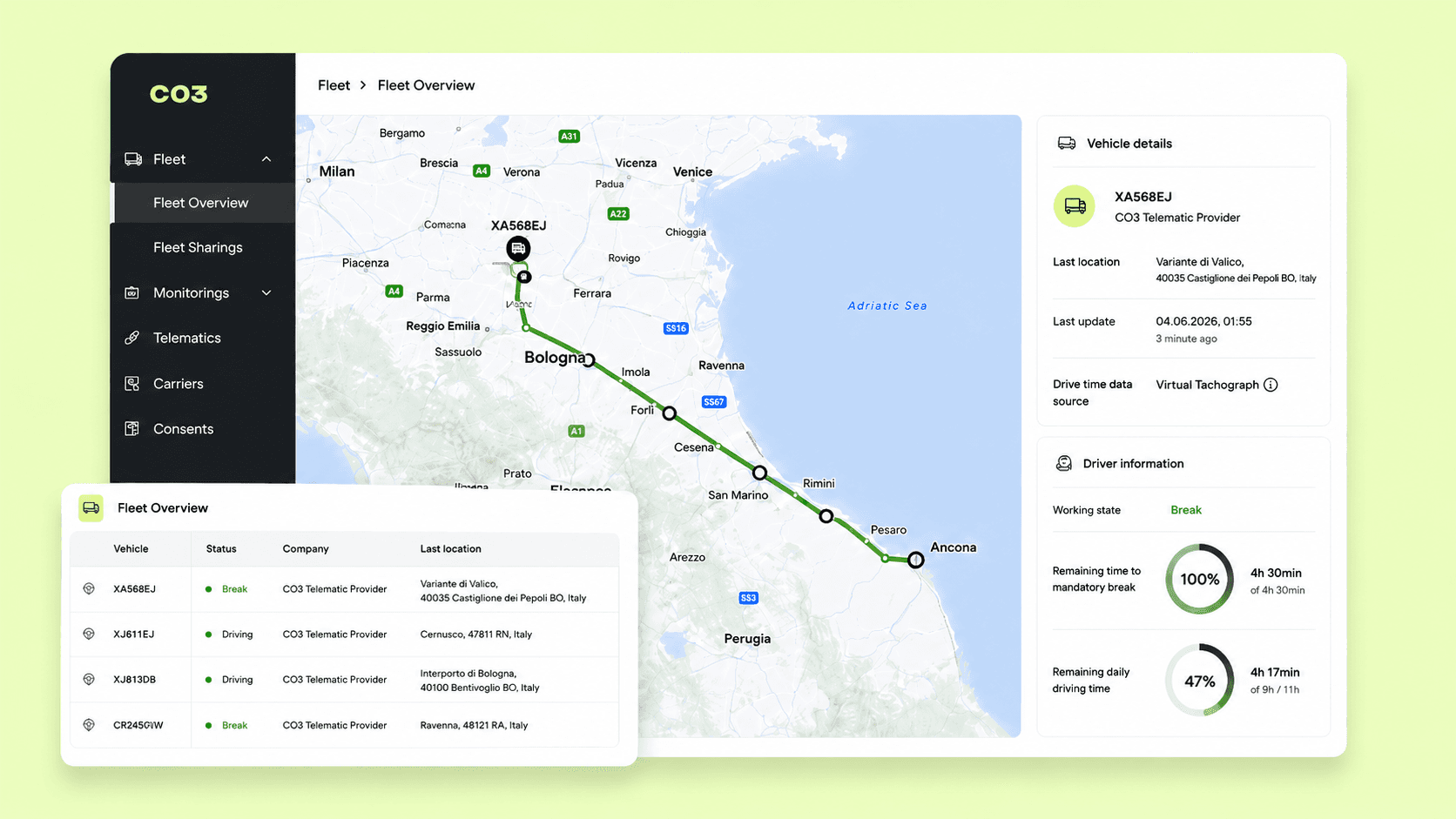
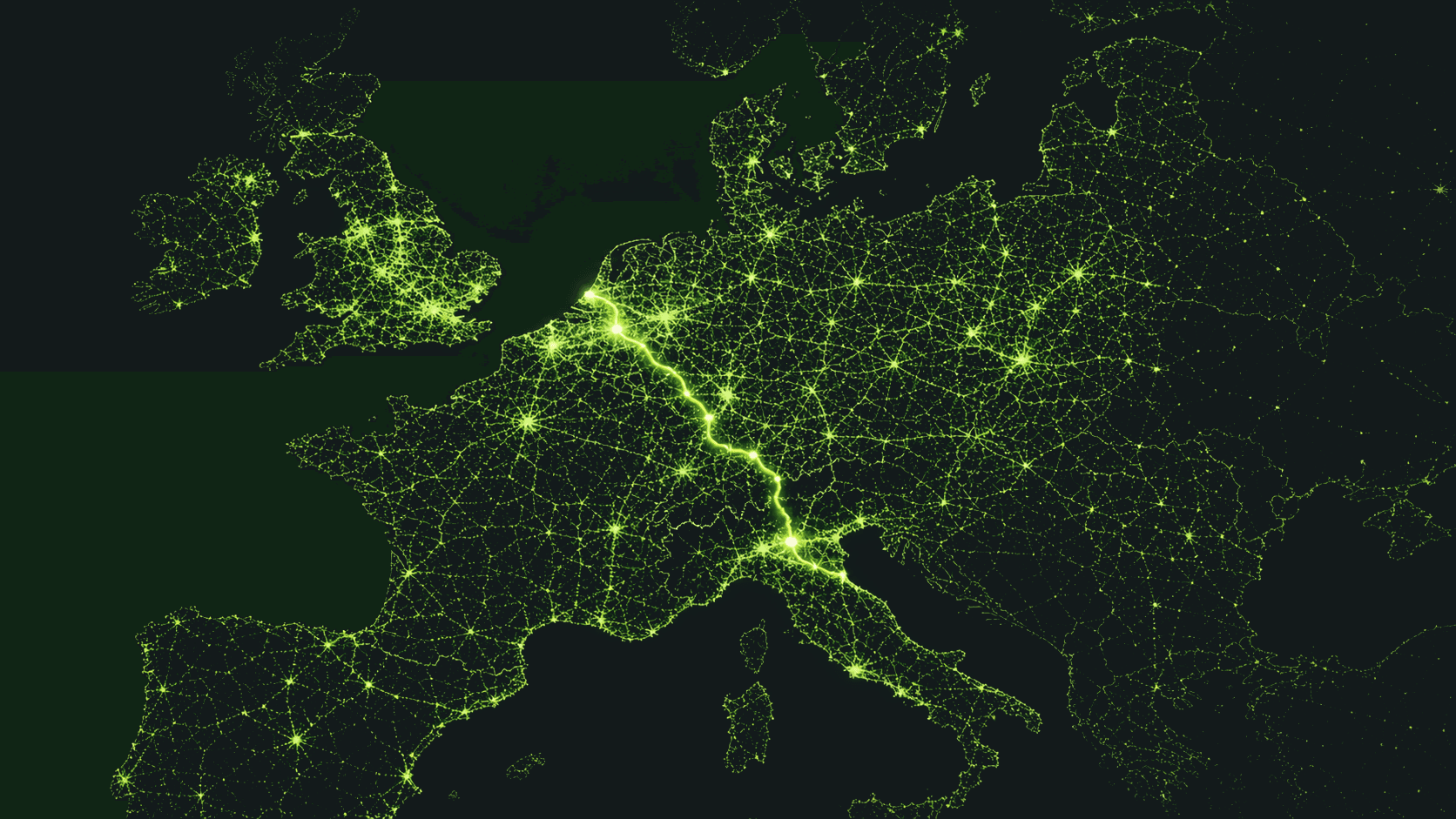
How CO3 approaches this today. CO3 aggregates telematics from 500+ integrations across trucks, trailers, and subcontractors into a single API, normalising data that would otherwise sit in incompatible silos. Because the same unified, primary vehicle data feeds visibility, ETAs, fuel, and CO2 reporting, the downstream outputs rest on one consistent source rather than five reconciled-by-hand ones.
Getting started without a big project
First, run the five-sign check below honestly with your operations, finance, and sustainability leads in the room — each tends to see a different symptom.
Second, find your darkest legs. Identify where coverage gaps and format mismatches concentrate — usually specific subcontractors or lanes — and prioritise unifying those first.
Third, measure one thing. Pick a single metric (ETA accuracy, dispute hours, or primary-data share) and baseline it. The improvement from better data is easiest to justify when you can show the before-and-after on one number.
Self-assessment checklist:
- Do your ETAs regularly miss despite looking precise?
- Do staff spend hours each week reconciling charges or events?
- Can you explain your transportCO2 method to an auditor?
- Can you answer a lane- or carrier-level question in minutes, not days?
- Is every shipment leg visible, including subcontracted ones?
- Is your transport data unified, or scattered across systems and formats?
- Does each downstream report draw from the same source data?
- Have you ever baselined a data-quality metric?
Three or more "no" answers means poor data quality is probably costing you more than you've measured. CO3 can run this assessment with your team against your live data.
What to watch over the next 12–18 months?
Data-quality expectations are rising on three fronts at once: customers want parcel-grade visibility, auditors want defensible CO2 method transparency, and regulators (via smart tachographs and the Mobility Package) want demonstrable movement records. All three reward the same thing — clean, unified, primary data — so investment here pays off across multiple pressures rather than just one.
Closing thought
Poor transport data quality is a tax you pay without seeing the invoice. The five signs above are how it shows up day to day; data fragmentation is almost always the cause; and unification is the fix that pays off in every direction at once. If even two of these signs sound familiar, it's worth putting a number on what they cost. CO3 can help you do that.
Glossary
- Data quality: The accuracy, completeness, timeliness, and consistency of data for its intended use.
- Data fragmentation: Data spread across multiple disconnected systems and formats.
- Telematics: In-vehicle systems transmitting position, speed, fuel, and related data.
- TMS (Transport Management System): Software for planning and executing freight movements.
- POD (Proof of Delivery): Confirmation a shipment was delivered, often paper or scanned.
- Dwell time: Time a vehicle spends stationary at a loading/unloading site.
- Primary-data share: The proportion of an emissions figure based on measured (not averaged) data.
- Normalisation: Converting data from varied formats into one consistent structure.









.png&w=3840&q=75)









.png&w=3840&q=75)