Primary vs. Modelled CO2 Data: Why Your Calculation Method Decides Your CSRD Score

Primary vs. Modelled CO2 Data: Why Your Calculation Method Decides Your CSRD Score
Two carriers can move the identical load on the identical lane and report very different CO2 figures — purely because of how the number was calculated. Under the GLEC Framework and ISO 14083, emissions can be based on primary data (what the truck actually burned), modelled data (real distance with default factors), or default data (industry averages). The further you sit from primary data, the more your reported emissions are an estimate, the more calculatory buffer they include, and the harder they are to defend to an auditor. As CSRD-driven scrutiny of Scope 3 transport emissions tightens, the method matters as much as the number.
Why the method, not just the number, is now under scrutiny
For years, a transport CO2 figure was a figure: you put it in a sustainability report and moved on. That era is ending. Under the EU's Corporate Sustainability Reporting Directive (CSRD) and the underlying European Sustainability Reporting Standards (ESRS), companies must disclose Scope 3 emissions — the emissions in their value chain — and transport is often a large, visible chunk of that.
Crucially, disclosure now comes with expectations about data quality and assurance. Auditors and customers increasingly ask not just "what's your transport CO2?" but "how did you calculate it, and can you show your working?" A number you can't trace back to a method is a number you can't defend. That is why the distinction between primary and modelled data has moved from a technical footnote to a board-level concern.
The three data tiers, in plain language
The GLEC Framework — now aligned with the international standard ISO 14083 — recognises a hierarchy of data quality. Think of it as three ways to answer the question "how much fuel did this trip burn?"
Primary data is the measured truth: the actual fuel or energy the vehicle consumed, read from the truck itself. It's the equivalent of reading your car's fuel gauge rather than guessing. This is the gold standard, because the emissions follow directly from real consumption.
Modelled (or "hybrid") data uses some real inputs — typically the actual distance travelled — combined with default coefficients for how much a vehicle of that type typically burns per kilometre. It's a reasonable estimate when you know the route but not the fuel. Better than a pure guess, but still an average dressed up as a measurement.
Default data is the industry-average fallback: standard distance assumptions and standard emission factors, with little or no real input from the specific trip. It's the "best available guess when you have almost nothing" tier.
The principle running through GLEC and ISO 14083 is simple: use primary data wherever you can, and fall back down the tiers only when you must. The more primary data in your calculation, the more accurate — and more defensible — the result.
Why the same shipment produces different numbers
Here's the part that surprises people. Take one truck, one lane, one load. Calculate its emissions three ways:
- Primary: the truck burned 78 litres of diesel on the run. The CO2 follows directly from that 78 litres. Hard to argue with.
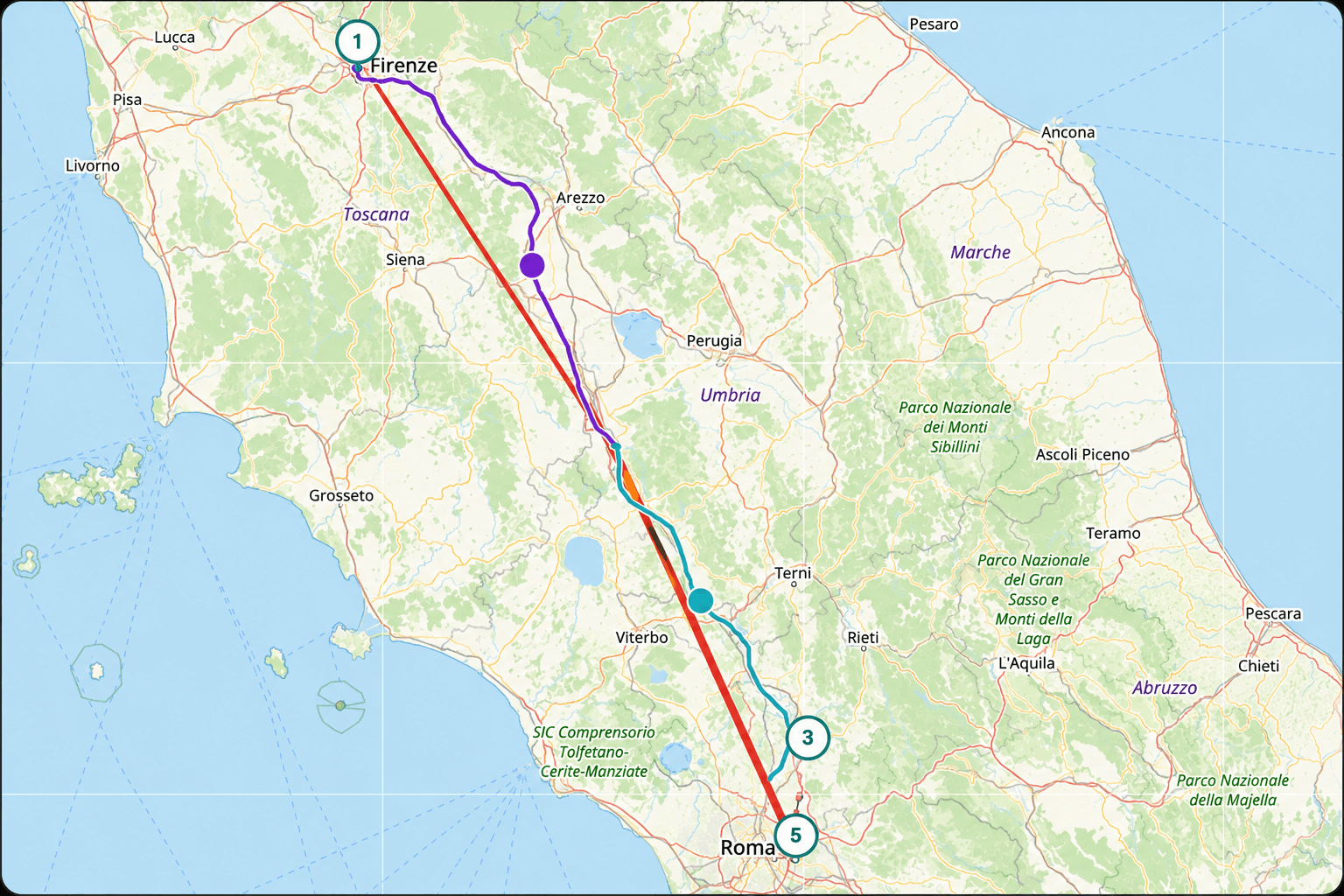
- Modelled: you know the real distance was 412 km; you multiply by a default consumption factor for that vehicle class. You get a plausible number — but it ignores load weight, terrain, traffic, driver behaviour, and idling, all of which moved the real figure.
- Default: you don't have the real distance, so you use a standard great-circle distance plus an uplift, times an average factor. Now two of your three inputs are assumptions.
Modelled and Default often even calculate higher CO2 emissions than necessary given the calculator buffers required to guarantee validity.
None of these is "wrong" under the framework — but they are not equally trustworthy, and they will not produce the same answer. A company reporting on modelled or default data is reporting an estimate with an error bar it usually can't see. When an auditor or a major shipper customer probes the figure, the estimate is where the conversation gets uncomfortable.
Where companies get stuck
The fuel-card trap. Many carriers calculate emissions from fuel-card purchase data. But a litre bought on Tuesday isn't a litre burned on a specific shipment — fuel-card data tells you spend, not per-trip consumption. It feels like primary data and isn't, which is the worst of both worlds.
The averaging trap. Modelled figures based on fleet averages can systematically understate or overstate emissions for any individual customer or lane. A shipper running heavy, hilly, congested routes is not "average," and reporting them as average misrepresents their actual footprint — in either direction.
The subcontractor blind spot. A large share of European road freight is subcontracted. If you can't get real consumption or even real distance from the carriers actually moving your freight, you default down the tiers for exactly the legs you have least visibility into — which is often where the emissions are highest.
The certification-language trap. "Certified" and "compliant" are used loosely in the market. What matters operationally is whether a calculation is aligned with GLEC/ISO 14083 methodology and, above all, how much primary data underpins it. A confident label on a thin data foundation does not survive assurance.
A practical approach: maximise primary data, then be transparent about the rest
The goal is not to claim 100% primary data — almost nobody can. The goal is to (1) push as much of your calculation onto primary data as your data sources allow, and (2) be transparent about the mix, so every figure carries its own quality signal.
That transparency is what makes a number auditable. If you can show, per shipment, which method was used and what share of the result rests on measured data, you can defend it. If you report a single blended figure with no method behind it, you can't.
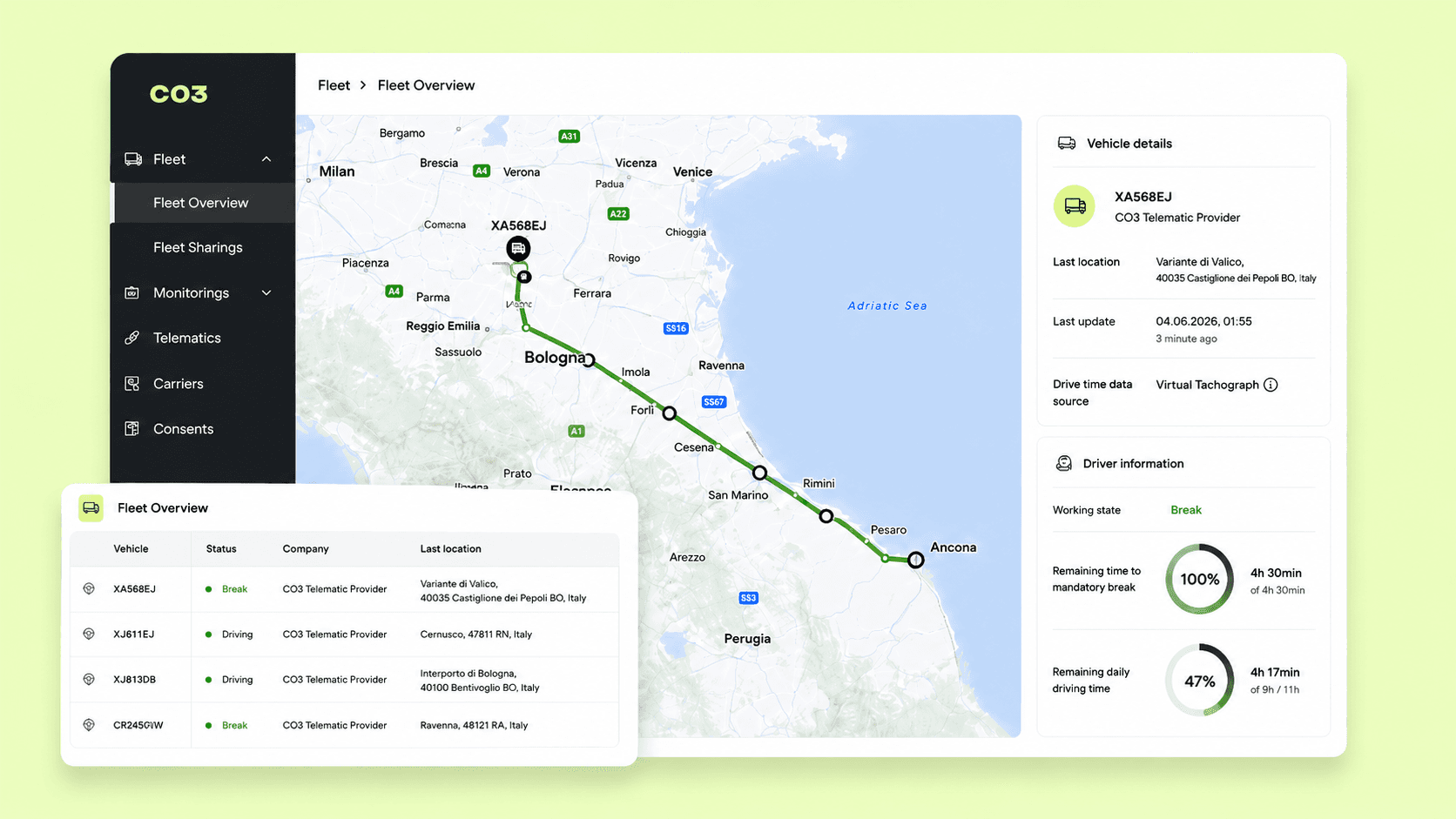
How CO3 approaches this today. CO3'sCO2 product calculates emissions per leg, aggregated to order totals, using a three-tier method hierarchy: PRIMARY (measured fuel/energy), HYBRID (real distance plus default coefficients), and MODELLED (shortest feasible distance plus uplift and defaults). Each leg returns a calculationMethod field and a primaryDataShare metric, and legs map to GLEC Transport Chain Elements. Because CO3 pulls fuel and energy data directly from vehicle telematics across 500+ integrations — including subcontractors — more legs can be calculated on primary data rather than defaults. CO3 aims to align with the GLEC Framework and ISO 14083.
The two fields above — which method and what share is primary — are the heart of a defensible report. They turn "trust us, it's 4.2 tonnes" into "4.2 tonnes, of which 71% rests on measured fuel data, here's the breakdown."
Getting started without overhauling your reporting
First, audit your current method. For your last reporting period, what share of transport emissions was primary, modelled, or default? Most companies have never asked and are surprised by the answer.
Second, connect real vehicle data where the emissions concentrate. You get the biggest accuracy gain by moving your highest-volume lanes and largest subcontractors from default to primary or hybrid first.
Third, report the data-quality mix alongside the number. Disclosing your primary-data share isn't a weakness — it's exactly the transparency that builds trust with auditors and customers.
Self-assessment checklist
- Do you know what share of your transportCO2 is based on primary data?
- Can you state, per shipment, which calculation method was used?
- Are you using fuel-card spend as a proxy for per-trip consumption?
- Do your subcontracted legs default to averages?
- Is your method aligned with GLEC / ISO 14083?
- Can you produce a per-leg breakdown if an auditor asks?
- Does your reported figure carry any indication of its own uncertainty?
- Could you defend your transportCO2 number in an assurance review tomorrow?
If several answers are "no," your CSRD-relevant transport emissions rest on estimates you can't yet defend. CO3 can assess your current data-quality mix with your team.
What to watch over the next 12–18 months
CSRD assurance requirements are tightening, and "limited assurance" reviews of Scope 3 data are becoming routine — method transparency will be checked, not assumed. GLEC continues to converge with ISO 14083 (the v3.2 update reinforced this), so "aligned with GLEC" and "aligned with ISO 14083" increasingly mean the same thing. And expect large shippers to start requiring primary-data shares from their carriers in tenders, making data quality a commercial differentiator, not just a compliance line.
Closing thought
The CO2 number on your report is only as strong as the data tier beneath it. Primary data is harder to get than a default factor — but it's the only foundation that holds up when someone asks how you got there. As scrutiny tightens, the carriers and shippers who can show their primary-data share will be the ones whose numbers go unchallenged. CO3 was built to maximise that share.
Glossary
- Scope 3 emissions: Indirect emissions across a company's value chain, including transport.
- CSRD: EU Corporate Sustainability Reporting Directive, mandating standardised sustainability disclosure.
- ESRS: European Sustainability Reporting Standards; the detailed rules under CSRD (E1 covers climate).
- GLEC Framework: Global Logistics Emissions Council method for calculating logistics emissions; aligned with ISO 14083.
- ISO 14083: International standard for quantifying greenhouse gas emissions from transport operations.
- Primary data: Emissions calculated from actual measured fuel/energy use.
- Modelled/hybrid data: Real distance combined with default consumption coefficients.
- Default data: Industry-average distances and factors used as a fallback.
- TCE (Transport Chain Element): A discrete leg of a transport chain in GLEC methodology.
- primaryDataShare: A metric expressing what proportion of a result is based on primary data.





























.png&w=3840&q=75)










.png&w=3840&q=75)