Build vs. Buy in Transport AI: Why the Data Layer Decides Who Wins
Every road freight and construction company is now under pressure to "do something with AI." The build-vs-buy debate that follows usually starts in the wrong place: at the top of the stack, with the visible application — the chatbot, the planning copilot, the predictive dashboard. But AI projects in transport rarely fail at the model. They fail underneath it, at the vehicle data layer: fragmented telematics, dark subcontractor legs, inconsistent formats, feeds that break silently. The practical answer for most operators is a hybrid: buy the data foundation, because it is undifferentiated heavy lifting that specialists already do better — and build on top of it, where your lanes, your customers, and your operating knowledge create advantages no vendor can copy.
Why this question is on every road freight agenda now
AI adoption in supply chain has crossed from experiment to expectation. The large majority of supply chain organizations report using AI somewhere in forecasting or planning, analysts project the supply chain AI market to grow by an order of magnitude over the next decade, and early adopters report double-digit reductions in logistics cost. Whatever you make of individual figures, the direction is not in dispute — and neither is the competitive subtext: the question has shifted from whether to apply AI in transport operations to how fast you can do it without burning eighteen months on the wrong approach.
That is where build vs. buy enters. Get it wrong in one direction and you spend a year and a half rebuilding plumbing you could have bought on day one. Get it wrong in the other direction and you rent a generic black box that doesn't survive contact with your operation — and traps your data on the way out.
For road freight specifically, the stakes have a particular shape. The most valuable AI use cases — reliable predictive ETAs, fuel and CO2 optimization, automated exception handling, predictive maintenance, dynamic pricing — all share one dependency: they are only as good as the vehicle data feeding them. A planning copilot reasoning over stale, partial, or inconsistent fleet data is not artificial intelligence; it is confident guessing.
The part most frameworks miss: transport data is hostile terrain
Generic build-vs-buy frameworks assume clean data, stable workflows, and tidy problem boundaries. Road freight offers none of these.
A typical European road freight operation runs its own tractors on one telematics system, trailers on another, leased vehicles on the OEM's factory-fitted system, cooling units on the manufacturer's own portal, and a long tail of subcontractors on twenty different systems — or none you can access. Every one of those sources has its own API, its own data model, its own update frequency, its own quirks, and its own habit of changing without notice.
This is the terrain any transport AI has to live on. And it explains the pattern many teams discover 12–18 months into their AI journey: the pilot worked beautifully on the clean sample extract, then broke in production — not because the model was bad, but because real-world inputs are messy, late, duplicated, and full of gaps. The hard problem was never intelligence. It was the retrieval, normalization, and reliability of the data underneath it.
Think in layers, not in one decision
"Should we build or buy AI?" is a malformed question, because AI in transport is not one thing — it is a stack, and each layer is a separate build-vs-buy decision with different economics.
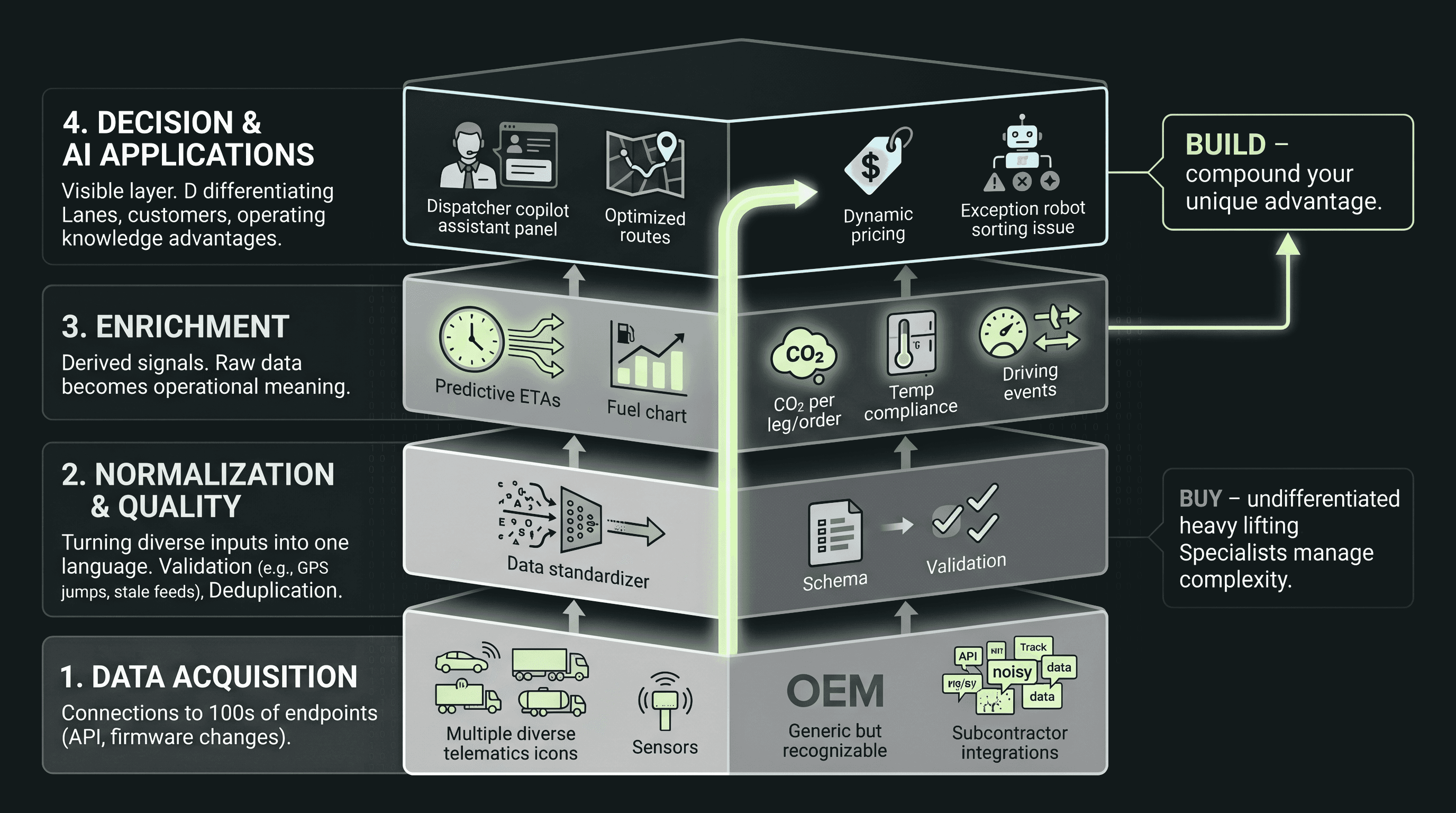
Layer 1 — Data acquisition. Connections into every vehicle, trailer, telematics box, and cooling unit across your own fleet and subcontractors. This is integration work measured in the hundreds of endpoints, each requiring ongoing maintenance as providers change APIs, firmware, and data formats.
Layer 2 — Normalization and quality. Turning twenty data dialects into one language: a unified schema, validation that catches GPS jumps and stale feeds, deduplication, and consistent semantics ("ignition on" should mean the same thing regardless of source).
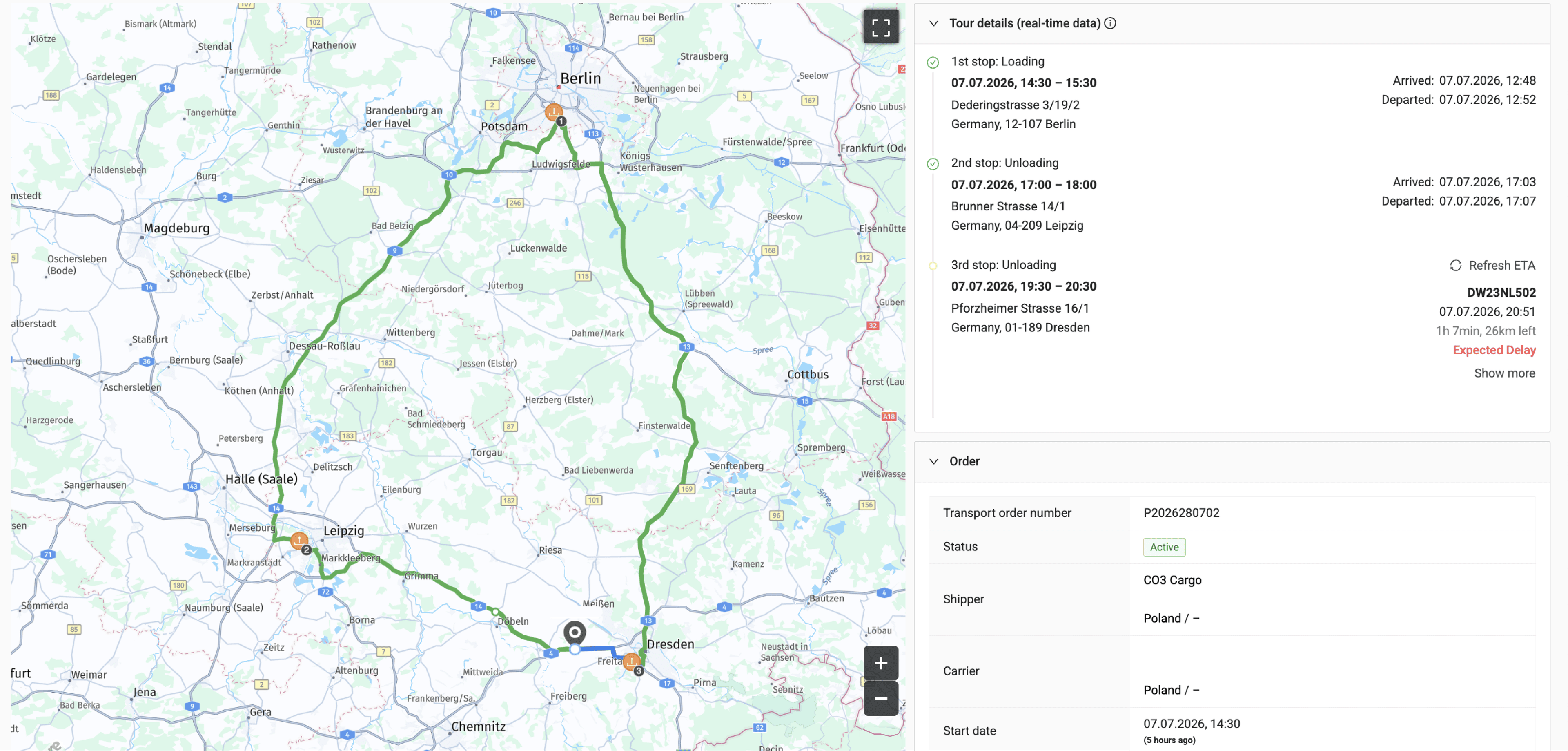
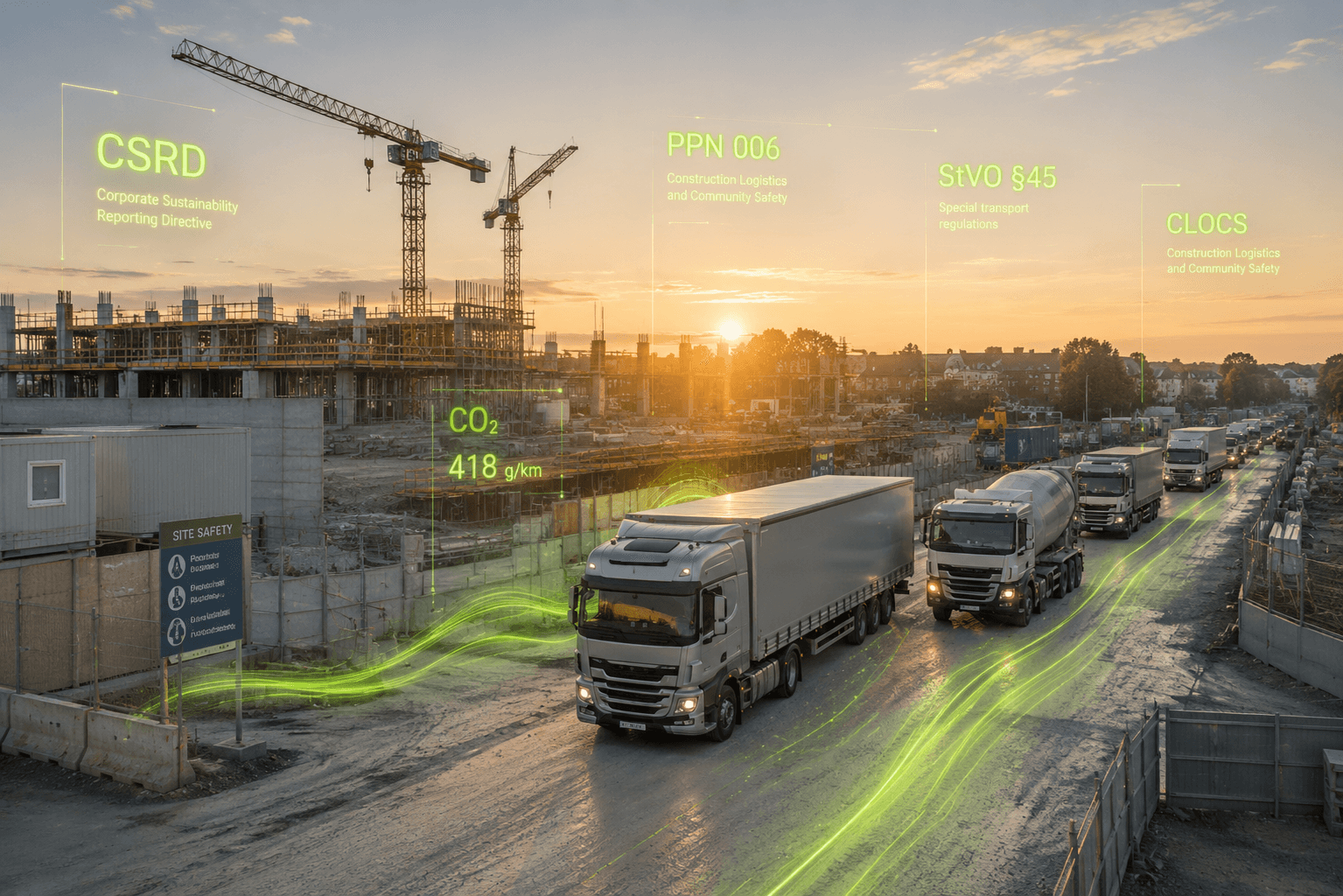
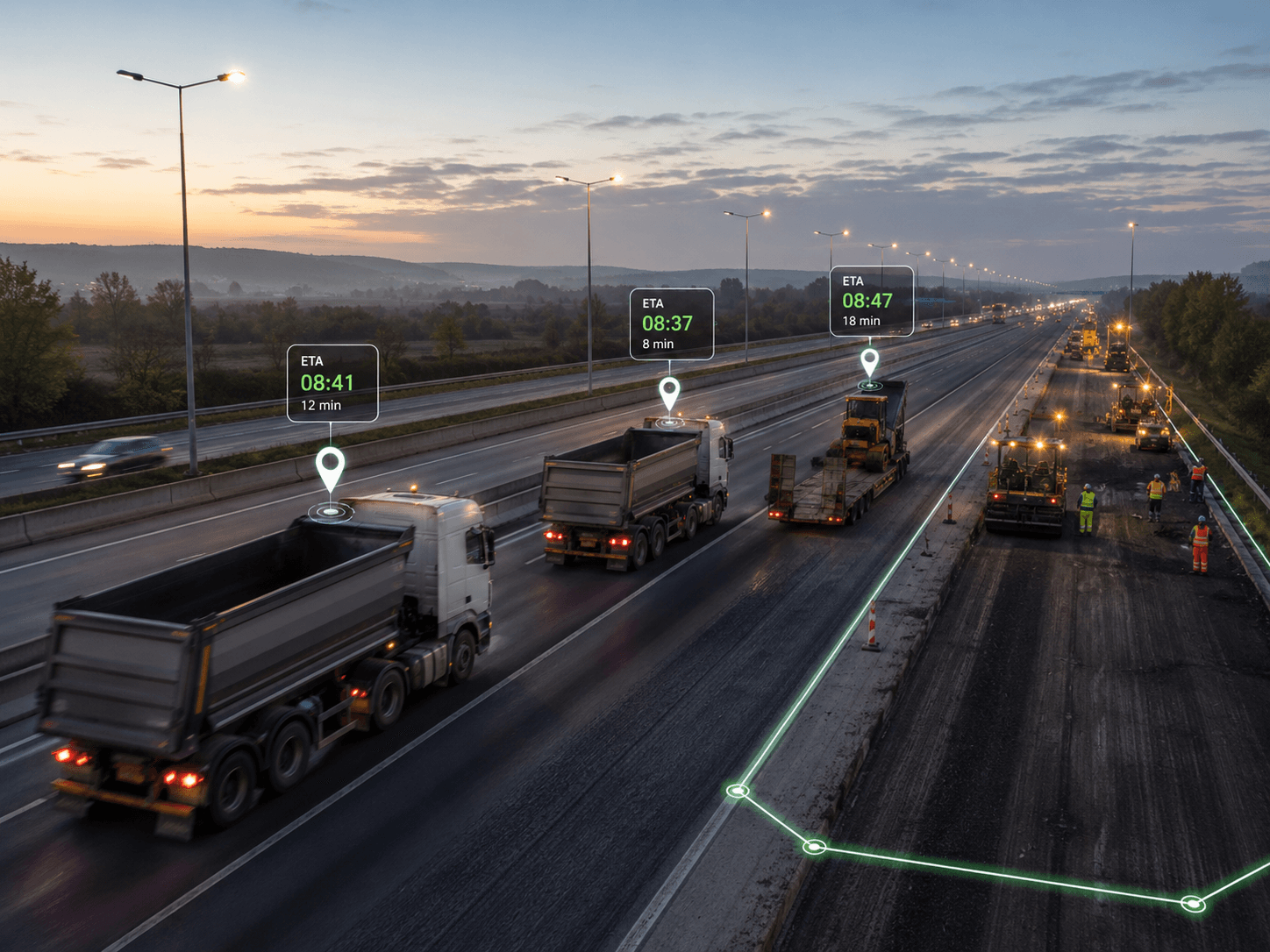
Layer 3 — Enrichment. Derived signals computed from the normalized stream: predictive ETAs, fuel consumption per vehicle and tour, CO2 per leg and order, temperature compliance, driving events. This is where raw data becomes operational meaning.
Layer 4 — Decision and AI applications. The visible layer: planning optimization, automated exception handling, dynamic pricing, customer-facing tracking products, copilots for dispatchers. This is what demos well and what board decks are made of.
The critical insight: each layer depends entirely on the one below it. Most teams debate layer 4 and underestimate layers 1–3 — and layers 1–3 are where transport AI projects actually die.
The economics of each layer
Why building the data layers rarely pays
Consider what building layer 1 in-house actually means. Each telematics integration is, individually, a manageable project — a few weeks of engineering. But the economics are brutal in aggregate:
The integration count is large and grows with every new subcontractor your commercial team signs. Each integration is a permanent maintenance liability, not a one-off: providers update APIs, deprecate endpoints, and change data semantics continuously, which means a standing engineering team forever. The output of all this work is competitively worthless on its own — your customers do not pay you more because you maintain 200 API connections; they pay for reliable transport. And you will always trail specialists on coverage: a dedicated platform amortizes each integration across hundreds of fleets, while you amortize it across one.
This is the classic profile of "undifferentiated heavy lifting" — necessary, expensive, and invisible when done well. The build case only holds for operators with genuinely unusual requirements and a standing platform engineering organization — and even then it deserves scepticism.
Why building the application layer often does pay
The calculus inverts at the top of the stack. Your dispatching heuristics, your lane knowledge, your customer commitments, your pricing logic, your way of handling the Friday-afternoon surge — this is operational knowledge no vendor has and no competitor can copy. AI applications that encode your decision-making on top of commodity data infrastructure compound your existing advantage instead of replacing it with someone else's average.
The same logic applies to customer-facing products. A logistics service provider that builds its own customer portal, scorecards, or CO2 reporting on a reliable data feed differentiates. One that resells a vendor's generic portal does not.
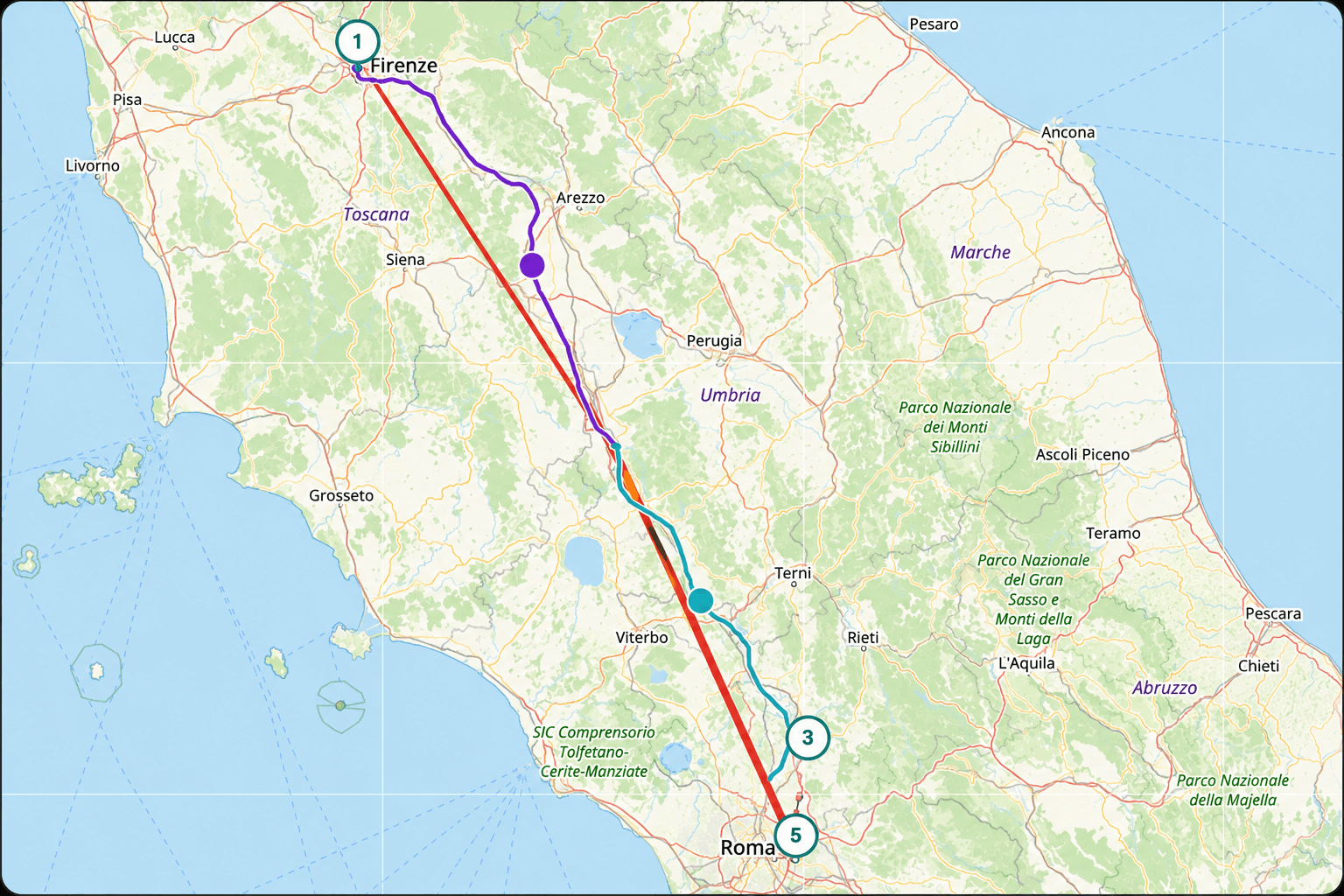
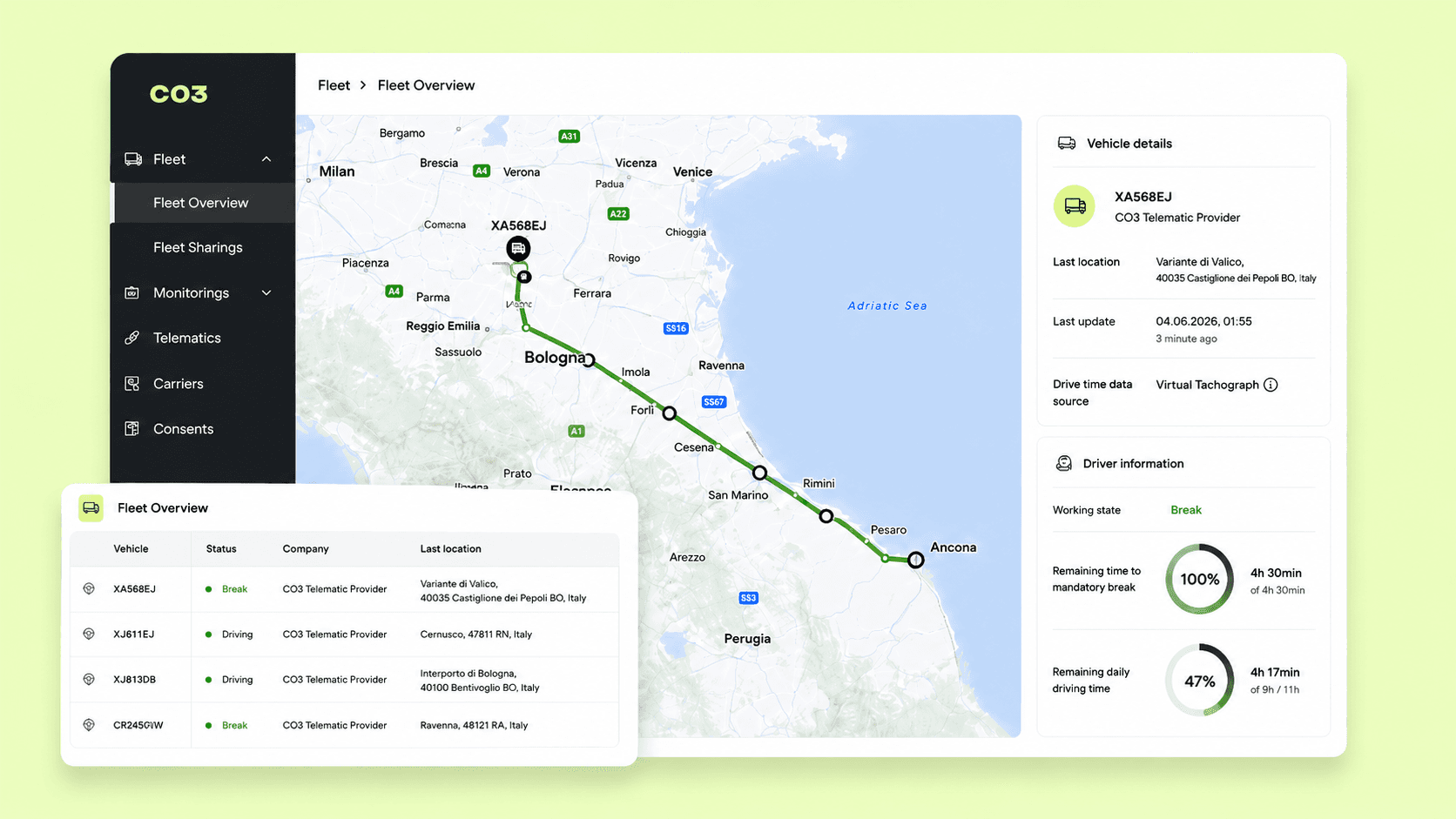
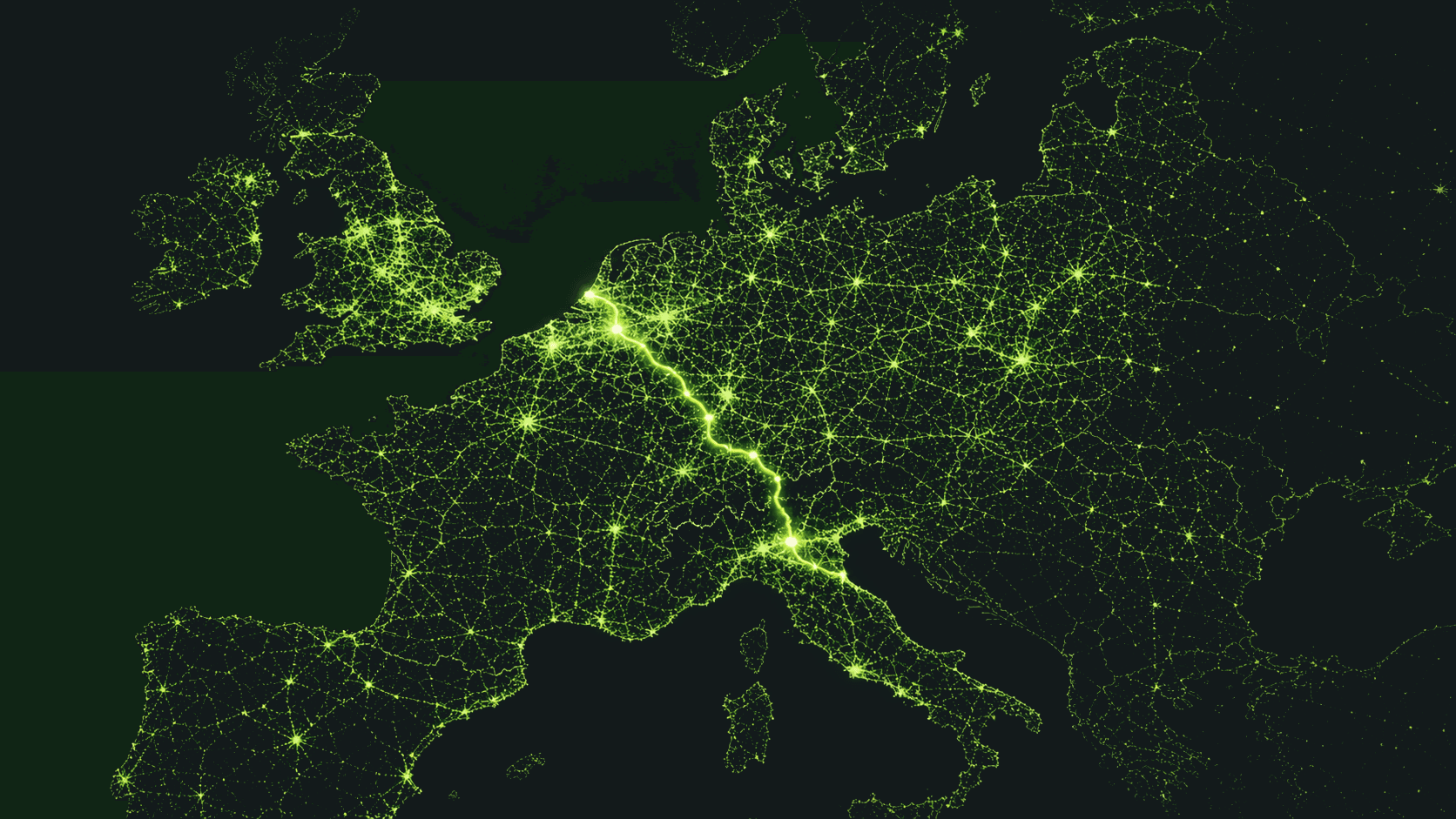
Where CO3 sits in this stack. CO3 is the bought foundation: layers 1–3 as a service. More than 500 telematics integrations across trucks, trailers, telematics devices, and cooling units — including subcontractors — normalized into a single API, with enrichment like predictive ETAs, fuel consumption, temperature monitoring, and CO2 reporting per leg and order computed on top. No hardware installation, no integration maintenance burden, and the data remains accessible via API rather than locked in a portal — which means whatever you build on layer 4, you build on your own data.
Where transport companies go wrong — on both sides
Build-side mistakes
Rebuilding what already exists. The most common failure: an internal team spends two quarters building telematics connectors that a specialist platform already offers in the hundreds. The opportunity cost is not just the engineering spend — it is the AI roadmap that waited a year for data.
Underestimating lifecycle cost. The build estimate covers version 1. It rarely covers the permanent reality: monitoring feeds, chasing breaking API changes, onboarding every new subcontractor's system, and keeping quality validation current as the fleet mix changes.
Treating it as a data science project. Transport AI lives in operations — dispatch decisions, exception handling, customer commitments — not in notebooks. A model that doesn't integrate into the dispatcher's actual workflow doesn't get used, and an unused model has negative ROI.
No ownership when it's wrong. If an automated decision misroutes a load or a CO2 report is off, who is accountable? Internal builds frequently launch without an answer, and trust erodes on the first incident.
Buy-side mistakes
Buying on demos. Every vendor demo runs on clean data. Evaluate on your ugliest reality instead: your most fragmented subcontractor fleet, your worst lane, a month of your real feeds. The differentiator between platforms is not the dashboard — it is what happens to data quality at the edges.
Locking into the wrong data model. Some platforms absorb your data and make it hard to access, audit, or take with you. Insist on full API access to your own raw and normalized data, and check the exit path before signing. Data portability is the difference between buying a foundation and renting a dependency.
Assuming "good enough" without benchmarking. An ETA feature checked as "available" tells you nothing. Demand accuracy figures, measure them on your lanes during a paid pilot, and write performance into the contract.
Scaling before proving value. Multi-year commitments before a production-grade validation on real workflows transfer all the risk to you. Structure the first phase around one measurable use case.
The mistake on both sides
Making one blanket decision. "We build everything" and "we buy everything" both fail, because the economics differ per layer. Decide layer by layer, use case by use case. And on either path: define success numerically before you start — ETA accuracy, share of exceptions resolved automatically, hours saved per dispatcher per week — or you will never know whether it worked. Finally, do not underestimate the human side: operators who don't trust or understand a system will quietly work around it, and a workaround culture kills any AI investment regardless of technical quality.
A decision framework you can run in one meeting
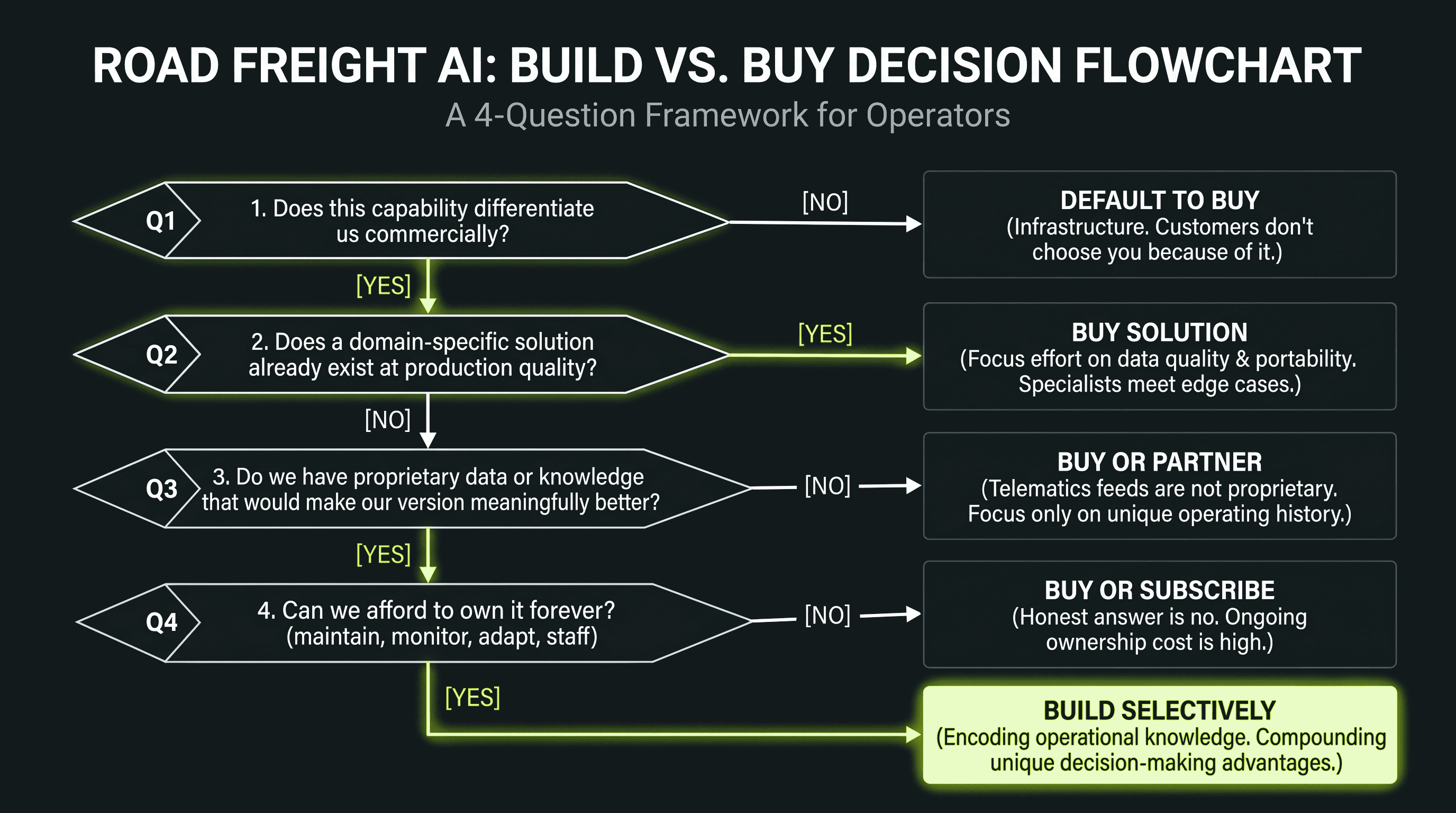
For each capability on your AI roadmap, ask four questions in order:
- Does this capability differentiate us commercially? If customers don't choose you because of it, it is infrastructure → default to buy.
- Does a domain-specific solution already exist at production quality? Domain-specific matters — generic data tools that have never met a tachograph or a reefer unit will rediscover transport's edge cases at your expense. If a specialist exists → buy, and spend your evaluation effort on data quality and portability.
- Do we have proprietary data or knowledge that would make our version meaningfully better? Your operating history, lane performance, and customer behavior are proprietary. The telematics feed format of a major OEM is not. Build only where the answer is a confident yes.
- Can we afford to own it forever? Not build it — own it: maintain, monitor, adapt, staff. If the honest answer is no → buy.
For most road freight and logistics operators, this lands in the same place: buy layers 1–3, build selectively on layer 4 — starting with one use case where your operational knowledge is strongest and the success metric is unambiguous.
Getting started without betting the company
First, audit your data foundation before any AI initiative. Coverage (what share of legs, including subcontractors, have live data?), freshness (minutes or tens of minutes?), and consistency (one schema or per-source formats?). If the foundation scores poorly, fix that first — every euro spent on layer 4 before layers 1–3 are solid is largely wasted.
Second, pick one use case with a hard number attached. Predictive ETA for your top 20 lanes, automated handling of one exception type, CO2 reporting for your three largest customers. Prove value in one quarter, then expand.
Third, contract for an exit. Whatever you buy: API access to your own data, documented export, no punitive switching terms. Whatever you build: documentation and at least two people who understand it.
Self-assessment: where does your operation stand?
- Do we know what share of our shipments (incl. subcontractors) has live vehicle data today?
- Is our vehicle data accessible through one interface, or scattered across portals?
- Has any AI/analytics pilot in the last two years failed on data quality rather than model quality?
- Are engineers currently maintaining telematics integrations in-house — and do we know the annual cost?
- For each AI initiative on our roadmap: is it classified as differentiating or infrastructure?
- Do we have a numeric success definition for our next AI investment?
- If we left our current data/visibility vendor, would we keep our historical data?
- Is there one named owner for data quality across the fleet?
- Have we evaluated any vendor on our messy real data rather than their demo data?
- Could our dispatchers explain what the AI feature they use actually does?
Three or more "no" answers suggests the foundation, not the application layer, is your constraint. CO3 can run this assessment with your team against your actual fleet setup.
What to watch over the next 12–18 months
Agentic AI is moving into transport execution — systems that don't just predict but act: rebooking slots, notifying customers, resolving routine exceptions. Every credible version of this depends on a complete, live data layer; agents acting on partial data automate mistakes at machine speed. The data-access question is becoming regulatory, not just contractual: EU data-sharing rules are pushing vehicle manufacturers toward opening operational data access, which will expand what a good data layer can deliver — and raise expectations for what counts as complete coverage. And AI capability is commoditizing while data advantage is not: as models become cheaply available to everyone, the differentiator shifts further toward who has the cleanest, broadest, most current operational data to point them at.
Closing thought
Build vs. buy in road freight AI is not one decision — it is a different decision at every layer of the stack, and the layer that decides success is the one nobody puts in a board deck: the data foundation. Buy the plumbing from people who do nothing else. Build where your operation knows things nobody else knows. And before any of it: find out, honestly, what share of your fleet you can actually see today. That number, more than any model, predicts how your AI story ends. CO3 can help you establish it.
Glossary
- Build vs. buy: The decision between developing a capability in-house versus licensing it from a specialist vendor.
- AI stack: The layered set of capabilities behind any AI application: data acquisition, normalization, enrichment, and decision applications. Each layer depends on the one below.
- Undifferentiated heavy lifting: Necessary infrastructure work that creates no competitive advantage — customers don't pay more for it being done in-house.
- Telematics: In-vehicle hardware/software transmitting GPS position, speed, fuel use, temperature, and vehicle events.
- Normalization: Converting data from many sources and formats into one consistent schema and semantics.
- Enrichment: Derived signals computed from raw data — e.g., predictive ETAs, fuel consumption per tour, CO2 per order.
- Data portability: The ability to access and export your own data from a vendor's platform, including on exit.
- Agentic AI: AI systems that take actions (rebooking, notifying, resolving) rather than only producing predictions or text.
- Predictive ETA: A continuously recalculated arrival forecast based on live position, traffic, driver hours, and historical lane data.
- Lifecycle cost: Total cost of owning a system over its life — maintenance, monitoring, adaptation — not just initial development.
- Dark leg: A shipment segment (often subcontracted) without live tracking data.





















.png&w=3840&q=75)










.png&w=3840&q=75)