Route Optimization and Network Planning When the Tachograph Is Your Most Underused Dataset
The Tachograph Is Your Most Underused Dataset for Route Optimization and Network Planning
From 1 July 2026, a van crossing a single EU border falls under the same driver-hours rules as a 40-tonne truck: a 9-hour daily driving limit, a 45-minute break after 4.5 hours, and a minimum daily rest — all recorded by an installed tachograph. Most planners treat that as a compliance burden. The more useful way to see it: every cross-border vehicle in Europe is now generating a continuous record of driving and rest, and that record is the single most accurate input you have for route optimization and network planning. This deep-dive explains why driver hours — not distance — are the real constraint in road freight planning, how remote tachograph data and remaining-drive-time become a live planning asset rather than a compliance afterthought, and a practical way to feed that data into routing, ETAs, and network design without ripping out your existing systems.
Why routing is really a driver-hours problem
Tomorrow's regulatory change makes a long-running truth impossible to ignore. As of 1 July 2026, EU driving- and rest-time rules, the Smart Tachograph 2 mandate, and posting rules extend to light commercial vehicles between 2.5 and 3.5 tonnes used in international transport or cabotage. Vans that yesterday needed nothing now carry the same obligations as heavy trucks — enforced with roadside checks, fines, and in serious cases immobilisation. It follows the August 2025 milestone, when the smart-tachograph retrofit for trucks over 3.5 tonnes in international transport concluded and the European Commission moved towards "stronger and more unified enforcement." The population of vehicles whose movements are governed by driver hours just expanded sharply.
Here is what that means for anyone who plans transport. The binding constraint on a route is rarely the distance or even the traffic. It is whether the assigned driver has enough legal driving time left to complete the job before they must stop. A route that looks perfect on a map — shortest distance, lowest toll, lowest fuel — is worthless if the driver runs out of hours 40 kilometres short of the delivery window. Distance-based optimization answers "what is the fastest path?" The question that actually decides whether the load arrives on time is "can this driver, with the hours they have left, legally make it — and if not, where do they stop, or where do we swap?"
For the executive reader, the commercial translation is simple. Driver hours drive three numbers you care about: on-time performance (the threshold above which shippers keep paying premium rates), asset utilisation (the number-one KPI in chartering), and empty kilometres (a forced reassignment typically adds 50–100% more empty running). Planning that ignores remaining drive time degrades all three at once. Planning that respects it protects all three.
The background, explained simply
A few terms recur in this piece. None of them are complicated once you strip away the jargon.
EU Regulation 561/2006 is the rulebook for driving and rest. The headline limits: a maximum of 9 hours of driving per day (extendable to 10 hours no more than twice a week), a 45-minute break after every 4.5 hours of driving (splittable into 15 + 30 minutes), a maximum of 56 hours in a week and 90 hours across any two weeks, and a daily rest of at least 11 hours (reducible to 9 hours a limited number of times). In plain terms, the regulation is not one number but a set of clocks, each resetting on a different boundary.
The tachograph is the device in the cab that records those clocks — when the vehicle drove, when the driver rested, and, in the second generation, where it crossed borders. The Smart Tachograph 2 (also called G2V2) is the current mandated version. It records position at key points automatically, which is exactly the data enforcement bodies use.
Remote tachograph download (RDL) is the ability to pull tachograph data wirelessly, without the vehicle or driver being present. EU rules require operators to download vehicle data at least every 90 days and driver-card data every 28 days; remote download automates this. The by-product matters more than the compliance: once the data flows continuously, you can see remaining drive time — how much legal driving each driver has left right now — instead of guessing.
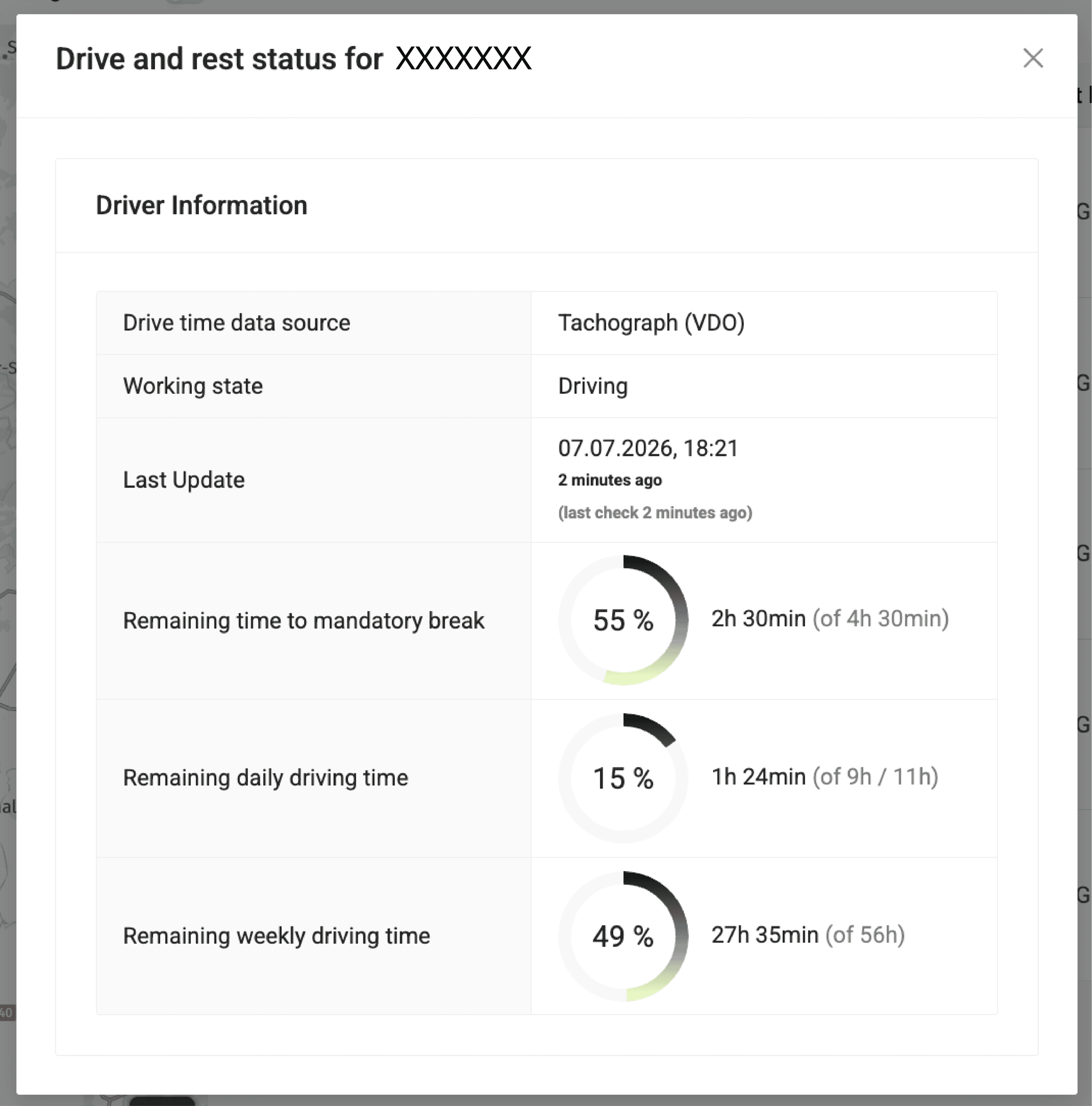
Remaining drive time is the planning asset. It is the difference between a static assumption ("a driver can do 9 hours") and operational reality ("this driver has 3 hours 40 minutes left, must break in 50 minutes, and owes two hours of compensated rest this week"). The first is a rule. The second is something you can actually plan around.
The distinction worth holding onto: a tachograph is a compliance record by law, but the data it produces — combined with telematics — is a planning input. Using it for planning does not turn your visibility tooling into a legal tachograph, and it should not pretend to. It simply means the richest dataset about your fleet's real capacity stops sitting unused in a compliance archive.
-2.png&w=3840&q=75)
-02.png&w=3840&q=75)
Where planners get stuck
Four patterns show up on almost every ops floor.
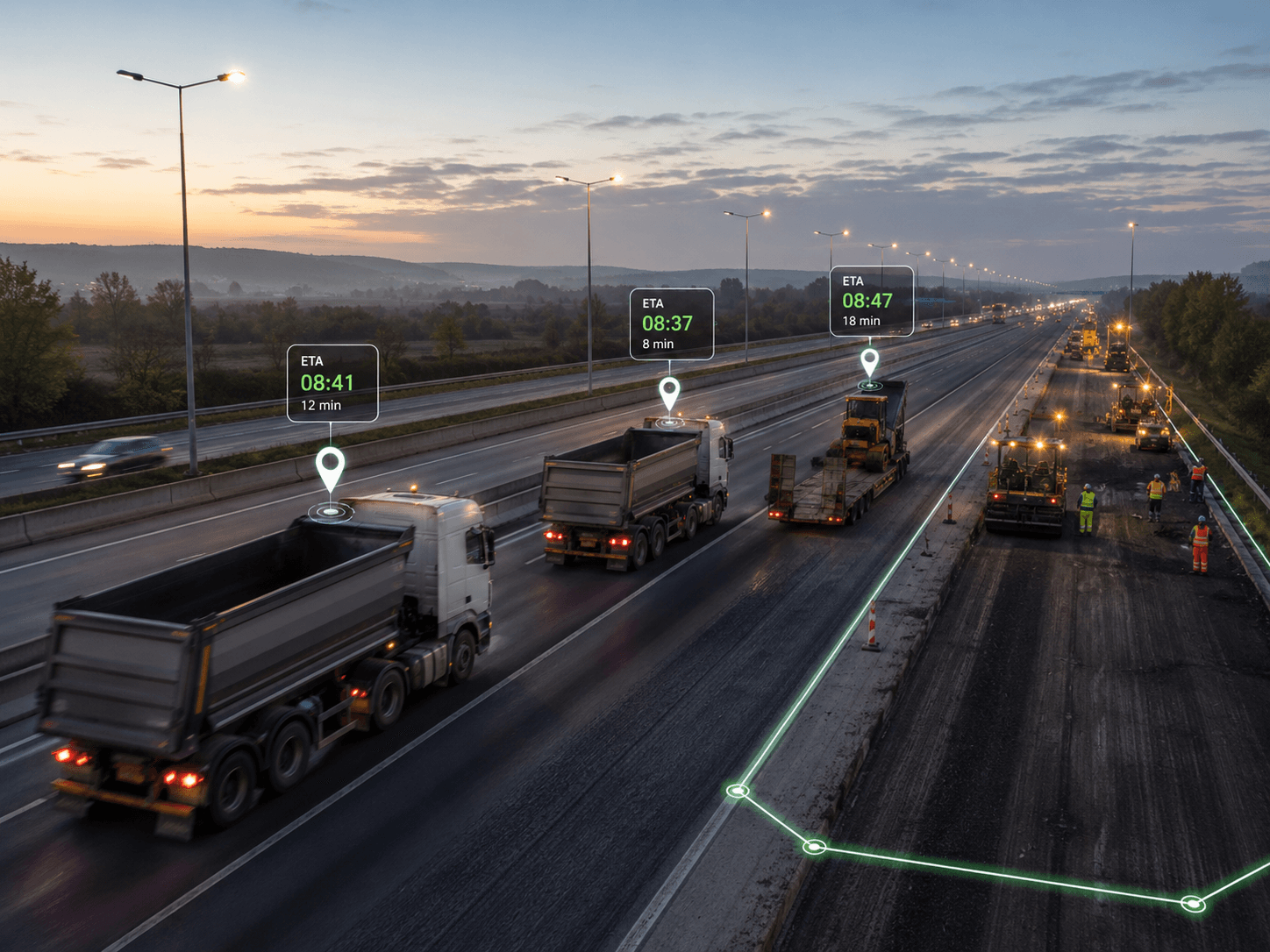
The optimistic-ETA trap. Most routing engines compute arrival from distance, speed, and traffic, then assume the driver can run the clock down without stopping. Real journeys have a mandatory 45-minute break after 4.5 hours and an 11-hour rest that can land mid-route. An ETA that ignores those is precise but wrong — and a precise wrong number is worse than an honest range, because operations act on it. The break and rest aren't noise; they're the difference between "arrives 16:00 today" and "arrives 08:00 tomorrow."
The subcontractor blind spot. A carrier's own trucks may sit on a clean OEM telematics feed. The chartered truck and the spot booking do not. Yet a single international move often involves all three, on different systems, with different data and different refresh rates. Planners end up phoning carriers and doing the 9-hours-versus-11-hours-rest arithmetic in their heads, per truck, several times a day. The driver whose hours you can't see is the one most likely to break your plan.
Manual remaining-hours guesswork. Even where data exists, a tachograph snapshot is a counter frozen at an instant — the driver kept driving after it was taken. By the time a planner looks, a 15-minute-old snapshot already understates how much time has been used, and a snapshot built from periodic file downloads can be far older. Decisions get made on stale numbers, and the cost of being wrong is asymmetric: a driver told they have 30 minutes who actually has 50 is a minor inefficiency; the reverse is a violation, a fine, and a stranded load.
A network designed without rest geography. Network planning — where you site hubs, how you structure relays, which lanes you run direct versus staged — is usually optimised for distance and facility cost. But if a lane reliably forces a driver to exhaust their hours at a point with nowhere legal to rest, the network is fighting the regulation every day. Rest geography (where drivers can legally and safely stop) and relay points (where one driver can hand off to another with fresh hours) are network-design variables, not operational accidents. Most networks were drawn before anyone treated them that way.
A practical approach: make remaining drive time a first-class input
The shift is from treating driver hours as a constraint you check at the end to treating remaining drive time as an input you plan from at the start. Three moves get you there.
First, unify the drive-time signal across the whole fleet. The planning question — "can this driver do this load?" — can only be answered well if every vehicle, owned or chartered or spot, presents the same drive-time picture. That means harmonising tachograph downloads, telematics activity, and movement events into one consistent view, with the same fields for the OEM-connected truck and the hard-to-reach subcontractor. The complexity of "which provider, which format, which refresh rate" should be absorbed once, centrally — not re-solved by every planner and every TMS.
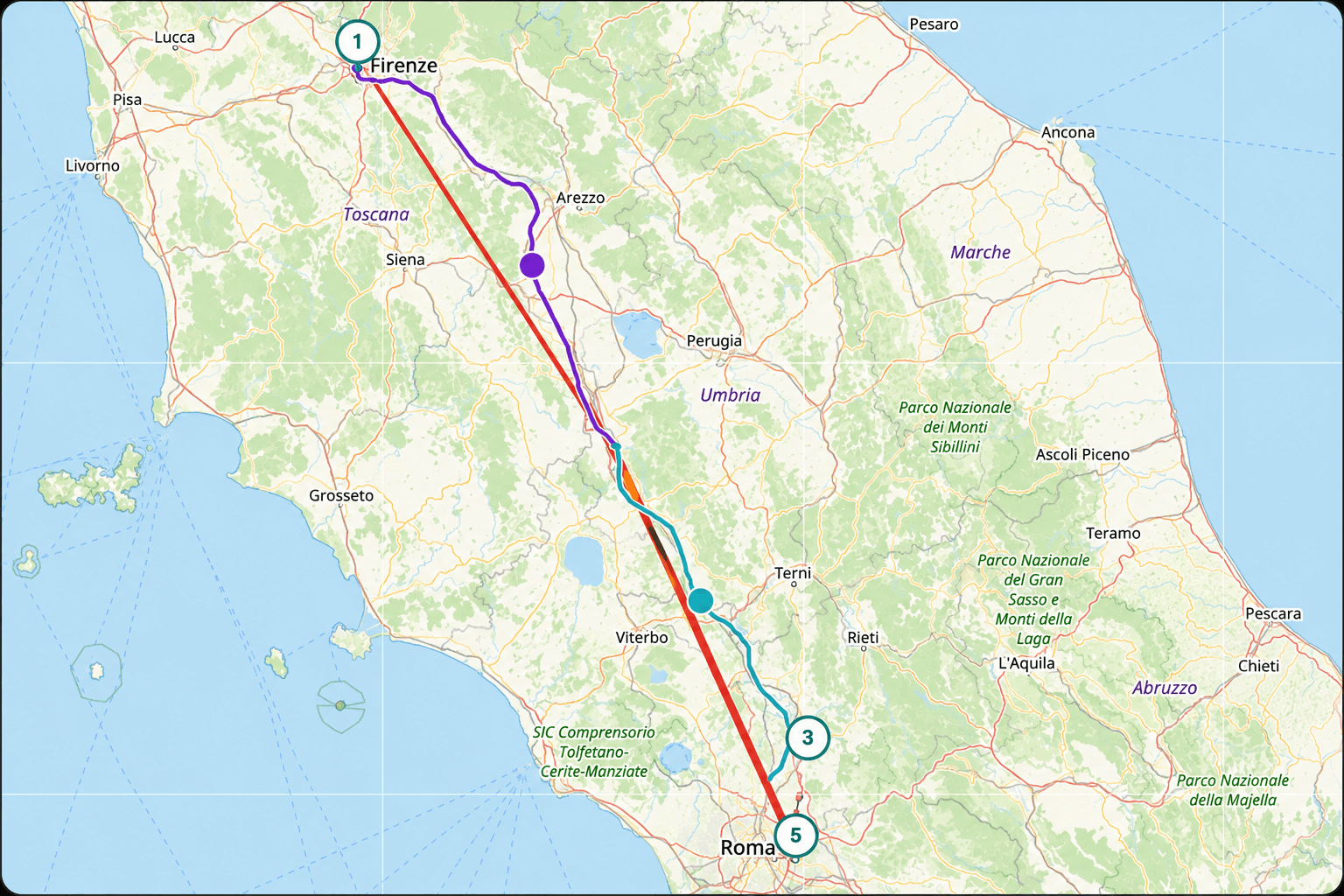
Second, feed remaining drive time into routing and ETAs. Once you have a trustworthy remaining-budget per driver, routing can place mandatory breaks and rests where they actually fall, and ETAs can reflect them. The result is fewer "precise but wrong" arrival times and earlier, calmer re-plans — you find out a driver won't make the window while there is still time to swap, not at the dock.
Third, plan the network around rest and relay geography. Use the accumulated drive/rest data to see where lanes routinely run drivers out of hours, and design relays, staging, and hub locations so that hand-offs happen where fresh hours are available and legal rest is possible. This is where network planning and driver hours stop being separate disciplines.
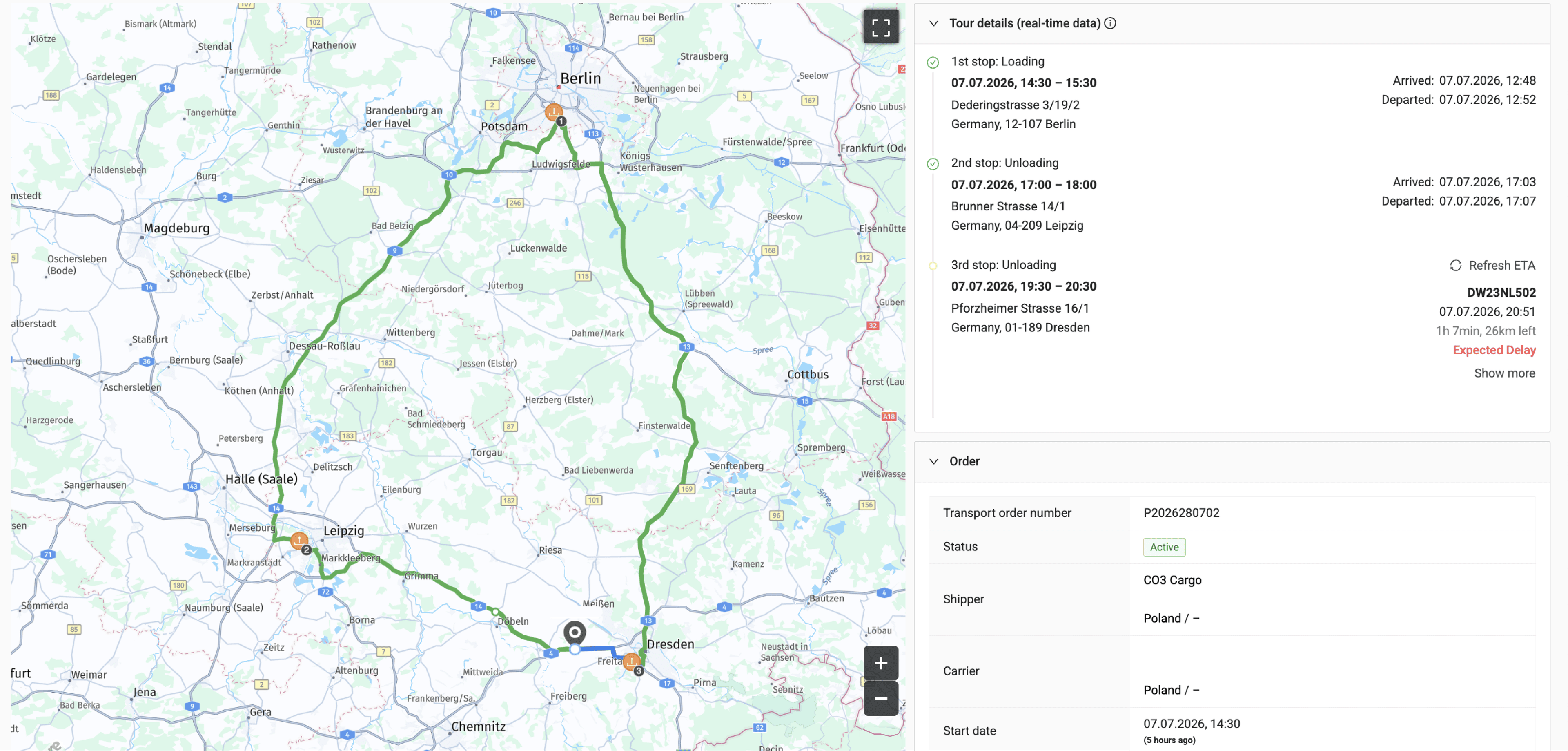
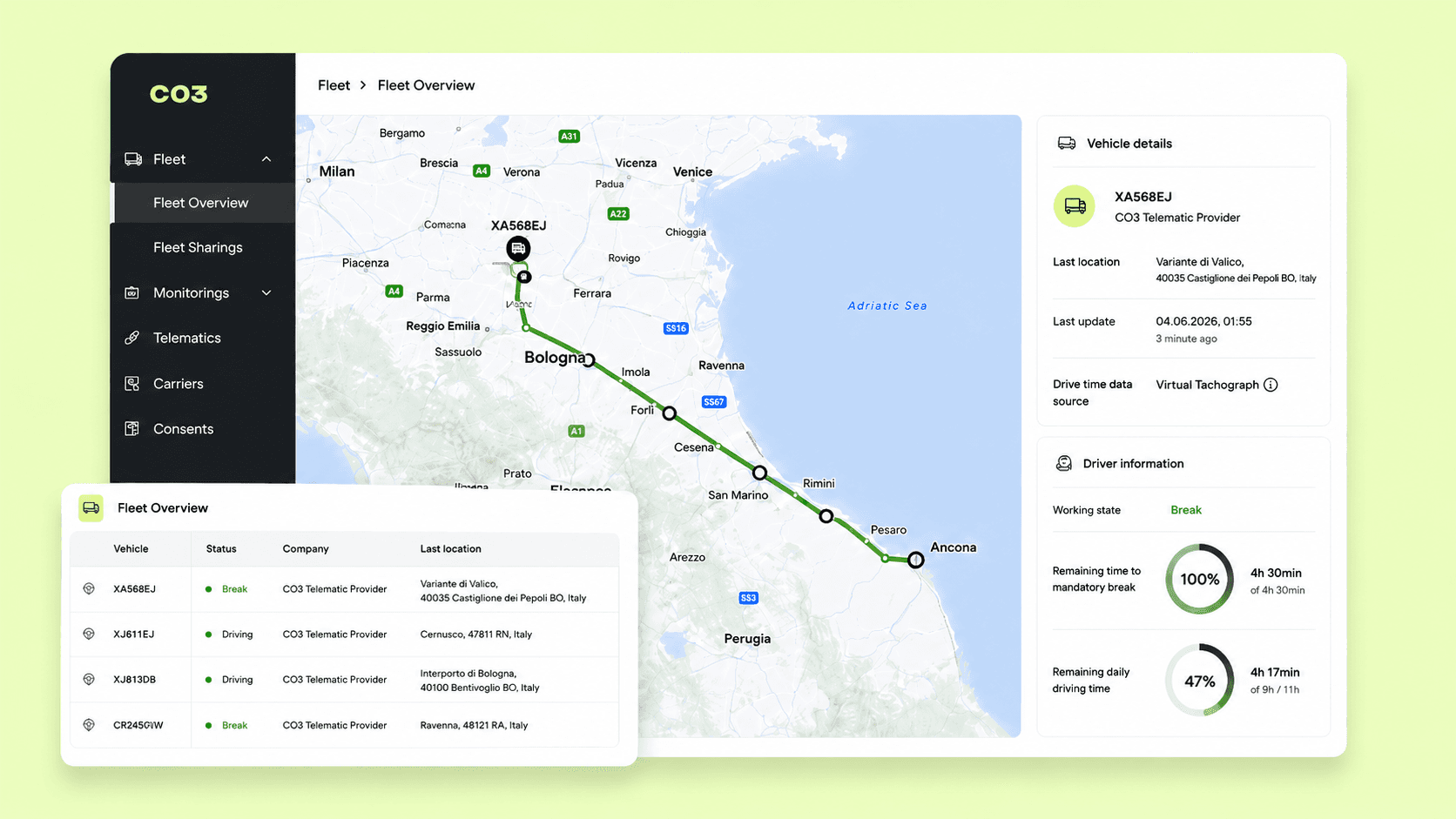
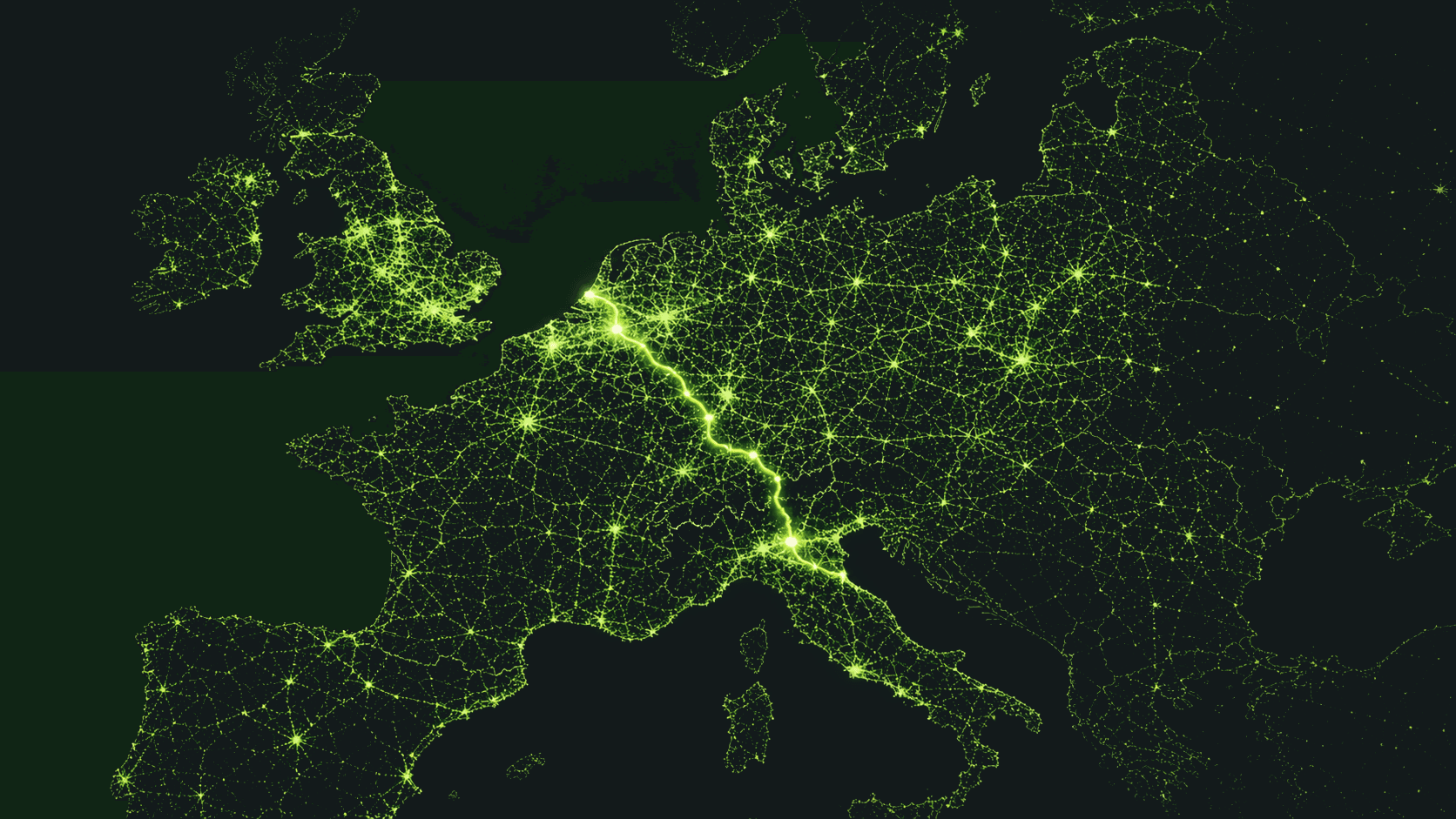
How CO3 does this today. CO3 aggregates telematics from 500+ integrations across trucks, trailers, and subcontractors into a single API. It can remotely access drive time data from tachograph (DDD) upload or simulate drive time data through its Virtual tacho algorithm. Its Direct Tacho integration takes the actual drive time data from the tachograph in real time. The Virtual Tacho comes into play when tachograph integrations are absent, automatically captures stops, breaks, and movements for every vehicle, reconstructs each truck's driving and rest pattern, checks it against legal drive- and rest-time requirements to estimate remaining legal drive time, and feeds that into CO3's ETA predictions — which sharpens accuracy most in the 2–12-hour-ahead window where re-plans actually happen.
Getting started without a rip-and-replace
You do not need a new TMS or a routing-engine migration to begin. Three steps, each useful on its own.
Step 1 — Make the data flow continuously. Move from periodic, manual tachograph downloads to remote, automated download across the fleet, and connect your subcontractors' telematics so their vehicles appear alongside your own. The compliance benefit (you stop missing the 28- and 90-day download deadlines) pays for the effort; the planning benefit is the real prize.
Step 2 — Put remaining drive time in front of planners. Surface a single, trustworthy remaining-budget and shift-window view per driver — the same fields for every vehicle regardless of source — so the "can this driver do this load?" question is answered on screen, not by phone. Start with your highest-value or most time-critical lanes.
Step 3 — Let the data reshape the network. After a quarter of clean drive/rest data, review where lanes routinely exhaust drivers' hours and where breaks and rests cluster. Use that to reposition relays, staging points, and hub choices. This is the compounding step: small structural changes remove recurring empty kilometres and missed windows for years.
Self-assessment checklist
Answer yes or no. A run of "no" answers means driver hours are happening to your plan rather than being planned with.
- Do your ETAs account for mandatory 45-minute breaks and daily rest, or do they assume the driver runs the clock down without stopping?
- Can a planner see remaining legal drive time for any vehicle — owned, chartered, or spot — on one screen?
- Is that drive-time view the same shape for a subcontractor's truck as for your own?
- Do you know, per driver, when the current shift window must end?
- Can you trust the remaining-hours number enough to act without phoning the carrier to confirm?
- Do you find out a driver won't make the window early enough to swap, rather than at the dock?
- Are your tachograph downloads automated and continuous, or still periodic and manual?
- Have you mapped which of your vehicles (including 2.5–3.5t vans) came into scope on 1 July 2026?
- Does your network design account for where drivers can legally rest and hand off with fresh hours?
- When a lane routinely runs drivers out of hours, do you redesign it — or absorb the cost every time?
If most of these are "no," the fix is rarely a bigger routing engine. It is making remaining drive time visible and trustworthy first. CO3 can run this audit with your team and show where the recurring losses sit.
What to watch over the next 12–18 months
The van fleet adjusts to life under tacho rules. The 1 July 2026 extension pulls a large population of parcel, e-commerce, and express vans into driving-time and tachograph obligations for the first time. Expect a scramble on workshop capacity for retrofits, and a learning curve on break and rest planning for operators who never had to do it.
Enforcement gets more data-driven. With smart tachographs feeding position and time data, roadside and remote checks increasingly rely on the data trail rather than paper. Operators who already keep clean, retrievable movement data will find checks routine; others will not.
Drive-time data becomes a routing-engine expectation, not a differentiator. As remaining-drive-time feeds mature, ETAs that ignore breaks and rests will look as dated as ETAs that ignored live traffic a decade ago. The bar for a credible ETA is rising.
Network design absorbs rest geography. As relay-based and staged models spread (partly to manage driver hours, partly for driver retention), where drivers can legally rest and swap becomes a standing input to network planning rather than an afterthought.
Closing thought
The July 2026 rules will be read by most operators as another compliance cost. The ones who get ahead will read them differently: as the moment nearly every vehicle in Europe started producing the most accurate planning input there is — a continuous, legal record of how much each driver can actually do. The tachograph has always been treated as something you file. Treated as something you plan with, it quietly fixes the ETAs, the utilisation, and the empty kilometres that distance-based planning never could. That is the opportunity hiding inside the regulation.
This guide is a plain-language overview for planning purposes, not legal advice. Confirm specific driving-time, tachograph, and posting obligations with a qualified transport-law adviser or your national authority.
Glossary
- EU Regulation (EC) No 561/2006: The EU rules on maximum driving times and minimum breaks and rest periods for drivers of most goods and passenger vehicles.
- Driving time limit: Max 9 hours per day (10 hours up to twice a week); max 56 hours per week and 90 hours per fortnight.
- Break rule: A 45-minute break after 4.5 hours of driving, splittable into 15 + 30 minutes.
- Daily rest: At least 11 hours (reducible to 9 hours a limited number of times per week).
- Remaining drive time: How much legal driving a specific driver has left at a given moment, after accounting for time already used and rules that apply.
- Tachograph: In-cab device that records driving, rest, and (in the smart version) position. A legal compliance record.
- Smart Tachograph 2 (G2V2): The current mandated generation, recording border crossings and position automatically.
- Remote tachograph download (RDL): Wireless, automated retrieval of tachograph data without needing the vehicle or driver present; supports the 28-day (driver card) and 90-day (vehicle) download obligations.
- DDD file: The standard digital file format produced by a tachograph download.
- Mobility Package: The set of EU road-transport reforms (phased from 2020) covering driver hours, posting, cabotage, and vehicle/driver returns; the 2.5–3.5t van extension applies from 1 July 2026.
- Relay (relay-based routing): Handing a load from one driver to another mid-route so a fresh driver with available hours continues, instead of one driver resting.
- Rest geography: Where along a route or network a driver can legally and safely take a break or rest.
- Shift window: The period within which a driver's daily work must be completed before a required rest.




























.png&w=3840&q=75)











.png&w=3840&q=75)