What Does Road Freight Really Cost per Kilometre in Europe? A 2026 Breakdown

What Does Road Freight Really Cost per Kilometre in Europe? A 2026 Breakdown
Full-truckload road freight in Europe typically costs in the range of €1.10–€1.90 per kilometre in 2025/26, but the honest answer is "it depends — measurably". Driver costs, fuel, tolls, vehicle costs and overheads each move differently by country, corridor, and even by the truck's CO2 emission class. This post breaks down the cost stack component by component, shows why the same lane can differ 30% between operators, and explains how to build a cost-per-km view for your own fleet that is current rather than last year's average.
Why cost-per-km is the number everyone quotes and nobody trusts
Ask three people what a truck kilometre costs in Europe and you will get three confident, incompatible answers. A Polish carrier running international FTL, a German regional distributor, and a French tanker operator have cost structures that differ by 40% or more — and all three are right about their own number.
Cost-per-km matters because it anchors everything: pricing, lane profitability, make-or-buy decisions on subcontracting, and increasingly the business case for cleaner vehicles. Getting it wrong in either direction is expensive — underprice and you subsidise your customers; overprice and you lose the tender.
The problem is that most operators carry a single annual average in their heads while the underlying components move monthly. Diesel fell about 5% in 2025 while tolls in parts of Central Europe jumped double digits. An average from last January is wrong by spring.
The cost stack, component by component
Driver costs — typically 30–40% of total. Wages and social charges are the largest line for Western European operators and the fastest-converging one for Eastern European fleets, where wage growth has run well ahead of inflation for years. France's CNR tracks driver costs rising around 2.2% annually, and the structural driver shortage — 444,000 unfilled positions in Europe in 2025 — guarantees continued pressure. Posted-worker rules under the EU Mobility Package mean international drivers earn host-country rates for many operations, narrowing the East–West gap further.
Fuel — typically 22–30%. The most volatile line. Professional diesel fell roughly 5.3% in 2025, the only major cost component to decline. But consumption is also the component you can influence most: the spread between efficient and inefficient drivers on the same route is commonly reported at around 10%.
Tolls — around 14% on average, and rising fastest. Tolls have quietly become the third pillar of the cost stack, and in some corridors they rival fuel. Germany's Maut for a standard 40-tonne Euro VI truck runs about €0.35/km in the lowest CO2 class — but about €0.19/km in the best class, because the toll now includes a CO2 surcharge of €200 per tonne emitted. Austria, Czechia, Belgium and Hungary also differentiate by CO2 class. Czech tolls rose 14.4% recently; Austria's 7.7%. The practical consequence: two identical-looking trucks on the same lane can have meaningfully different toll bills, and route choice can matter as much as distance.
Vehicle costs — roughly 15–20%. Depreciation or leasing, maintenance, tyres, insurance. New truck prices have risen substantially, and EU registrations fell 6% in 2025 — older fleets mean higher maintenance and worse toll classes, a double penalty.
Overheads — roughly 8–12%. Dispatching, planning, administration, facilities. The component most affected by digitisation: how many trucks one dispatcher can manage depends largely on how much data arrives automatically.
Why the same lane differs 30% between operators
Take Duisburg–Milan, roughly 1,000 km through two toll regimes and the Alps. The cost gap between operators on this single lane comes from identifiable, measurable factors: the truck's CO2 toll class (worth up to €0.16/km in Germany alone), fuel efficiency (driver skill and vehicle age), whether the return leg is loaded or empty (EU average: 21.6% of kilometres run empty), driver cost base, and how much waiting time gets absorbed unbilled at either end.
None of these is luck. Each is a managed variable — if it is measured per vehicle and per trip rather than averaged annually.
From industry averages to your own number
Industry benchmarks are a sanity check, not a management tool. The operators pricing confidently in 2026 are the ones who can compute their own cost-per-km, per lane, from live data:
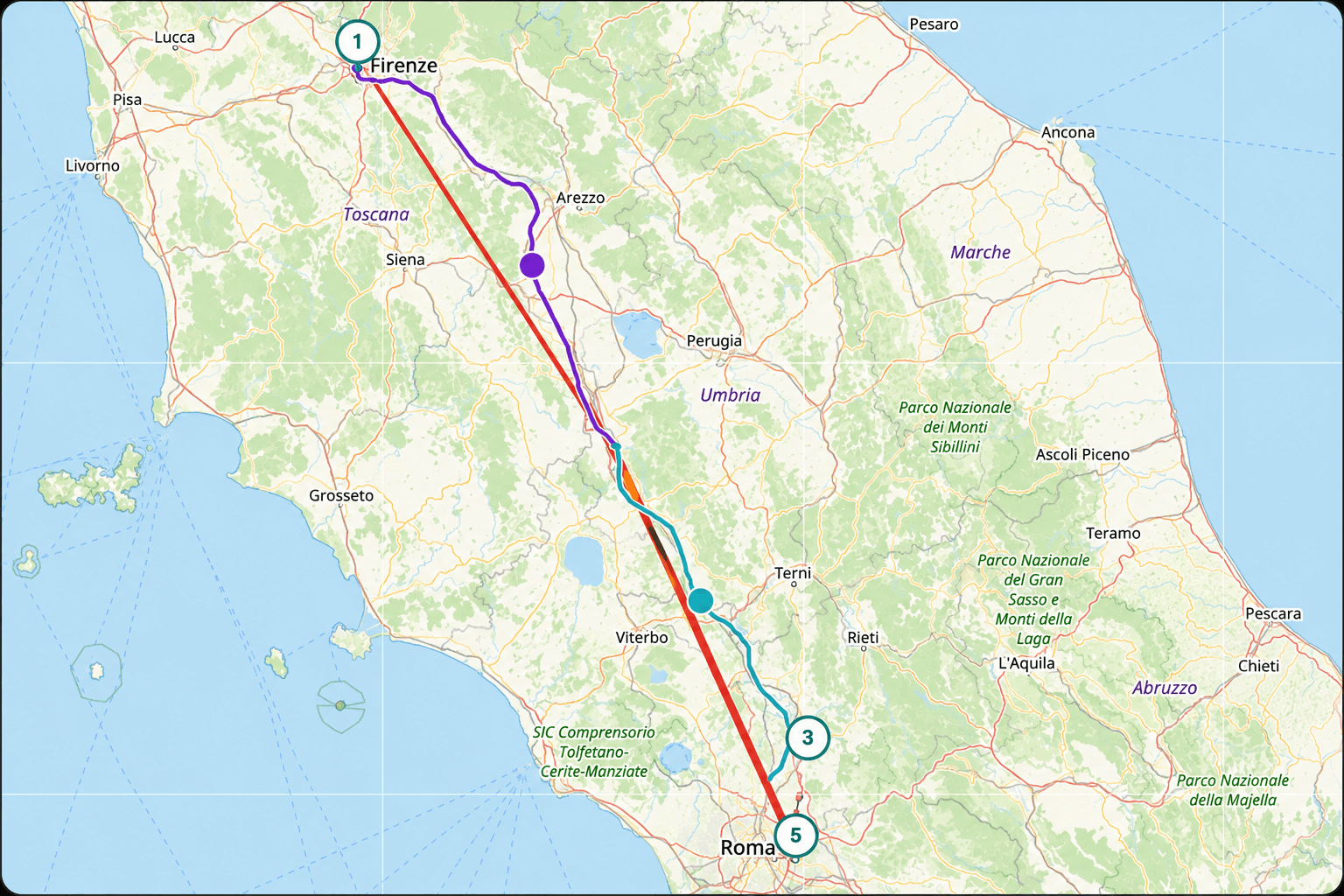
- Distance and routing from actual GPS tracks, not planned kilometres — including the empty legs.
- Fuel measured from the vehicle, not allocated from fuel-card invoices.
- Tolls calculated from actual routes and each vehicle's real toll class.
- Time-based costs (driver, vehicle) allocated from actual trip durations, including waiting time at ramps.
How CO3 does this today
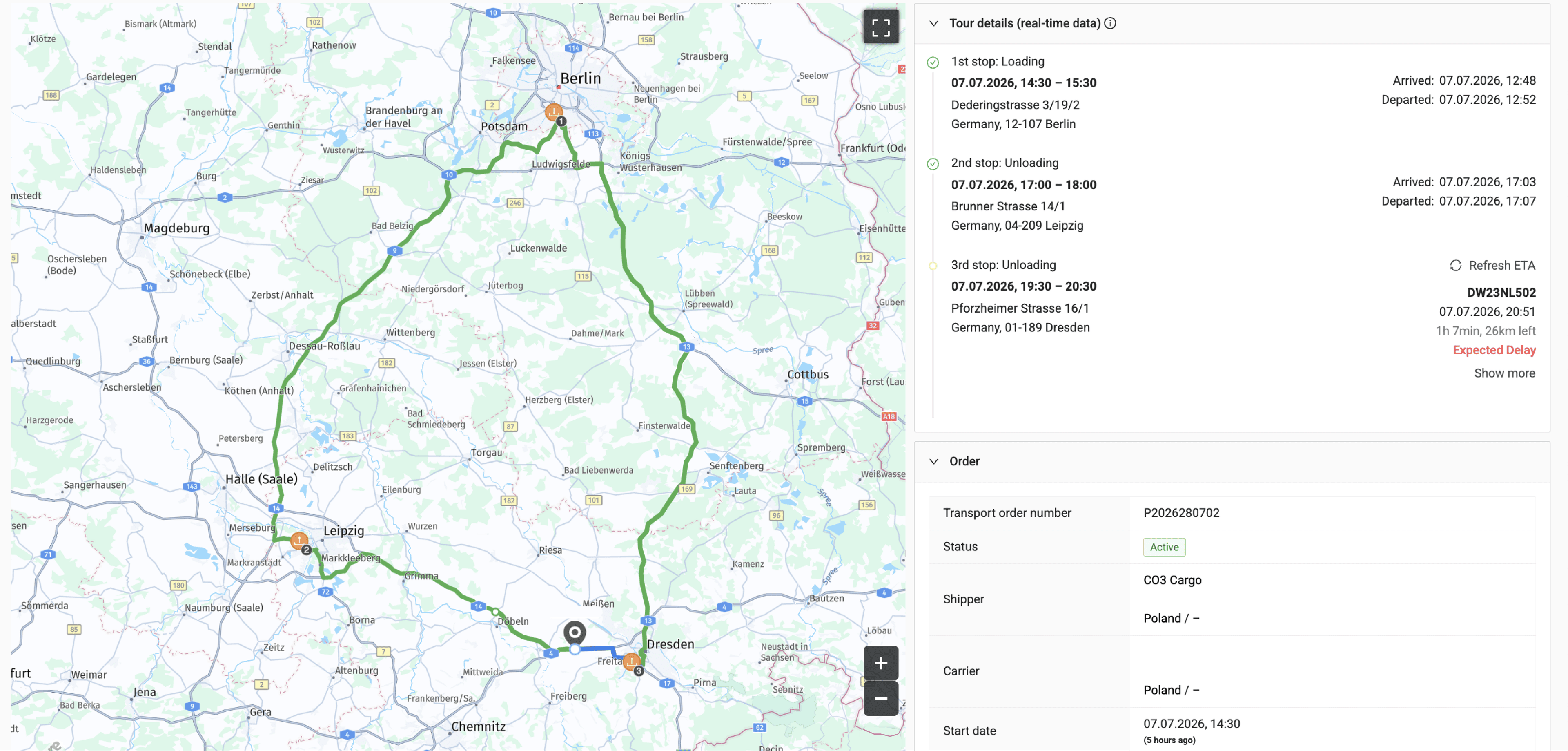
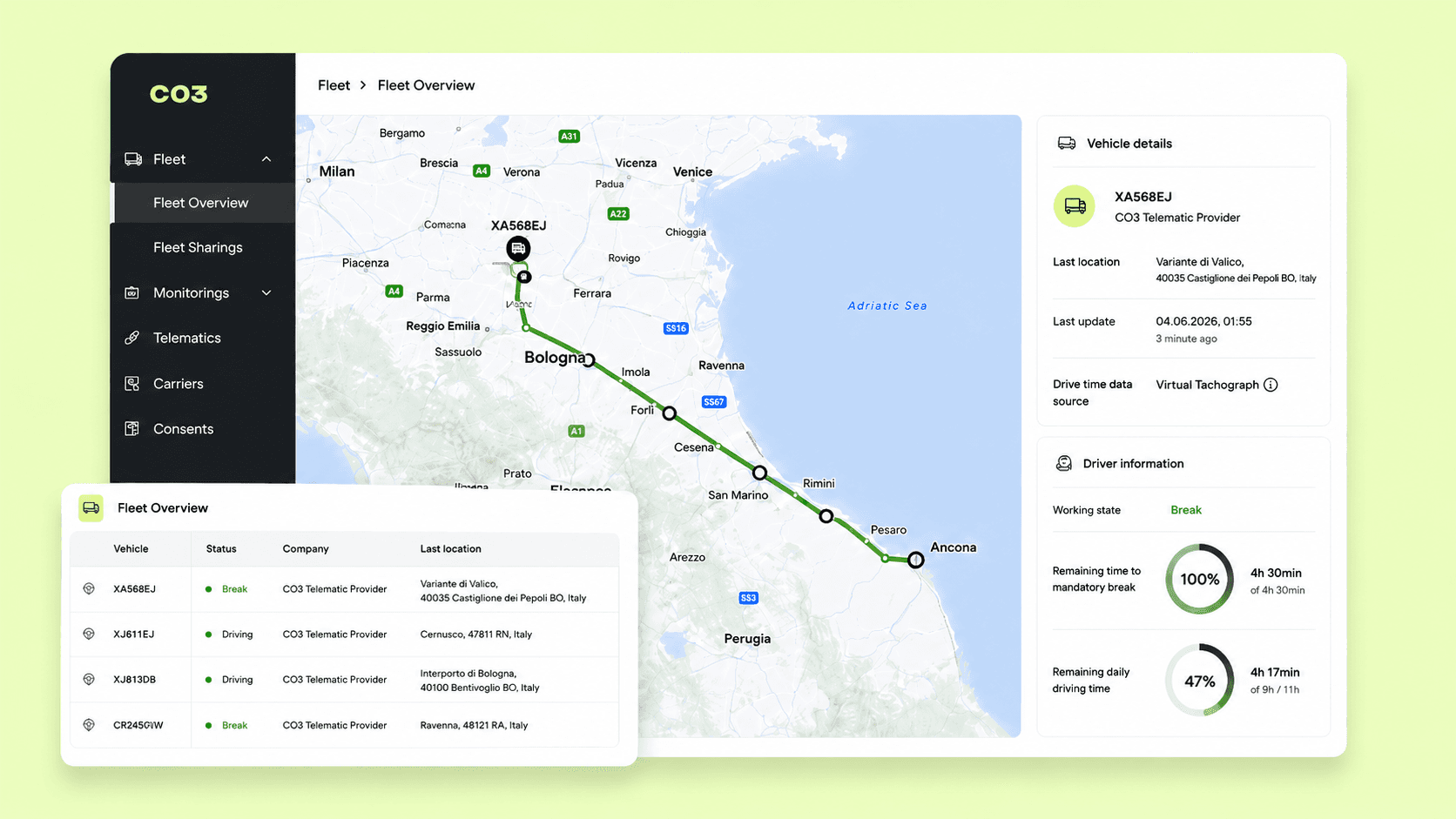
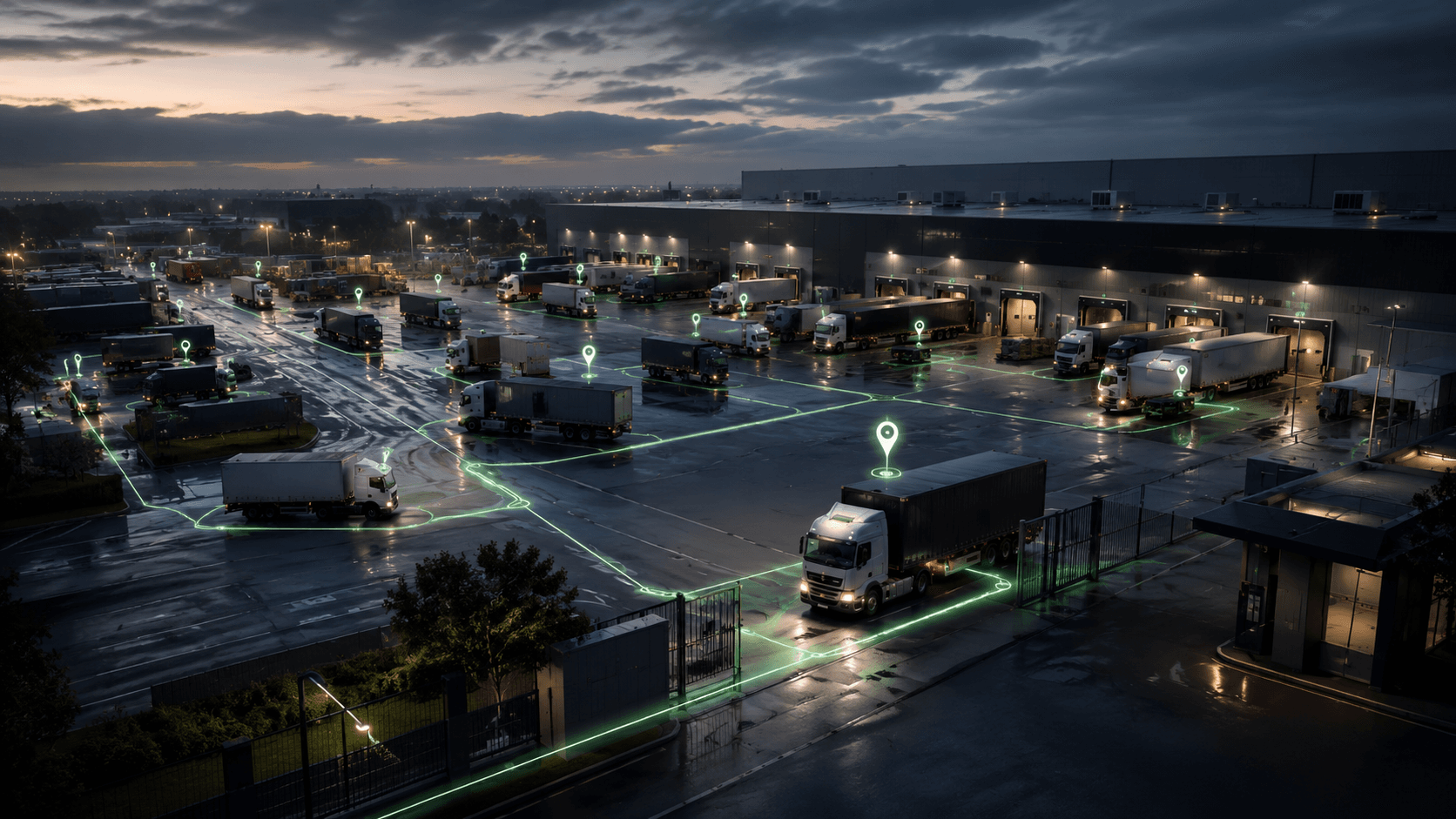
CO3 delivers the operational inputs for a live cost view from the fleet's existing systems: positions and completed trips across trucks, trailers and subcontractors via 500+ telematics integrations, measured fuel consumption per vehicle, and per-leg distance data — all through one API, with no new hardware. The same per-leg structure carries CO2 reporting (primary, hybrid, or modelled method per leg, flagged per calculation), aligned with the GLEC Framework and ISO 14083 — which matters because toll class, fuel burn, and CO2 are increasingly the same conversation.
Getting started: a cost-per-km baseline in three steps
- Reconstruct last quarter from actual trips. Real kilometres (loaded and empty), real fuel, real tolls by route and vehicle class. Most operators find their true cost differs from their quoted cost by 5–15% on specific lanes.
- Split by lane and customer. A fleet-average cost-per-km hides which traffic earns money. Lane-level is where pricing decisions live.
- Refresh monthly. Components move monthly; the spreadsheet from January doesn't. Automate the data feed so the number stays current without analyst effort.
Self-assessment: do you know your real cost per km?
- Can you state your cost-per-km for a specific lane — not just the fleet average?
- Does your calculation use actual GPS kilometres, including empty legs?
- Is fuel measured per vehicle rather than allocated from invoices?
- Do you know each truck's CO2 toll class and its per-km toll consequence?
- Have you re-priced any lane in the last six months based on cost data?
- Are subcontracted legs costed with the same rigour as your own fleet?
- Is waiting time at customer sites visible in your lane costing?
- Is your cost model refreshed at least monthly?
If you answered "no" three or more times, your prices rest on averages — and averages are where margin goes to die. CO3 can help you build the live data baseline.
What to watch over the next 12–18 months
- CO2 tolling spreads. More member states are implementing CO2-differentiated charging under the revised Eurovignette framework; the toll line in the cost stack keeps growing and keeps splitting by vehicle class.
- Driver cost convergence continues. East–West wage gaps narrow further under Mobility Package enforcement; cost advantages based purely on driver domicile keep shrinking.
- Zero-emission economics shift. From January 2026, zero-emission trucks in Germany pay a (reduced) infrastructure toll share rather than nothing — the free-ride phase is ending even as diesel toll penalties grow.
- Cost transparency in tenders. Shippers increasingly run should-cost models; carriers who cannot defend their cost stack line by line negotiate from weakness.
Closing thought
There is no single answer to "what does a truck kilometre cost in Europe" — and that is exactly the point. The range is wide because the variables are managed differently by different operators. The ones who measure their own stack, per lane, from live fleet data, price better, tender better, and spot their own leaks first. CO3 provides the data layer that makes that a weekly habit instead of an annual project.
Glossary
- FTL (Full Truckload): A shipment occupying an entire truck, priced per vehicle rather than per pallet.
- Cost-per-km: Total operating cost divided by kilometres run; the core unit-cost metric in road freight.
- CNR (Comité National Routier): French body publishing reference cost indices for road transport.
- Maut: Germany's distance-based truck toll, now differentiated by CO2 emission class.
- CO2 emission class: EU vehicle classification (Class 1–5) determining toll levels; cleaner vehicles pay less.
- Eurovignette Directive: EU framework for HGV road charging, revised to mandate CO2 differentiation.
- EU Mobility Package: EU rules on driver posting, pay, and cabotage that raise and converge driver costs across member states.
- Empty running: Kilometres driven without cargo; EU average ~21.6% of total mileage.
- Should-cost model: A buyer's bottom-up estimate of what a service ought to cost, used in tender negotiations.
- GLEC Framework / ISO 14083: Methodology and standard for calculating and reporting transport emissions.
















.png&w=3840&q=75)









.png&w=3840&q=75)