ISO 14083 vs GLEC: a road-freight carrier's guide to picking the right standard

ISO 14083 vs GLEC: a freight forwarder’s guide to picking the right standard
ISO 14083 is the standard for CO2 emission reporting. GLEC is the truck operator manual. They are not alternatives — they are layers. This piece explains how to use both, where they differ in practice, and which one your shipper's auditor will actually ask about.
Why this matters?
Three years ago, "CO2 methodology" was a footnote in the shipper conversation. Today it is a column in the tender, a section in the audit, and a paragraph in the contract. Two acronyms dominate the answer: ISO 14083 and GLEC. Most road freight forwarders reference both, often interchangeably, often inaccurately.
The cost of getting it wrong is concrete. Shippers' auditors are starting to test the methodology stated in the tender against the methodology used in the report. Inconsistency between the two is now a finding.
What each one actually is?
ISO 14083 is an international standard, published by the international ISO governance body in 2023, titled "Greenhouse gas emissions — Quantification and reporting of GHG emissions arising from transport chain operations". It defines the calculation principles, the system boundary (well-to-wheel), the data hierarchy (primary over default), and the reporting structure (Transport Chain Element, or TCE).
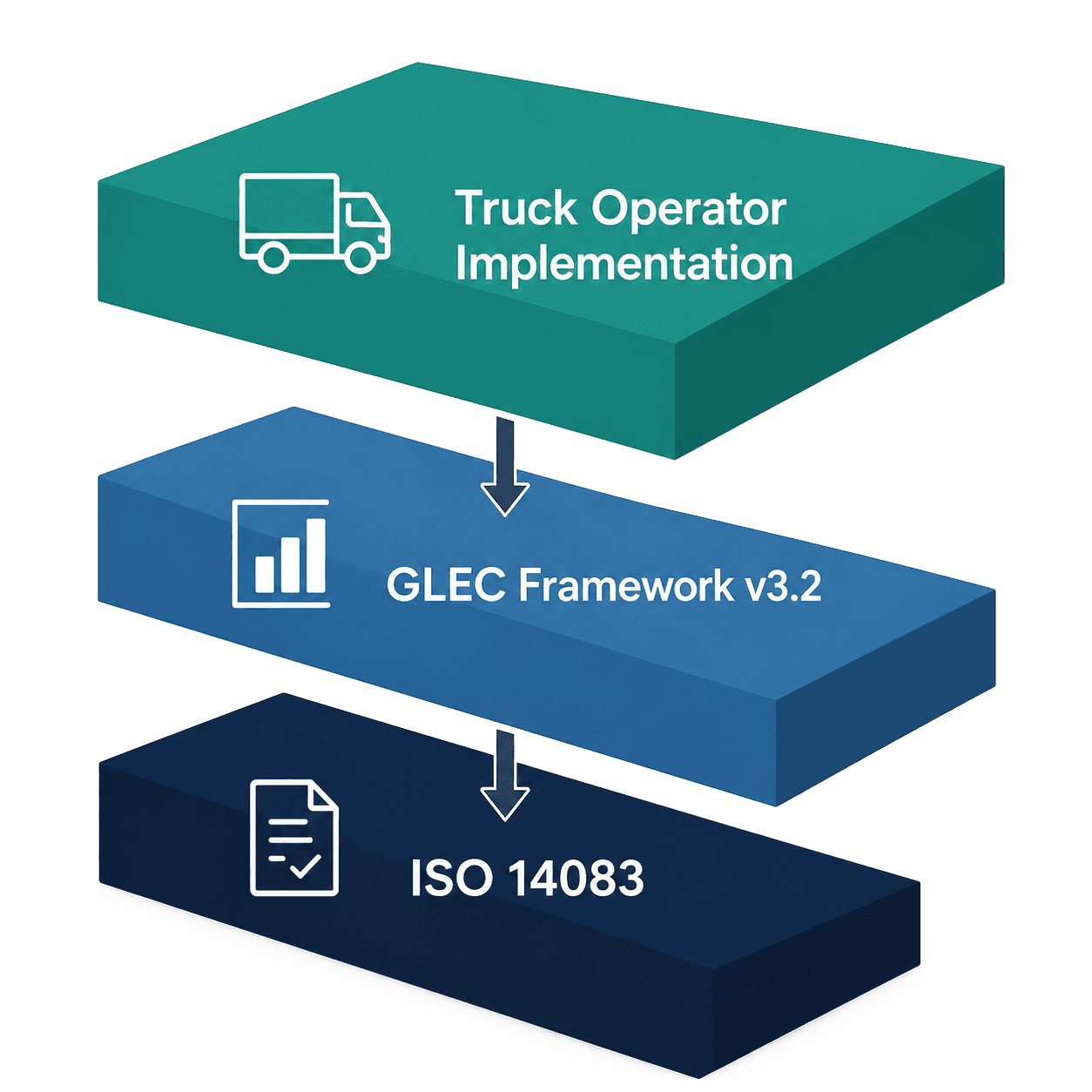
The GLEC Framework is published by Smart Freight Centre. It first appeared in 2014. The current version is v3.2, released October 2025. GLEC is a practical interpretation of ISO 14083 — it provides the default emission factors, the modal default values, and the worked examples that truck operators use to calculate. GLEC v3.2 is explicitly aligned with ISO 14083.
The relationship: ISO 14083 sets the rules. GLEC translates the rules into something an truck operator can put into a spreadsheet — or, more usefully, into an API.
Where they agree
- Well-to-wheel scope. Both cover upstream fuel emissions (well-to-tank) plus combustion emissions (tank-to-wheel).
- TCE structure. Both report at the Transport Chain Element level — a single leg of a single shipment.
- Primary-data preference. Both push the truck operator up the data hierarchy: measured fuel beats modelled fuel beats default factor.
- Modal coverage. Both cover road, rail, sea, air, inland waterways, and intermodal.
- Aim. Both want the same number: comparable, defensible per-leg CO2.
If a tender response says "ISO 14083 aligned" and "GLEC v3.2 aligned", the two statements are not contradictory — they are reinforcing.
Where they differ in practice
This is where most truck operators get tripped up.
Granularity of vehicle classes. GLEC publishes default emission factors at a finer granularity than ISO 14083 mandates. For a 40-tonne articulated diesel in 2026, GLEC gives you a number; ISO 14083 tells you what shape the number should be.
Default factor source. GLEC v3.2 follows the October 2025 HBEFA 5.1 update for European road factors. ISO 14083 is silent on which factor library to use — it says only that the library must be credible and disclosed.
Air pollutant module. GLEC v3.2 introduced a separate module for air pollutants (NOx, PM) alongside GHG. ISO 14083 stays inside the GHG boundary.
Truck operator-readiness. GLEC ships with worked examples, vehicle taxonomies, and load-factor defaults. ISO 14083 ships with principles and equations. A truck operator can implement GLEC over a quarter. Implementing ISO 14083 directly without GLEC is a research project.
Which one to use, and when?
- In your tender response: state alignment with both. "ISO 14083 aligned, calculated via GLEC v3.2 defaults where primary data is not yet available."
- In your shipper-facing report: state the GLEC version explicitly. Auditors check version numbers.
- In your contract: reference ISO 14083 as the standard, GLEC as the implementation, and your primary-data share as the operational target.
- In your audit trail: record the GLEC factor library version against every shipment so a later restatement is auditable.
A short rule: when you are talking to a regulator or a shipper's CSRD sustainabiity lead, lead with ISO 14083. When you are talking to a logistics buyer or an operations team, lead with GLEC. They want different parts of the same answer.
The primary-data direction of travel
Both standards push truck operators up the data hierarchy. The practical effect: in 2024 most road-freight emissions reports were 80–90% default-factor based. In 2026, leading shippers want a primary-data share above 50% on tendered volume. By 2028, expect 70%+ to be table stakes.
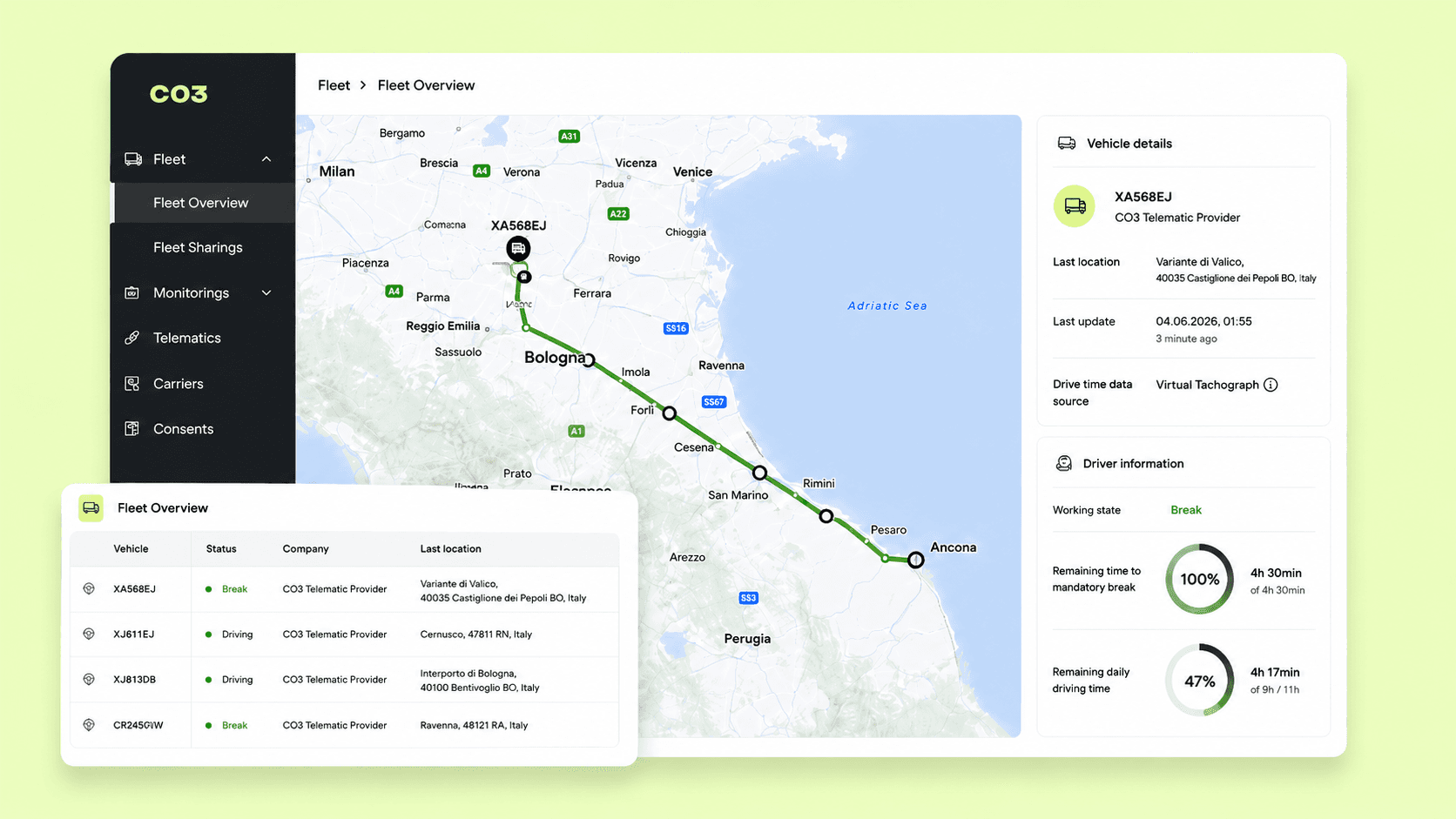
For a road carrier, primary data means measured fuel (telematics or invoice), measured distance (GPS or tachograph), and vehicle-specific factors (VIN-resolved). Each of those is a project on its own; together they are the answer to the "what's your primary-data share?" question in the RFP.
A practical adoption sequence
- Quarter 1: state ISO 14083 + GLEC v3.2 alignment in your standard tender response. Record the factor library version in every CO2 output.
- Quarter 2: instrument your top 20 lanes with primary fuel data. Most truck operators get to 40–60% primary-data share on these lanes in 8–12 weeks.
- Quarter 3: roll out VIN-resolved vehicle profiles across the fleet. This closes the second-largest default-factor gap.
- Quarter 4: publish your primary-data share number externally. This is the column shippers will read first in 2027 tenders.
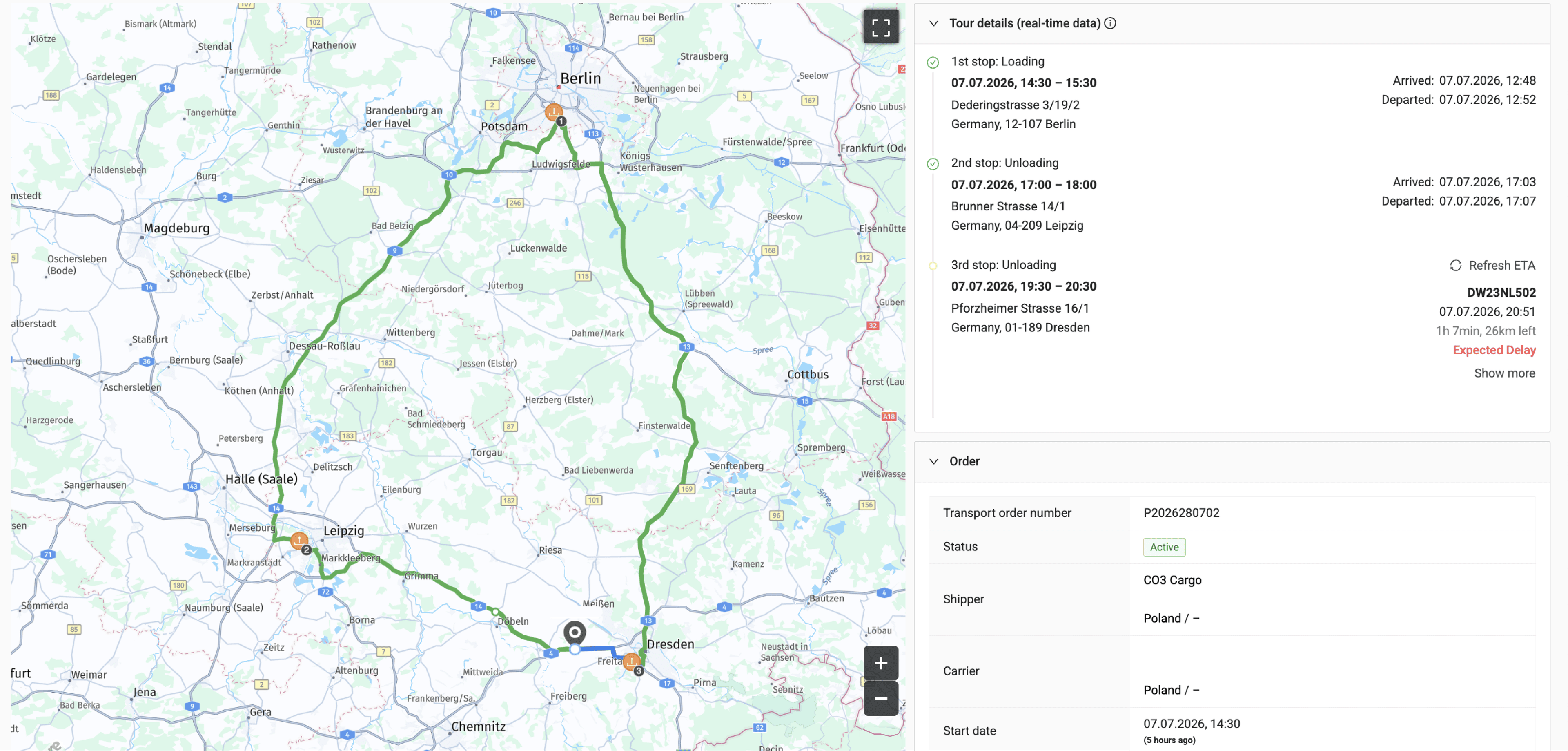
CO3's per-leg CO2 feed runs both calculations side by side and exposes the primary-vs-default flag on every shipment.
Closing thought
ISO 14083 vs GLEC is the wrong question. They are not alternatives. The right questions are which version of each are you aligned to, what is your primary-data share, and what is your audit trail. Get those three answers right and the methodology question is settled before the tender even asks it.
Glossary
- ISO 14083 — 2023 international standard for transport-chain greenhouse-gas emissions.
- GLEC Framework — Smart Freight Centre's practical implementation of ISO 14083. Current version 3.2 (October 2025).
- TCE — Transport Chain Element. One leg of one shipment.
- Well-to-wheel — full emissions scope: fuel production (well-to-tank) plus combustion (tank-to-wheel).
- HBEFA — Handbook of Emission Factors. European road-freight factor library; v5.1 published October 2025.
- Primary data — measured fuel, measured distance, vehicle-specific factor.
- Default factor — modal or class-level industry average used when primary data is unavailable.
- CountEmissionsEU — EU methodology for transport CO2 disclosure, built on ISO 14083.



























.png&w=3840&q=75)










.png&w=3840&q=75)