The Road Freight Data Glossary: 25 Terms Every Transport Professional Should Actually Understand

The Road Freight Data Glossary: 25 Terms Every Transport Professional Should Actually Understand
Road freight has quietly become a data industry, and the vocabulary shows it: FMS, geofencing, primary data, TCE, ping frequency, normalisation. Some of these terms decide real money — whether your CO2 report passes an audit, whether your toll bill drops by a fifth, whether a visibility project succeeds. This post explains the 25 terms that matter most, in plain language, grouped by what they are for: getting the data, judging its quality, using it operationally, and reporting emissions. No jargon left undefined.
Why a glossary, and why now
Ten years ago, a transport manager could run a fine operation knowing trucks, drivers, and customers. Today the same job involves evaluating APIs, debating data quality with auditors, and reading integration matrices. The vocabulary arrived faster than anyone explained it — and vendors have an incentive to keep it vague, because vague terms hide weak products.
Misunderstood terms cost real money. "Certified" versus "aligned with" can decide whether a CO2 report survives an audit question. "Integration" can mean a deep vehicle-data connection or a nightly CSV email — same word, completely different product. This glossary is the working vocabulary, in four groups, with the traps flagged.
Group 1 — Getting the data out of the fleet
Telematics. The umbrella term for in-vehicle systems that record and transmit operating data: GPS position, speed, fuel consumption, temperature, driver activity. Factory-fitted by the truck maker or retrofitted as an aftermarket box.
OEM (Original Equipment Manufacturer). The vehicle maker. "OEM telematics" means the manufacturer's own factory-fitted system — no extra hardware needed, but each OEM has its own portal and data format. That format zoo is the core integration problem.
FMS / rFMS. FMS is the standard European truck makers agreed (originating in 2002) defining a common set of vehicle data — speed, fuel, mileage — readable independent of brand. rFMS (remote FMS) is its internet-era extension: a standardised web API for pulling that data from the manufacturer's cloud. The trap: "rFMS-compliant" does not mean identical — OEMs implement optional fields differently, so normalisation is still required.
API (Application Programming Interface). A machine-to-machine connection that lets one system request data from another automatically. The opposite of portals and emailed spreadsheets. When evaluating vendors, "do you have an API?" is table stakes; the better question is what data, at what frequency, with what history.
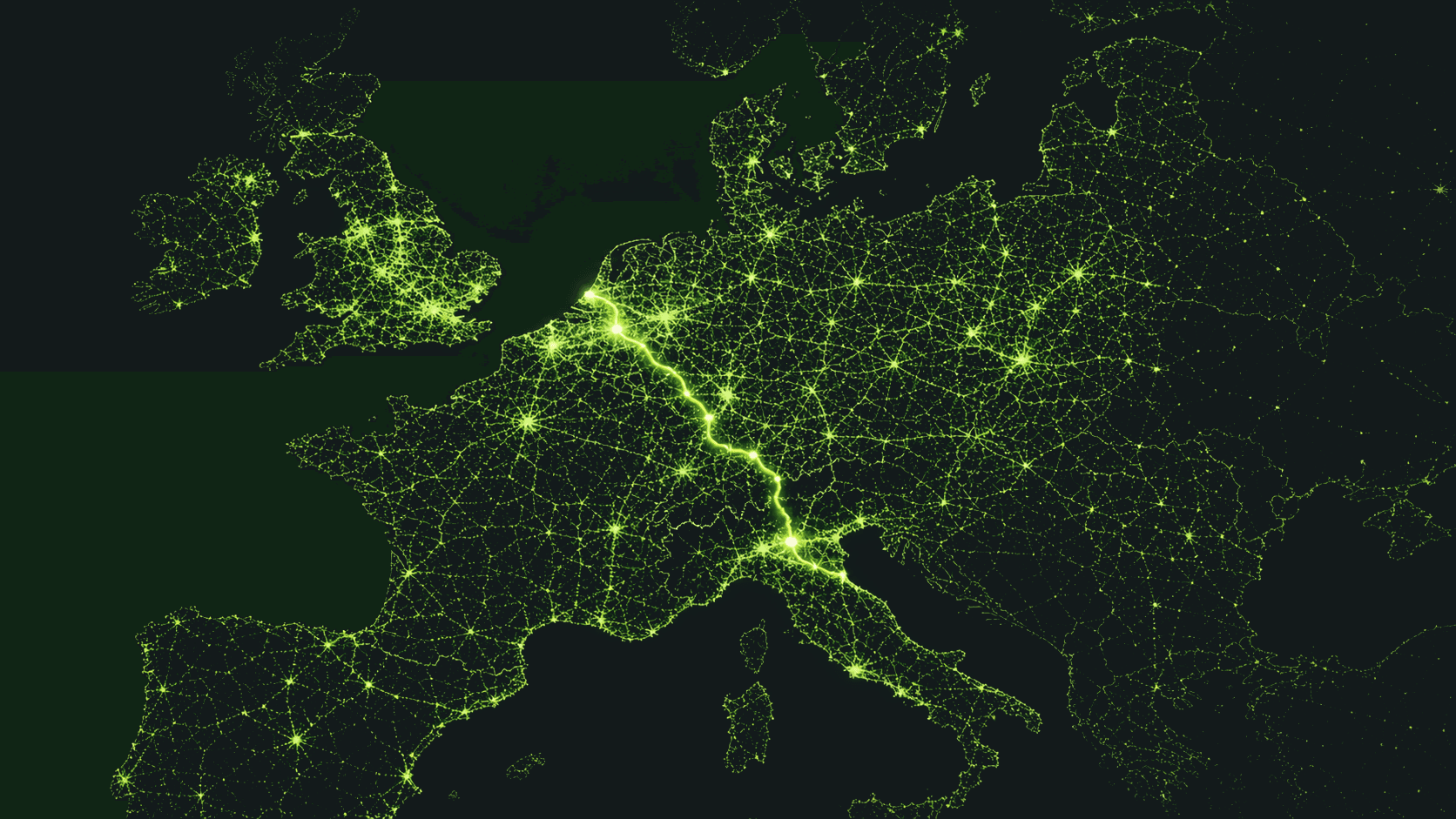
Cloud-to-cloud integration. Connecting two back-end systems directly over the internet — e.g., a visibility platform pulling from an OEM's cloud — with no hardware installed on the vehicle. This is why "we'd have to re-equip the fleet" is usually no longer true.
Ping frequency / update interval. How often a vehicle reports its position or status. A 30-second interval supports live ETA work; a 15-minute interval does not. Always ask for the real interval per source, not the marketing one.
Group 2 — Judging data quality
Normalisation. Translating many incompatible feeds into one consistent format — units, field names, timestamps, vehicle identifiers. Unglamorous, and the difference between "we have the data" and "we can use the data".
Primary data. Values actually measured on the asset — litres of fuel burned, kilometres driven — as opposed to estimated. The gold standard for emissions reporting, and increasingly what customers and auditors ask for explicitly.
Modelled data. Values estimated from assumptions (average consumption factors, shortest feasible distance) when measurement isn't available. Legitimate and standard-compliant — as long as it is labelled as modelled rather than passed off as measured.
Primary data share. The percentage of a report based on measured rather than modelled inputs. A single honest number that summarises the quality of an emissions report; expect to be asked for it.
Data completeness / coverage. What share of your movements actually appears in the data — including subcontractors. A perfect feed covering 60% of your traffic is a 60% answer.
Latency. How old data is when it reaches you. Yesterday's positions are history, not visibility.
Group 3 — Using the data operationally
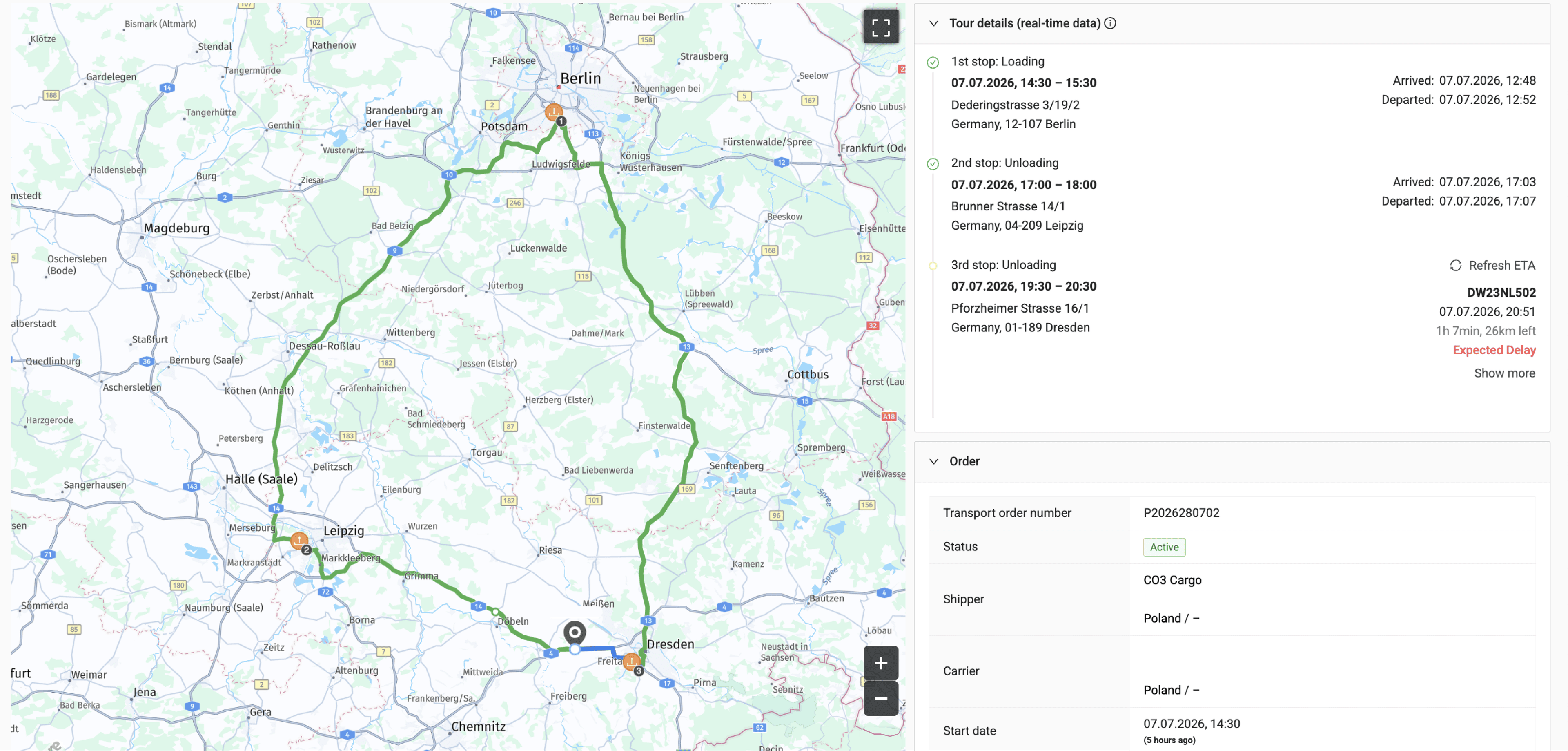
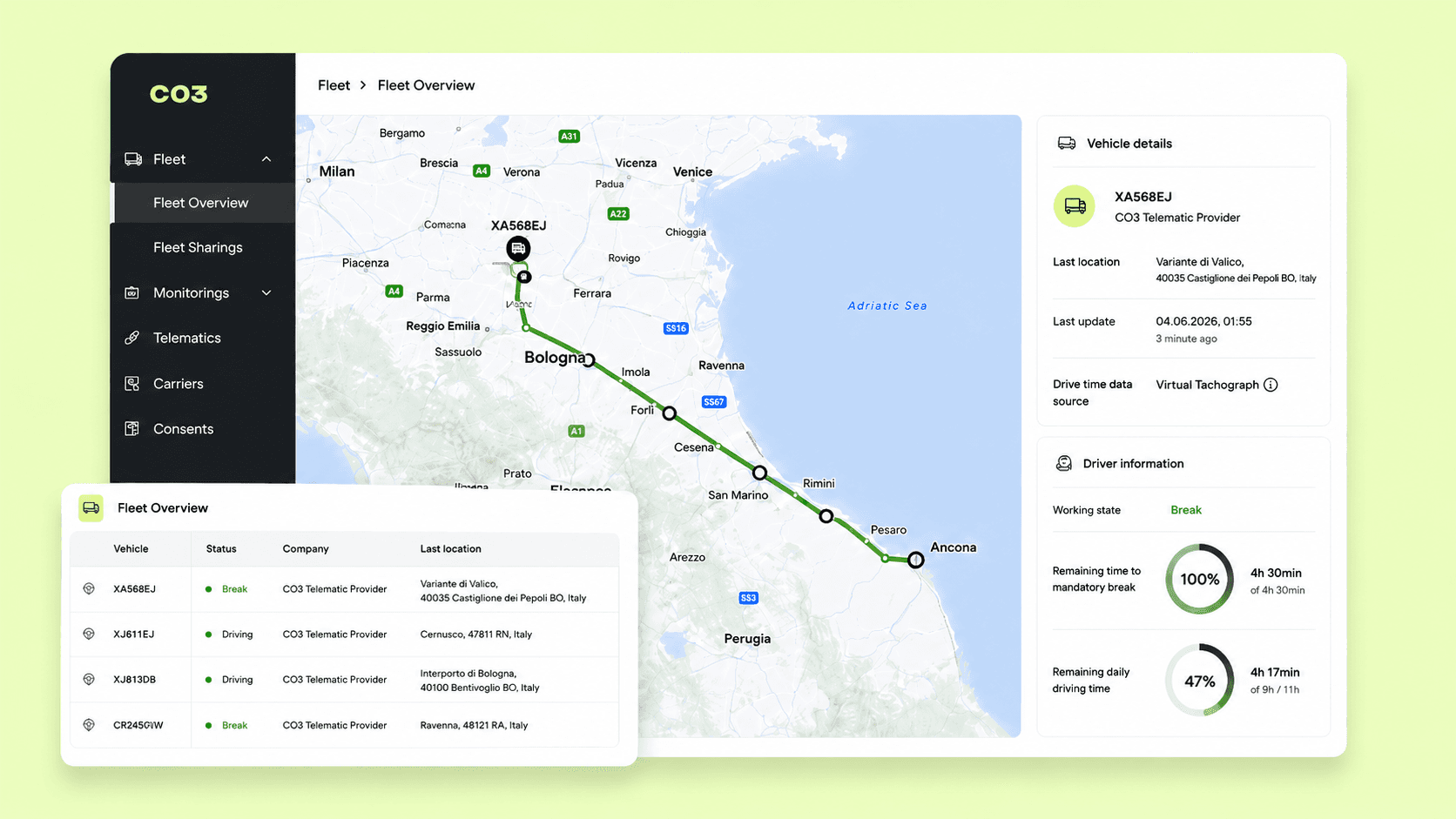
Real-time visibility (RTV). Knowing where shipments are and when they will arrive, now, from live vehicle data — across own fleet and subcontractors. The basis for proactive exception handling instead of phone-chain archaeology.
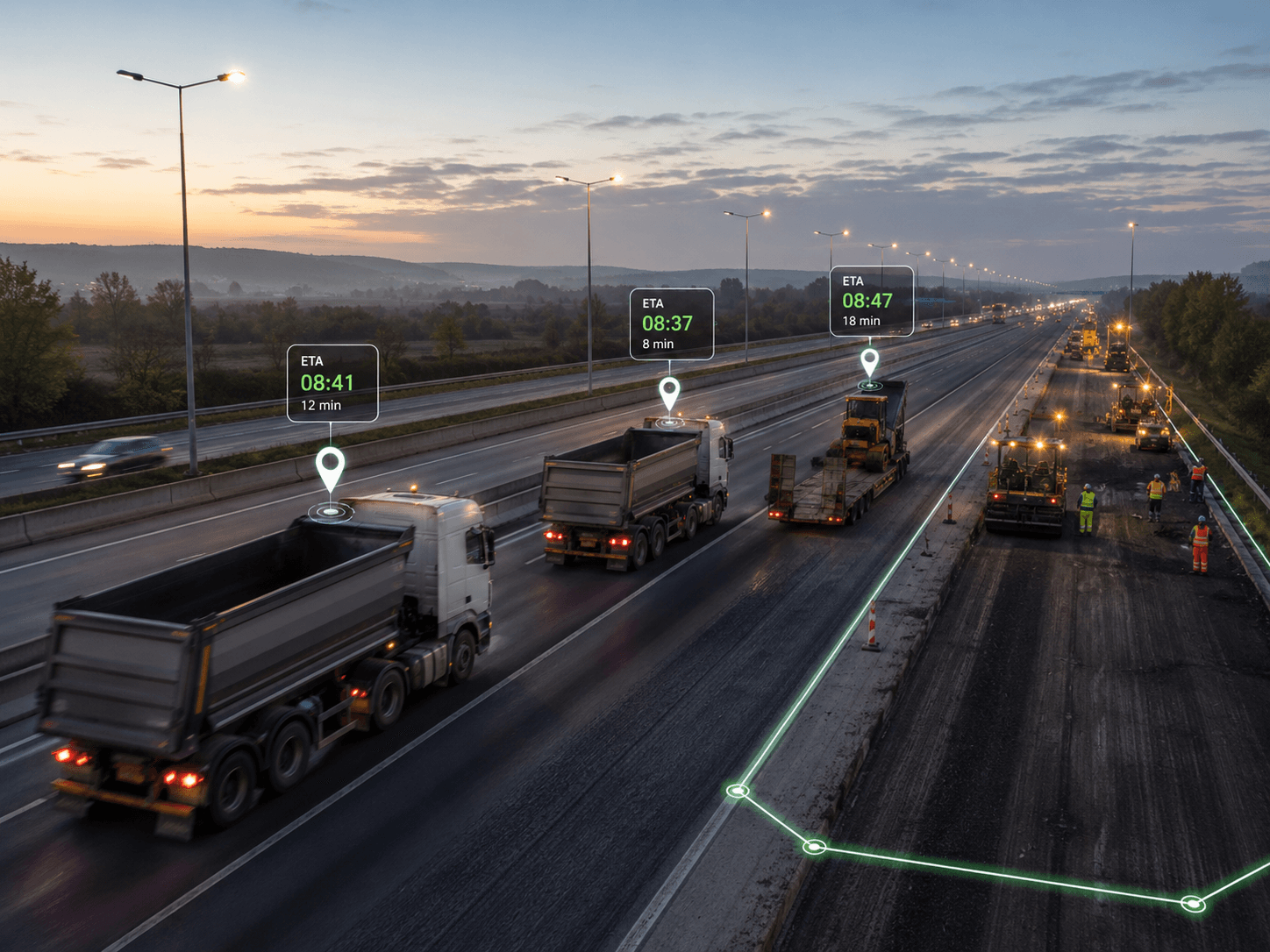
ETA (Estimated Time of Arrival). The continuously updated prediction of when a vehicle reaches its destination, computed from live position, route, traffic, and driving-time constraints. Quality varies enormously with input data; an ETA from a 15-minute ping lag is a guess wearing a suit.
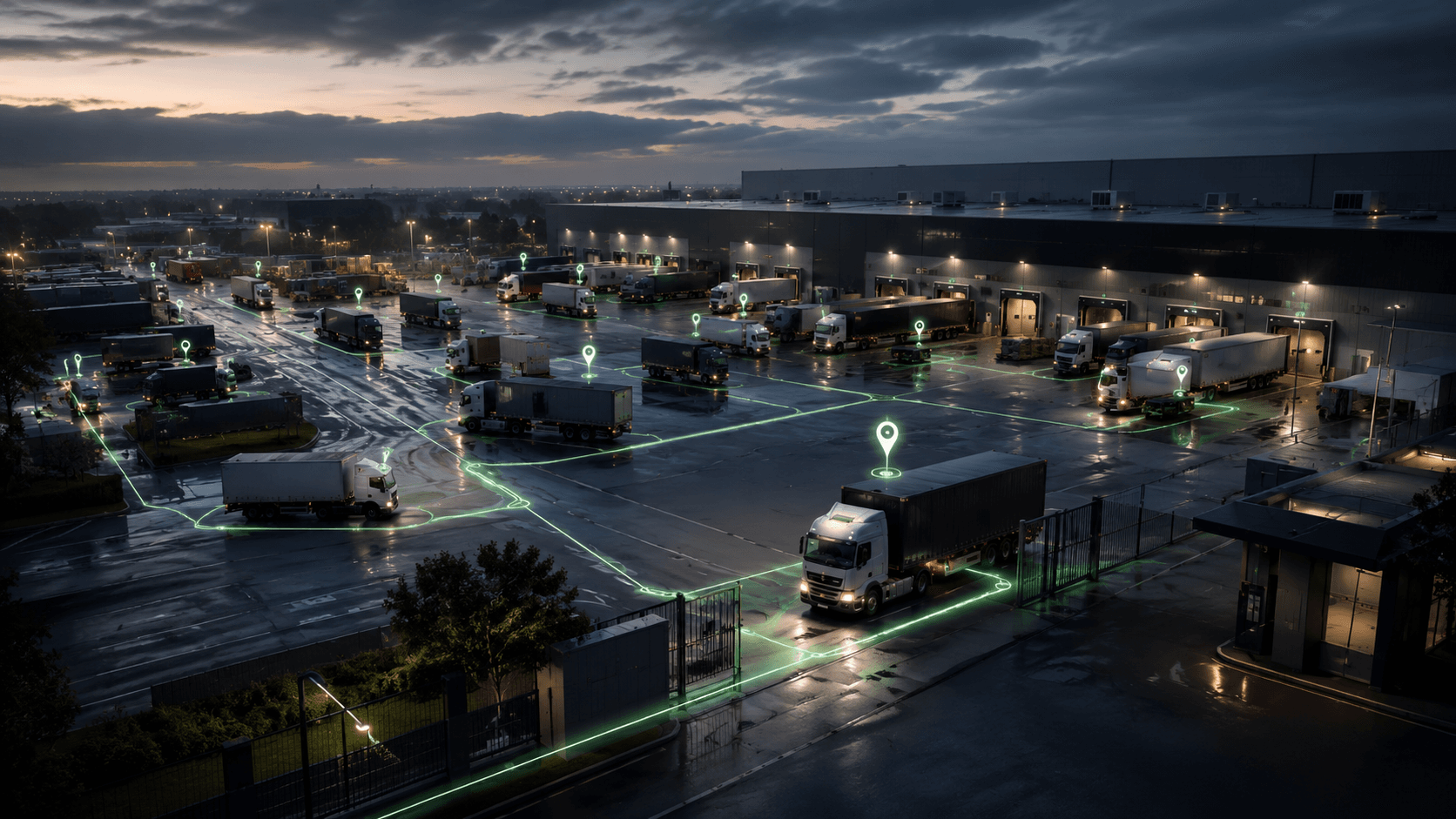
Geofence. A virtual perimeter around a location. Crossing it triggers automatic events — arrival, departure — that replace manual status calls and produce defensible timestamps for detention billing and on-time measurement.
Dwell time. How long vehicles sit stationary at sites, hubs, or borders. The quiet killer of fleet productivity and the first thing worth baselining.
Exception management. Working only the shipments that deviate from plan, flagged automatically, instead of monitoring everything manually. The operating model visibility is supposed to enable.
Slot booking. Reserving a specific loading/unloading time window at a site. Increasingly connected to live ETAs so slots adjust when the truck won't make it.
Detention / demurrage. Charges for holding transport equipment beyond agreed free time. In road freight, mostly waiting time at ramps — billable, if you can prove it with timestamps.
Group 4 — Reporting emissions
CO2e (CO2 equivalent). All greenhouse gases expressed as the amount of CO2 with the same warming effect. Transport reporting is normally in CO2e, even when colloquially called "CO2 reporting".
GLEC Framework. The Global Logistics Emissions Council's methodology for calculating logistics emissions consistently across modes — the de facto industry method, and the basis of the ISO standard.
ISO 14083. The international standard (2023) for quantifying and reporting transport-chain greenhouse gas emissions. The reference point auditors and large shippers use. Watch the language: tools are "aligned with" or "conformant to" a methodology; be sceptical of looser claims like "fully certified" until you see what was actually assessed, by whom.
TCE (Transport Chain Element). ISO/GLEC's building block: one leg of a transport chain (e.g., one road movement between two points). Emissions are calculated per TCE, then aggregated to orders and customers.
Scope 3. Emissions in a company's value chain but outside its own operations. Your trucking emissions are your shipper customers' Scope 3 — which is exactly why they keep asking you for per-shipment CO2 data.
Allocation. Dividing a vehicle's emissions among the shipments it carried (by weight, distance, or both per the standard). Where groupage maths gets contentious — and where method transparency matters.
How CO3 does this today
CO3's platform is essentially these four groups implemented: 500+ telematics and OEM integrations (Group 1), normalised into a single API with method labelling — each emissions leg carries its calculation method and a primary data share metric (Group 2), feeding live positions and ETAs across own fleet and subcontractors (Group 3), and per-leg CO2 reporting mapped to GLEC Transport Chain Elements, aligned with the GLEC Framework and ISO 14083 (Group 4). Today emissions reporting covers completed road transports.
What to watch over the next 12–18 months
- "Primary data share" becomes a standard ask. Expect it in shipper questionnaires and audits as ISO 14083-based reporting spreads.
- Vocabulary enters contracts. Ping frequency, coverage, and latency are starting to appear as SLA terms in visibility and telematics deals — definitions stop being academic.
- The acronym pile grows. EU regulatory reporting (CSRD timelines, CountEmissions EU) will add terms; a maintained glossary is cheap insurance against expensive misunderstandings.
Closing thought
Every industry that digitises goes through a phase where the vocabulary outruns the understanding — road freight is in it now. The operators who insist on plain definitions buy better technology, write tighter contracts, and pass audits with less drama. Keep this glossary handy; we will keep extending it. And if you want to see what these terms look like running live against your own fleet, CO3 will happily show you.






















.png&w=3840&q=75)










.png&w=3840&q=75)