Construction fleet telematics: from reactive to real-time
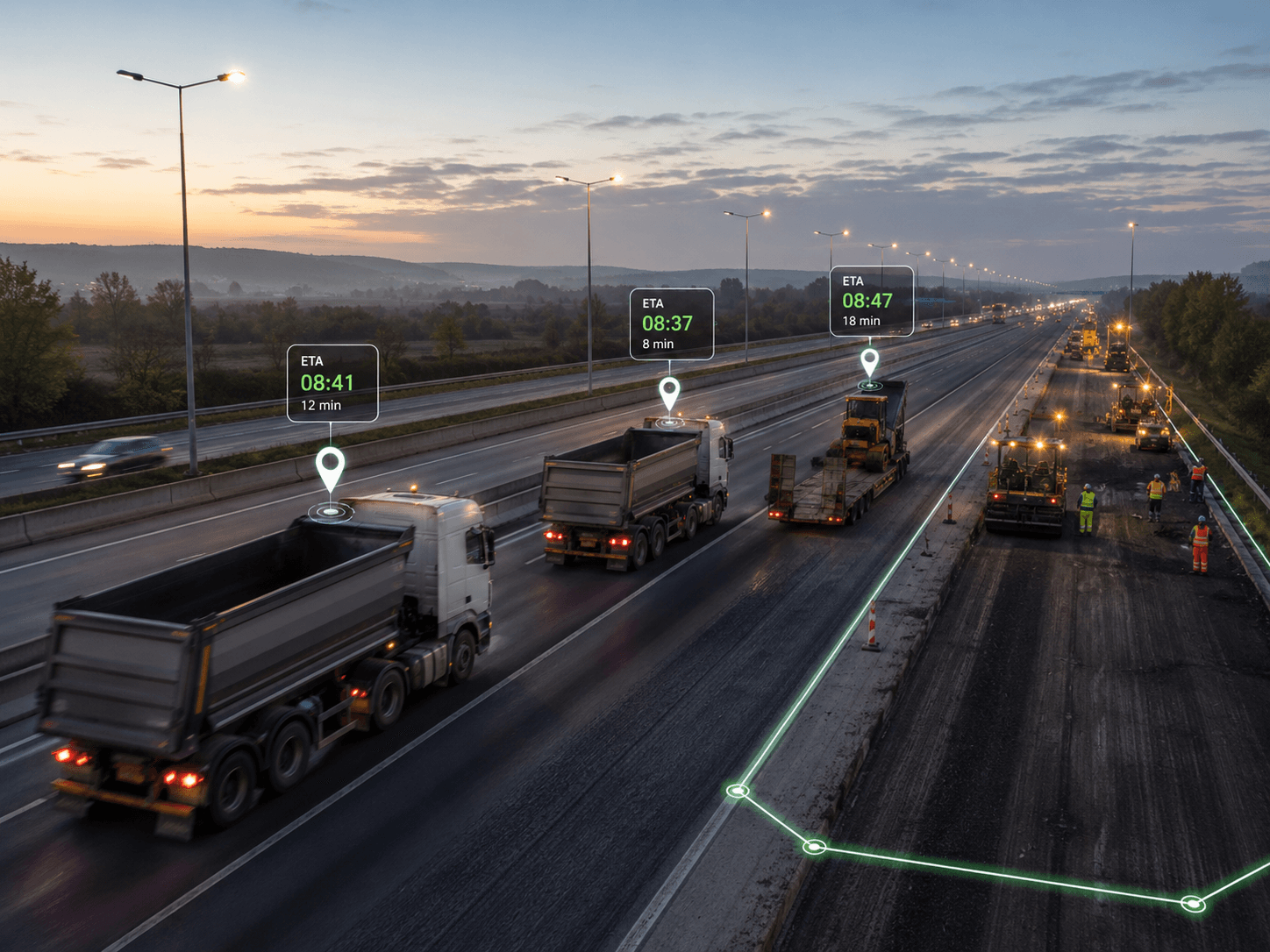
Construction fleet telematics: from reactive to real-time
Construction sites do not run on machines alone — they run on a steady flow of heavy-duty trucks moving aggregates, asphalt, concrete, spoil, plant and prefab in and out, all day. Most contractors still manage that flow reactively: phone calls when a truck is late, paperwork after a routing complaint, CO2 emissions reconciled at year-end. A predictive operation looks different: live GPS across every truck and carrier, ETAs the site can plan against, jobsite-level CO2 ready for regulatory reporting, and restricted routes that simply cannot be driven. The jump is not a software project — it is a data-integration project.
06:42 on the A1
A construction site logistics manager on a German motorway-resurfacing project takes a call at 06:42. Two articulated tippers are inbound with 80°C asphalt — working window roughly ninety minutes. A low-loader carrying the paver should be on site already; nobody can answer where it is. The rental's telematics live on another account. The dispatcher's last data point is a phone call at 22:14 last night. The asphalt cools, the paver rolls in at 09:38, the motorway closure window is missed, the day costs €18,000 in direct loss plus a contractual penalty.
Nothing was missing in the data: the paver had telematics, the low-loader had GPS, the tippers had OEM feeds, the rental house had a job sheet, the contractor had a project plan. None of those data sources lived in the same place. That is the reactive state — and almost every contractor reading this can name a version of it from the last twelve months.
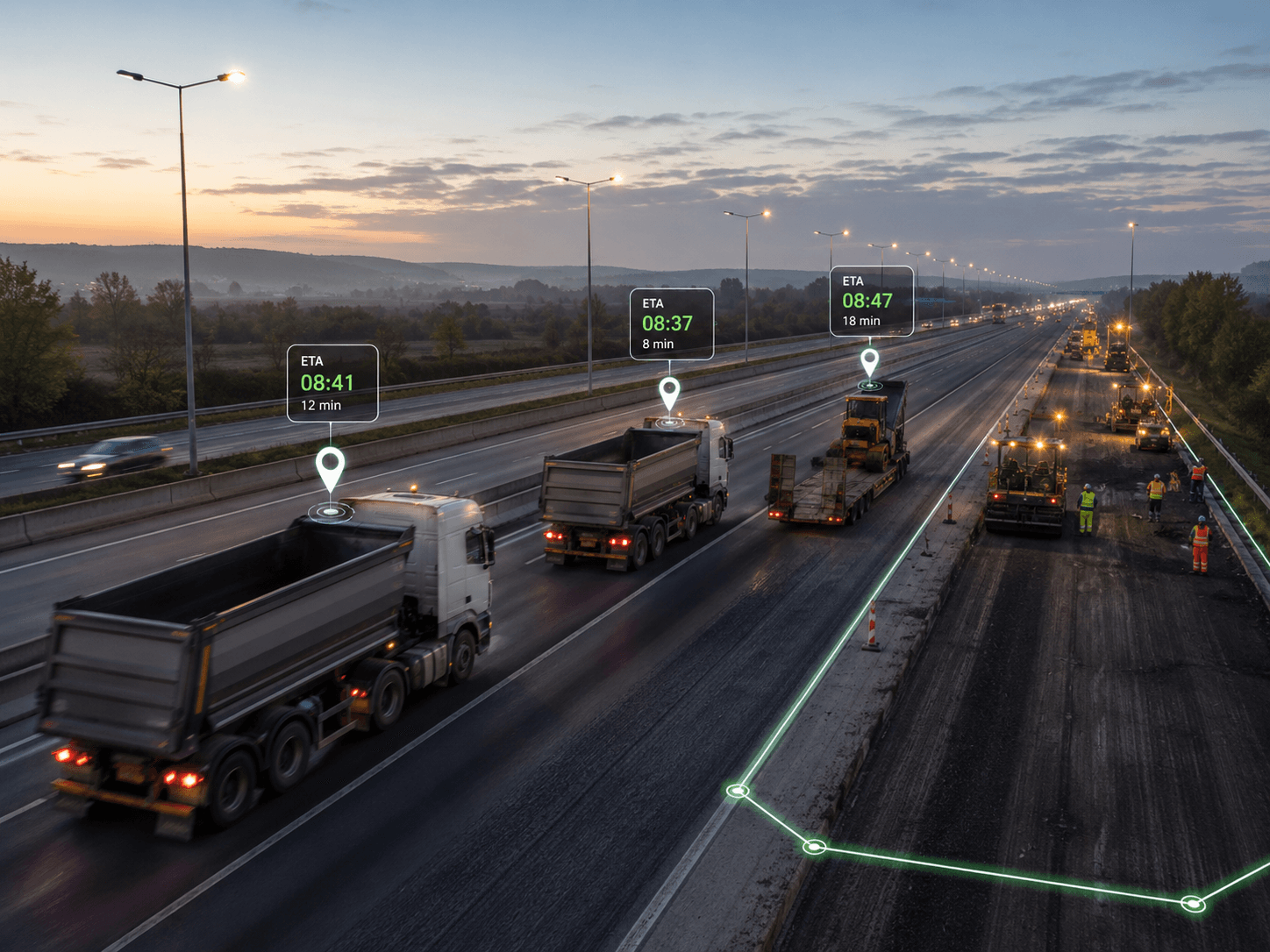
Why this matters now, not next year
Three pressures are turning truck flow in and out of a construction site from a productivity story into a 2026 budget story.
Costs have moved up. UK red diesel was withdrawn for most construction uses in April 2022, lifting effective fuel costs roughly five-fold for non-exempt fleets. Across Europe and the UK, low-emission zones (London ULEZ, Berlin Umweltzone, Paris Crit'Air, Antwerp LEZ, Milan Area B and a growing list) reshape truck routing daily.
Reporting has expanded. The first wave of CSRD-affected contractors files in 2026, and Scope 1 emissions from owned trucks are firmly in scope. Tier-1 clients with their own CSRD obligations are starting to demand jobsite-level CO2 data from subcontractors as a precondition of award.
Public tolerance has tightened. Local authorities, residents' groups and environmental NGOs across Europe escalate quickly when contractor trucks cut through villages, schools or nature reserves. One geotagged photograph on social media now produces a council inquiry within forty-eight hours.
Every truck movement in and out of a construction site is now a cost, a reporting line, and a reputational event.
Every truck movement in and out of a construction site is now a cost, a reporting line, and a reputational event.
What "reactive" looks like for site-bound trucks
For most contractors today:
- Truck location is known only when the driver calls in, or when the gate cam catches them arriving.
- ETAs are the dispatcher's best guess — and the asphalt either makes the window or does not.
- Carriers and subcontractors live in their own portals; the contractor reconciles spreadsheets afterwards.
- Scope 1 fuel and CO2 data are reconstructed from receipts at quarter-end.
- Restricted-route compliance depends on the driver's local knowledge — and the planning office's complaint inbox.
Twenty years of telematics on every truck has produced dozens of separate data sources per fleet, and very few operating realities that use any of them together.
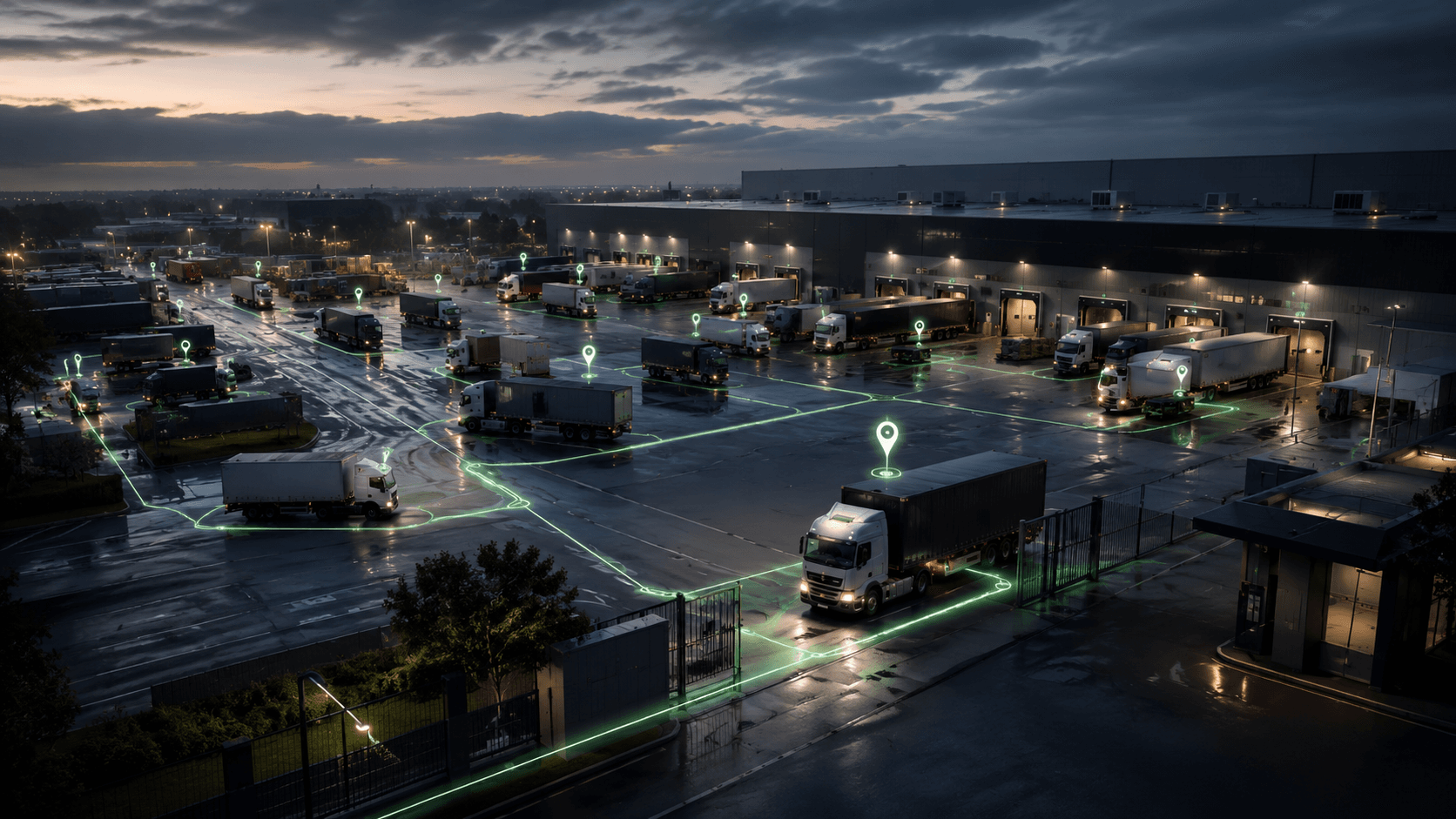
A unified visibility platform is the foundation. Connecting every truck OEM (Mercedes-Benz, MAN, Scania, Volvo, DAF, Iveco, Renault, Ford), every trailer maker (Schmitz, Krone, Kögel, Faymonville, Goldhofer, Nooteboom), every retrofit telematics provider, every carrier and every subcontractor under one project view is the prerequisite for everything that follows. CO3's aggregation layer carries 500+ live integrations and 12 OEM partnerships across exactly this stack.
Once the data sits in one place, four use cases move the operation from reactive to real-time.
GPS visibility across every truck, every carrier
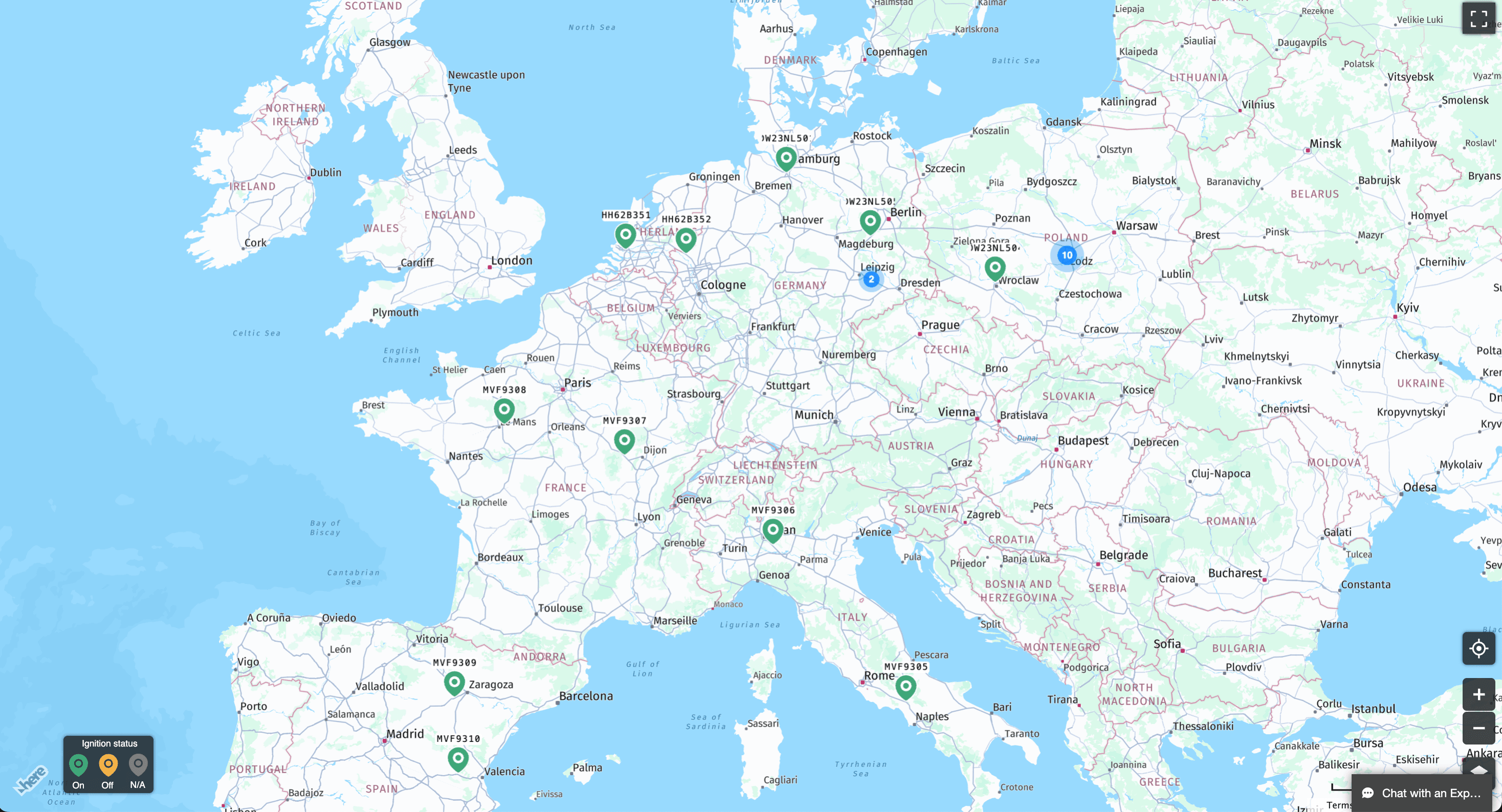
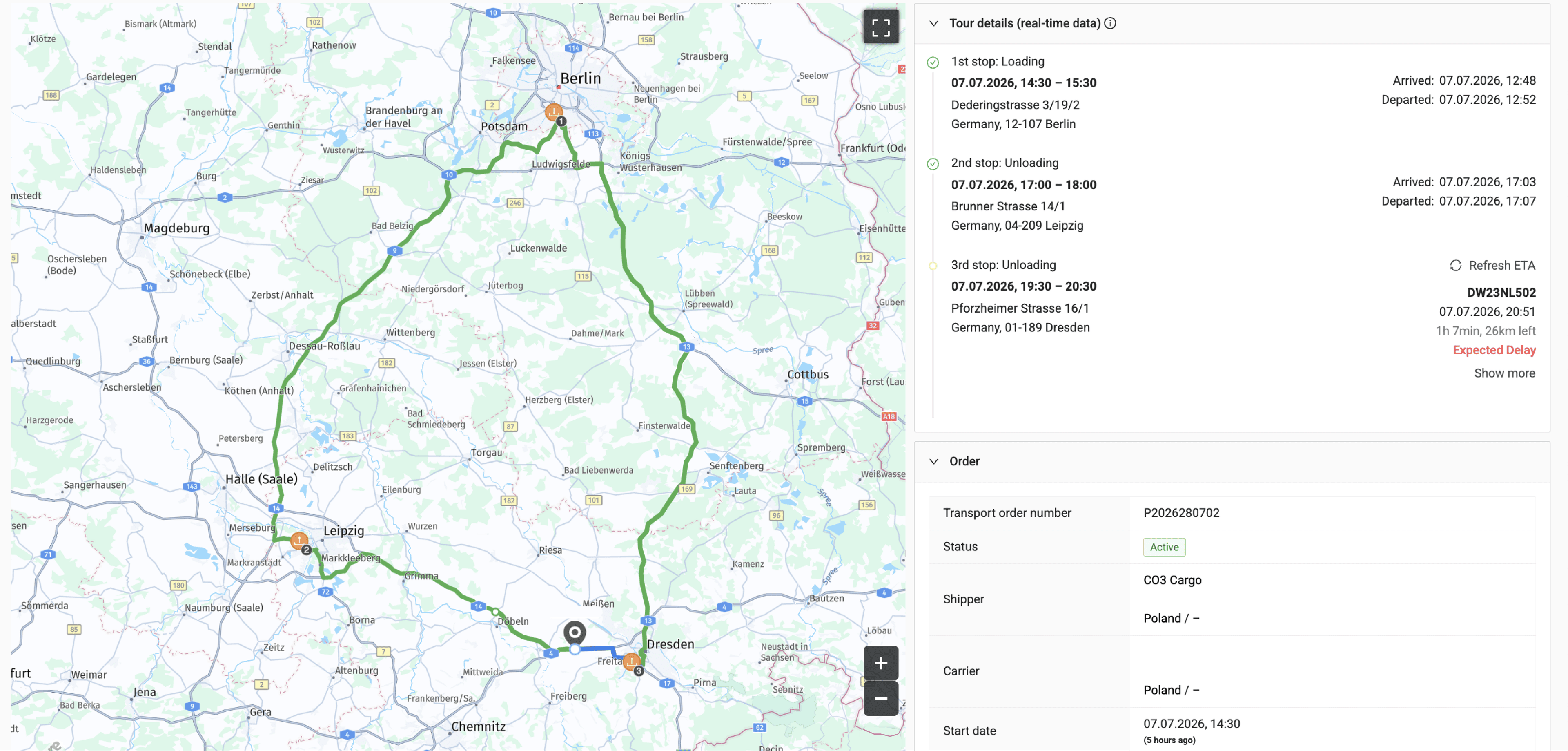
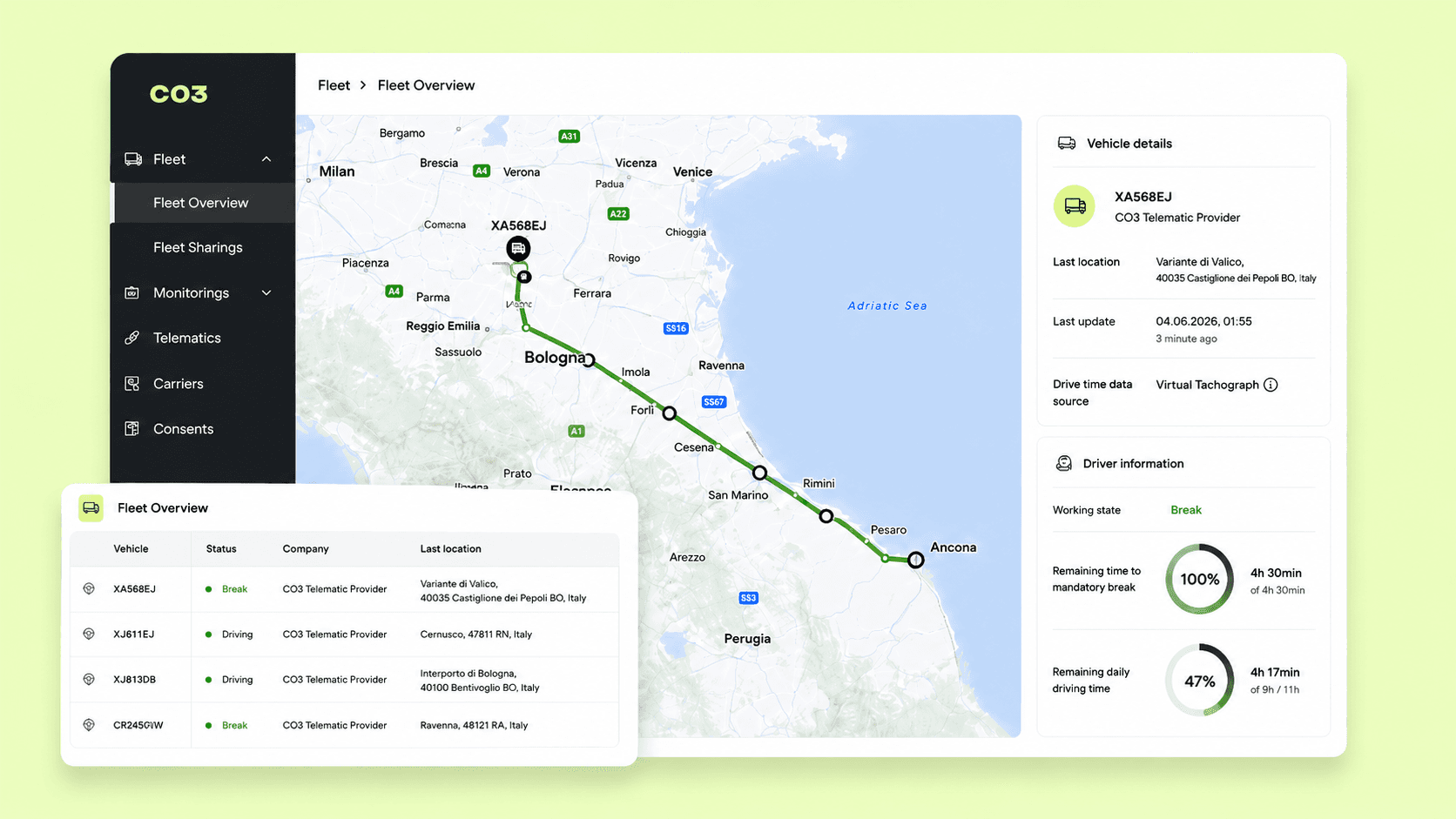
Live, accurate position on every truck inbound or outbound is the first dividend. Not the OEM dashboard, not the carrier's portal — one project map showing every aggregate tipper, asphalt feeder, concrete mixer, low-loader and delivery truck en route to or from the site, regardless of who owns and operates it.
The practical benefit is simple: the site manager stops guessing. The foreman knows there are two tippers fifteen minutes out, the next low-loader is held up at a weighbridge, and the concrete mixer due for the 14:00 pour has just left the batching plant on schedule. Every conversation that today consumes ten minutes on the phone collapses into a glance at the map.
This works only if the platform speaks every carrier's data language. On a typical European site, the truck flow is split across three to ten carriers, each with a different telematics stack. The site manager has no operational interest in which portal each one uses.
ETA predictions the site can plan against
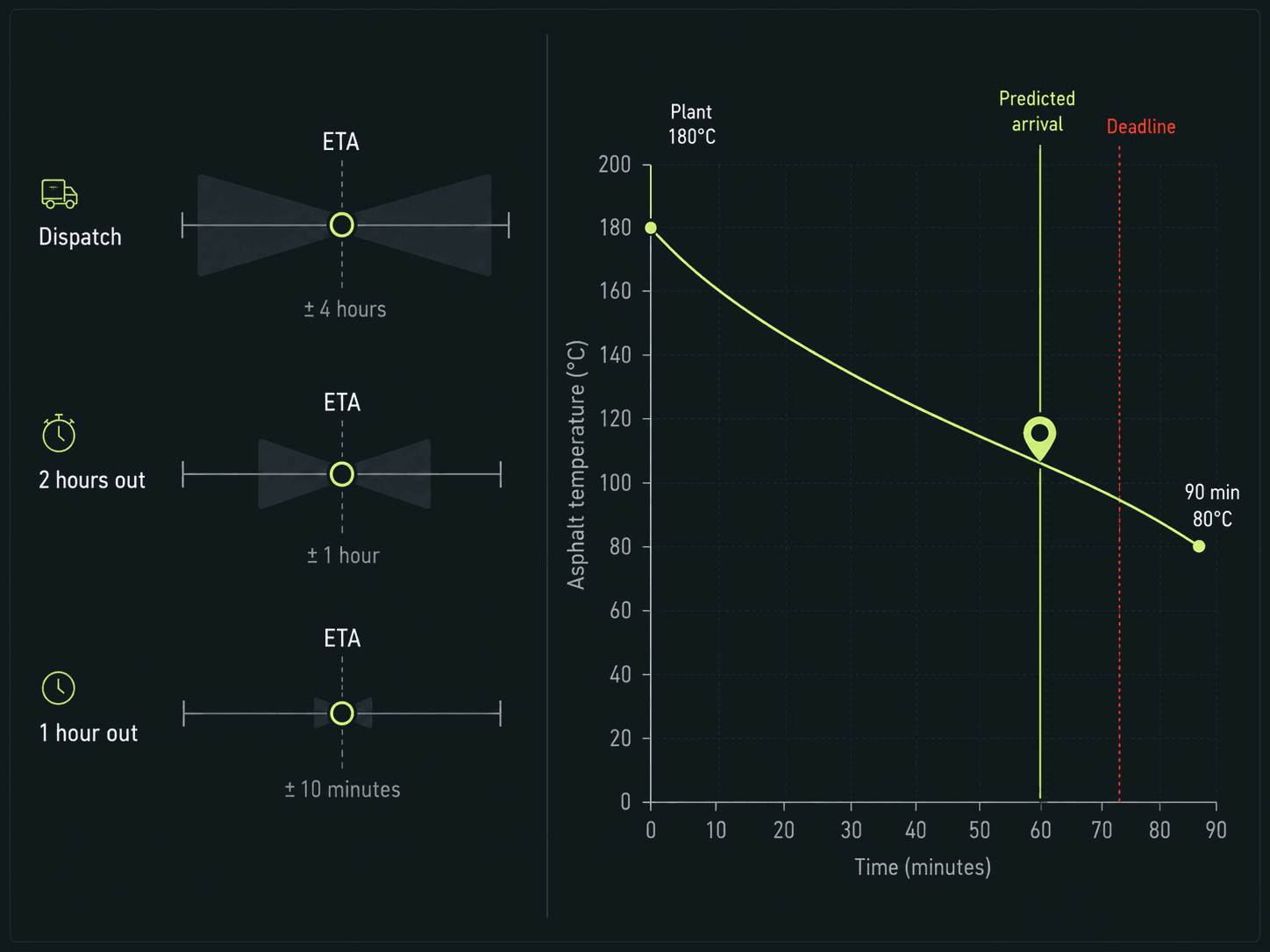
A dispatcher's "we'll be there around 07:00" is not an ETA. A predictive ETA is a continuously updated arrival time built from live GPS, traffic conditions, driver-hours availability, route restrictions and weight class — and it is what allows the site to plan asphalt orders, pour windows, crane lifts and gate slots against reality rather than memory.
For a contractor managing a hot-mix asphalt operation, the ETA is the order. Asphalt has a working temperature window of roughly ninety minutes from plant to laydown. Concrete is on a similarly hard clock. Crane-lift slots are booked to the quarter-hour. In all three cases the cost of being early is small; the cost of being late is the day.
A predictive ETA also reaches further back into the day. Once the platform has six to eight weeks of data on a route, it gives the contractor a realistic plant-to-site time that beats a generic map estimate — because it has learned how the contractor's own trucks actually run that corridor on a Tuesday morning. Inter-site moves of plants on low-loaders — historically the source of the most painful surprises — get the same treatment.
The vignette that opened this article ended in €18,000 of loss because nobody had an ETA. With a unified platform, that morning resolves itself before the foreman makes the call.
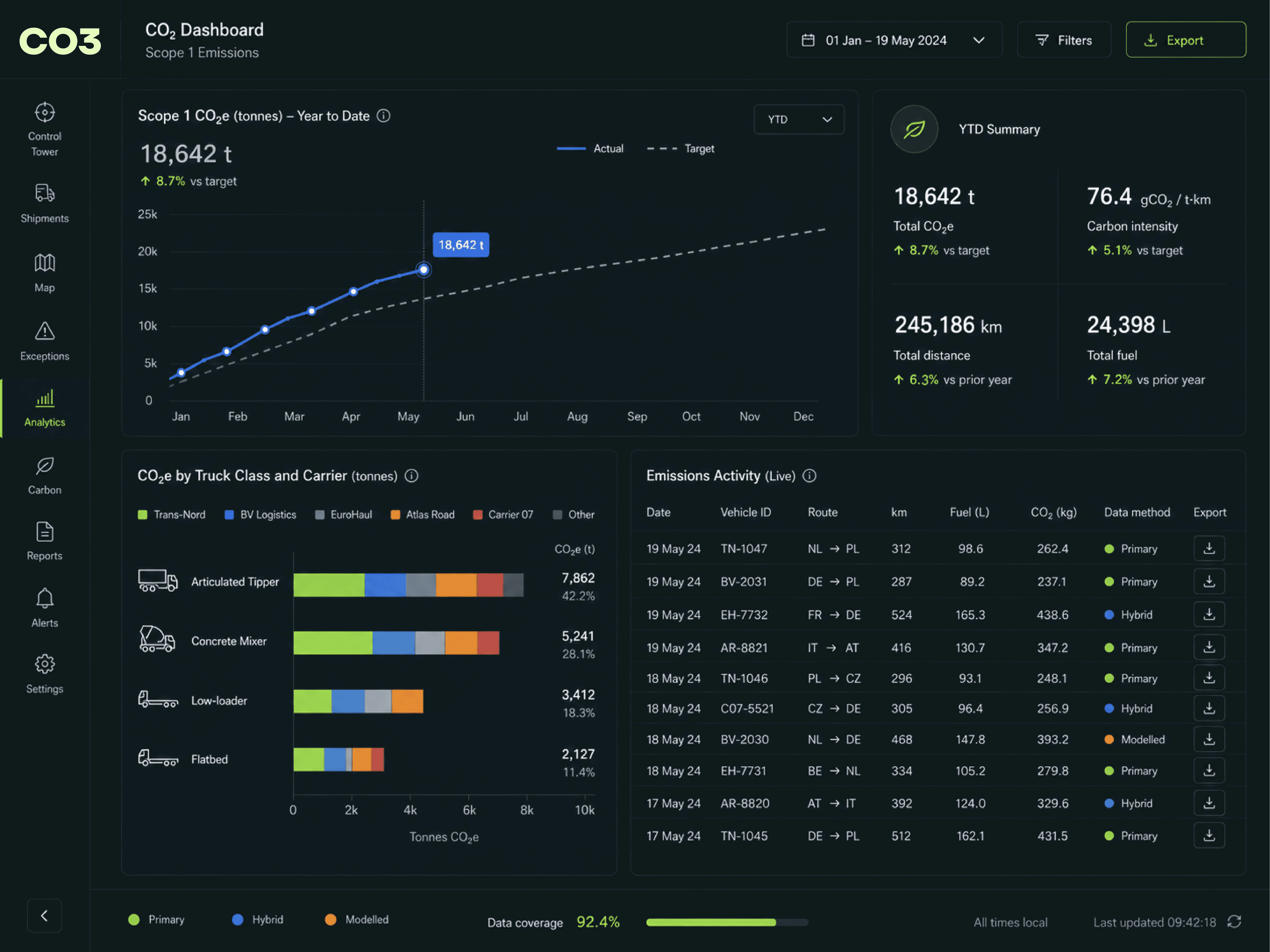
CO2 emission calculations for CSRD and client reporting
The reporting environment has changed faster than most contractors' systems. Under CSRD, in-scope contractors report Scope 1 emissions — direct emissions from owned trucks and equipment — with sufficient granularity to defend the figure. Tier-1 clients with their own CSRD obligations now ask for jobsite-level CO2 from subcontractors as part of award. Larger construction sites — particularly major infrastructure builds — increasingly carry their own emission caps written into the planning consent.
A unified telematics platform produces this data as a byproduct of normal operation. Every truck broadcasts fuel consumption per kilometre, idle time, engine load and route via the CAN bus. Multiplying through a verified emission factor produces an audit-grade CO2 figure per truck, per trip, per jobsite. Aggregated across the project, it gives the contractor a defensible Scope 1 number — and gives the project director a Scope 1 budget to manage during the build, not just to report after it.
Two practical consequences. First, the contractor can answer the client's procurement questionnaire in hours, not weeks, and increasingly use that answer as a tendering asset. Second, when a project is on pace to overshoot its quarterly emission budget, the platform flags it early enough for decisions — switching to a lower-emission carrier on a corridor, consolidating deliveries, rerouting through a shorter or less congested corridor — to actually change the number.
Zoning: stop trucks where they should not be, before they arrive
The fourth use case is where geofences stop being passive boundaries and become active controls.
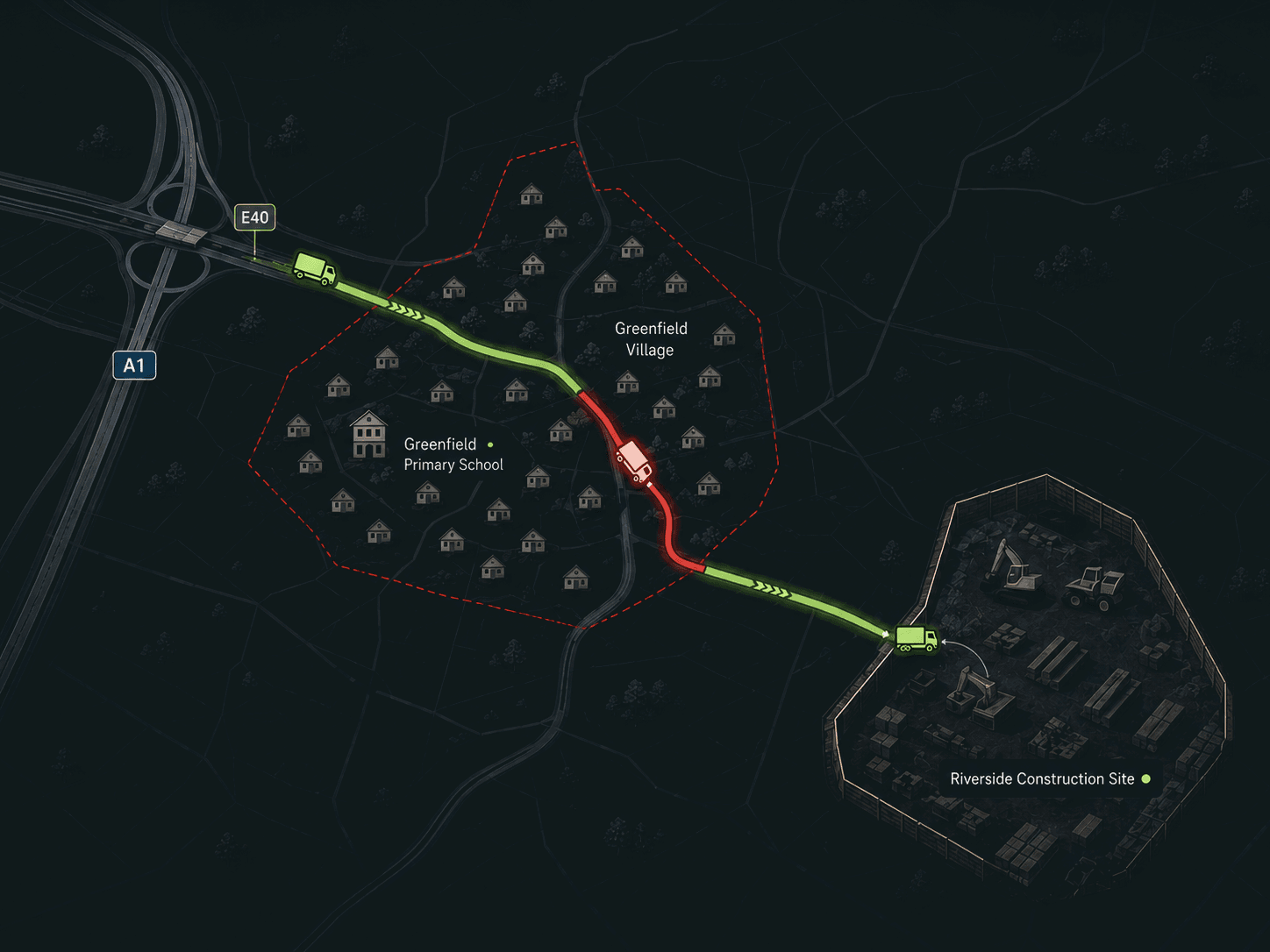
Construction trucks are the source of most of a project's external friction — they drive through villages, past schools and around nature reserves on the way to and from site, and most of those moves are happening because a route-guidance app optimized for time, not for the planning permission that governs the build. The result: council inquiries, social-media complaints, planning-condition breaches and, in the worst cases, stop-work notices.
A unified visibility platform converts the planning permission into geofenced rules. Three flavours matter on a construction project:
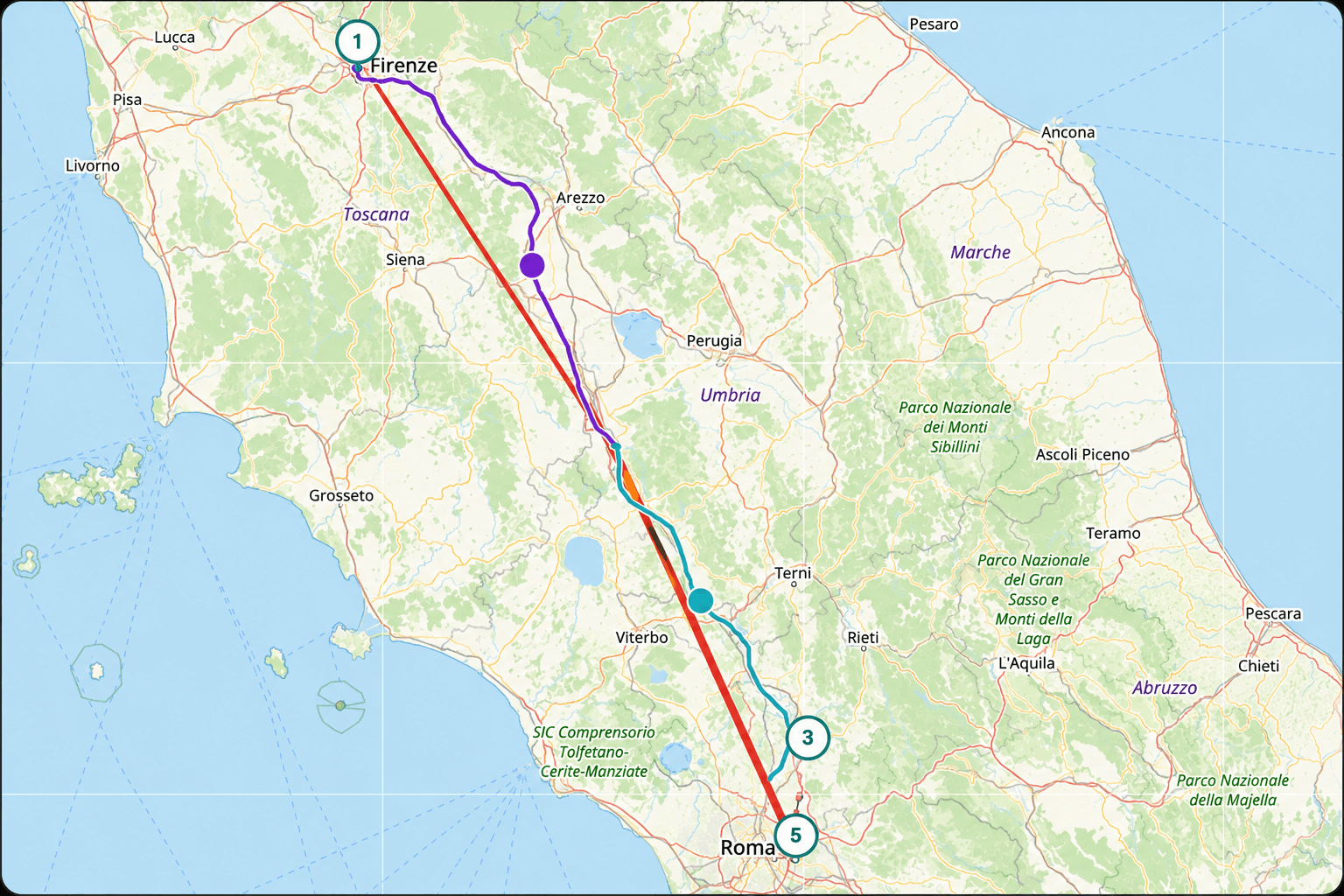
Restricted-corridor enforcement. Define the permitted access corridor for the site — typically the route specified in the Construction Traffic Management Plan. Trucks leaving the corridor trigger an immediate alert to dispatch, before the truck reaches the village.
No-go zones. Geofence the nature reserves, residential streets, school zones and protected habitats that the planning conditions explicitly exclude. A truck entering one is flagged in seconds — and the project director has an evidence trail showing exactly which carrier, vehicle, driver and timestamp produced the breach, ready for the contractual conversation.
Low-emission and time-window zones. Pre-clear every inbound truck against the LEZ rules along its route; flag any vehicle not compliant for the cities it is about to enter. Apply the same logic to night-work and quiet-hours windows in central European cities, before the noise complaint reaches the project director.
The point is not the alert. The point is that the alert arrives in time for someone to do something about it — and that the underlying data is captured cleanly enough to defend the project's planning compliance in front of a council or an environmental regulator.
A self-assessment: where is your fleet today?
Six Yes/No questions — fewer than 4 "yes" answers is a budgetable opportunity
If you scored below four, the gap is an integration problem, not a strategy problem. CO3 connects every OEM, carrier and subcontractor your site uses into one project view — the same one the use cases above run on. A 20-minute walkthrough shows exactly which of your current systems can be unified and which use cases go live first.
What to watch in the next 12–18 months
Mandatory OEM data exchange. The EU Data Act (Regulation 2023/2854) governs access to industrial data from September 2025. Through 2026–2027 it will be markedly easier for contractors to demand a real-time data feed from a Mercedes-Benz, Scania or Volvo truck without paying a per-vehicle premium for each portal.
Embedded CSRD inside procurement. Tier-1 contractors will increasingly require jobsite-level Scope 1 data from subcontractors as a precondition of award, not as a post-completion audit step.
Planning conditions tied to telematics. A growing number of UK and continental planning authorities are writing live telematics evidence into Construction Traffic Management Plans. By 2027 a contractor without integrated truck telematics will be tendering with one hand tied behind their back.
Closing thought
The reactive fleet is not failing because the trucks are bad. It is failing because the data is fragmented and the operator is asked to bridge it manually. Every step from reactive to predictive is a step in integration — connecting one more OEM, one more carrier, one more signal in one more place. The contractors who will outperform across the 2026–2027 cycle are the ones treating their truck-fleet data as part of the project, not as an afterthought to it.
CO3 connects construction sites to their entire heavy-duty truck flow: 12 OEM partnerships, 500+ integrations, 300,000+ assets and 6,000+ fleets across Europe and the UK. One project view, every truck, every carrier.
Euro VI — Current EU emission standard for new on-road heavy-duty trucks.
Stage V — Current EU emission standard for new non-road plant.
CAN bus — Internal data network on every modern truck, carrying engine, fuel, idle, location and operational signals to the telematics module.
OEM telematics — Data streamed by the truck manufacturer (Mercedes-Benz, MAN, Scania, Volvo, DAF, Iveco, Renault, Ford) from factory-fitted hardware, available via API.
Geofence — A virtual boundary on a digital map. When a truck crosses it, an alert or workflow is triggered.
Low-Emission Zone (LEZ) / Ultra-Low-Emission Zone (ULEZ) — Municipal zones restricting non-compliant vehicles. Examples: London ULEZ, Berlin Umweltzone, Paris Crit'Air, Antwerp LEZ, Milan Area B.
CSRD — Corporate Sustainability Reporting Directive. EU regime requiring in-scope companies to report ESG data including Scope 1, 2 and 3 emissions.
Scope 1 emissions — Direct emissions from sources owned or controlled by the company. For a contractor, this includes diesel burned by owned trucks and plant.
Construction Traffic Management Plan (CTMP) — The plan submitted with a planning application that defines truck access routes, hours of operation and approved corridors.
Red diesel — Rebated-duty gas oil. Withdrawn for most construction uses in the UK from April 2022.
EU Data Act — Regulation (EU) 2023/2854, in force from September 2025, governing access to and use of industrial data including connected-product telematics.

























.png&w=3840&q=75)










.png&w=3840&q=75)