CSRD & Fleet CO2 Compliance

New EU sustainability rules mean big shippers now have to publish the CO2 footprint of everything they ship with you. That number has to come from real data — not a rough estimate — and it has to hold up to an auditor’s review.
For road freight companies, that changes the game. “CSRD compliance” is not a finance-team task that can be solved with a spreadsheet. It is a question of whether the CO2 number you hand a customer can be traced back to an actual truck, on an actual day, burning an actual amount of fuel.
The good news: the data already exists. It sits inside the telematics boxes, the truck’s fuel system and the fuel cards you already use today. The question is whether you can collect it, structure it, and deliver it in a form your customer’s auditor will accept.
This article explains, in plain language, what is being asked of road freight carriers, what “primary data” really means, where most operators get stuck, and how a real-time transport data platform fits in.
Why sustainability regulation (CSRD) suddenly matters for trucking companies — even if you’re not in scope yourself
CSRD stands for the Corporate Sustainability Reporting Directive. It is the EU’s new law on what large companies have to disclose about their environmental and social impact. The rules it points to are called the European Sustainability Reporting Standard (ESRS).
Broadly speaking, companies above €450 million in revenue and more than 1,000 employees have to report annually, with the first wave of filings already happening in 2025. A simplified version of the rules is expected for 2027, with mandatory reporting from 2028.
If you are a mid-sized road freight company, you may read that and think you are off the hook. You are not — for one practical reason:
Your customers (the shippers) are in scope. And their biggest source of emissions is you.
When a manufacturer or retailer reports its climate footprint, the emissions from moving its goods around are usually the single largest line. That is everything you carry for them. They now have to report this number — accurately enough that their auditor will sign it off — and they cannot do that without you. In reporting terms, these emissions are called Scope 3 emissions (Scope 3 Category 4 — upstream transportation and distribution, to be exact).
CSRD is therefore the reason that ESG, sustainability, and emission questions suddenly show up in your RFP questionnaires, your contracts, and your quarterly business reviews. Even if you do not file a CSRD report yourself, your customers will need one from you to complete theirs.
What ESRS actually asks for — in plain English
Underneath the jargon, ESRS asks in-scope companies to publish, for each of Scope 1, 2 and 3:
- How many tonnes of CO2-equivalent they emitted: including a breakdown of Scope 3, the part that involves you.
- How they calculated the number: which emission factors they used, where the data came from, and how much of the result is based on real measurements versus estimates.
- How they plan to reduce it: in line with a 1.5°C climate pathway, with targets along the way.
- How they progress against those targets: year by year.
The detail that turns this from an ESG writing exercise into a data project is the third point above. Auditors don’t just look at the number. They look at how confident you are in the number. A report built on “we took our total kilometres and multiplied by a default factor” will pass a first-year filing. It will not pass its third.
That is where two more acronyms come in: ISO 14083 and the GLEC Framework.
ISO 14083 and GLEC: the methodology your customer’s auditor will expect
ISO 14083 is the international standard for measuring CO2 emissions from transport and logistics. It was published in 2023 and was largely based on work by the Global Logistics Emissions Council (GLEC). GLEC’s current framework (v3.x) and ISO 14083 together are the methodology the EU treats as the reference point for freight emissions. When Transporeon, Alpega, Searoutes or CO3 say their numbers are “compliant”, this is what they mean.
Two things freight forwarders and fleet owners should understand about ISO 14083:
- Measure trip by trip, not company-wide. Emissions have to be calculated for each transport operation (each leg) or, at worst, for a group of similar legs. A single company-wide “average CO2 per km” is not enough.
- Real data beats estimates — and you have to say which is which. The standard prefers measured fuel or energy use (primary data) over distance-times-factor estimates. Default factors are allowed as a fallback, but only if no primary data is available, and you have to disclose when you’ve used them. An auditor will challenge a big share of default-factor calculations if real telematics data could have been used instead.
The four pieces of data that make a CO2 number defensible
To produce a CO2 number for one truck leg that will stand up to scrutiny, you need four pieces of information at the same time:
- What kind of truck and what kind of fuel? The vehicle class, its emission standard (Euro V, Euro VI), and the fuel it runs on (diesel, HVO, LNG, CNG, electric). A 44-tonne articulated truck on HVO100 produces a very different number from a 7.5-tonne on B7 diesel.
- How much fuel did it actually burn? Measured from the vehicle itself — via the fleet management system (FMS), OEM manufacturer or CAN bus. If that is not available, the fallback is accurate distance plus a modelled consumption figure.
- What was the truck carrying? Weight and/or volume per leg, so that the emissions can be split across customers. This is the piece most often missing from telematics alone, and it is the most common reason carriers cannot produce CSRD-grade numbers.
- Where did the leg start and end? A clean definition of loading point, unloading point, and the stops in between. Without clean leg boundaries, you cannot tie fuel burn to a specific customer’s shipment.
If you have all four for every leg, you can produce a number that is CSRD-defensible. If you are missing one, you are estimating — which is allowed, as long as you say so. The commercial issue arrives when a shipper compares you to a competitor who isn’t estimating.
Where freight operators and fleet owners usually get stuck
In conversations with road freight operators across Europe, four situations come up again and again.
The fuel-card trap
Many freight forwarders and trucking companies still work out their CO2 number from monthly fuel-card totals. That gives you one company-wide figure, which is fine for your own first CSRD filing. But it cannot be split back down to a single shipment, and your customer will ask for per-shipment emissions. A fuel-card spreadsheet cannot produce them.
The subcontractor problem
A typical European carrier runs 30–40% of its volume through subcontractors. The data coming back from those sub-carriers is usually much thinner than from your own trucks — often just a pickup time, a delivery time, and a price. Under ISO 14083 that is only acceptable with default values, which (a) makes the reported number higher than it needs to be, and (b) shows up as a lower “primary-data share” — a number shippers are now using to compare carriers.
Too many telematics systems
A carrier with a few depots and a history of acquisitions may run five or six different telematics systems at once — Transics, Webfleet, Astrata, Continental, plus OEM feeds from Volvo, Scania, DAF, Daimler. Each of them returns data in a slightly different shape. Getting to one consistent CO2 number across all of them is, in practice, a data-engineering problem first and a sustainability problem second.
The “quarterly CSV” workaround
The usual stopgap today is to export a CSV every quarter, send it to an ESG consultant, and wait for a report back. That works for an annual filing. It breaks the moment a shipper asks for emissions at the point of tender — weeks before a truck has even moved. Annual reporting cannot serve tender-time requests.
A practical way to set up the data
There is a common pattern emerging across EU visibility platforms for how to build this well. It has four layers.
Layer 1 — Collect data from every telematics system in one place.
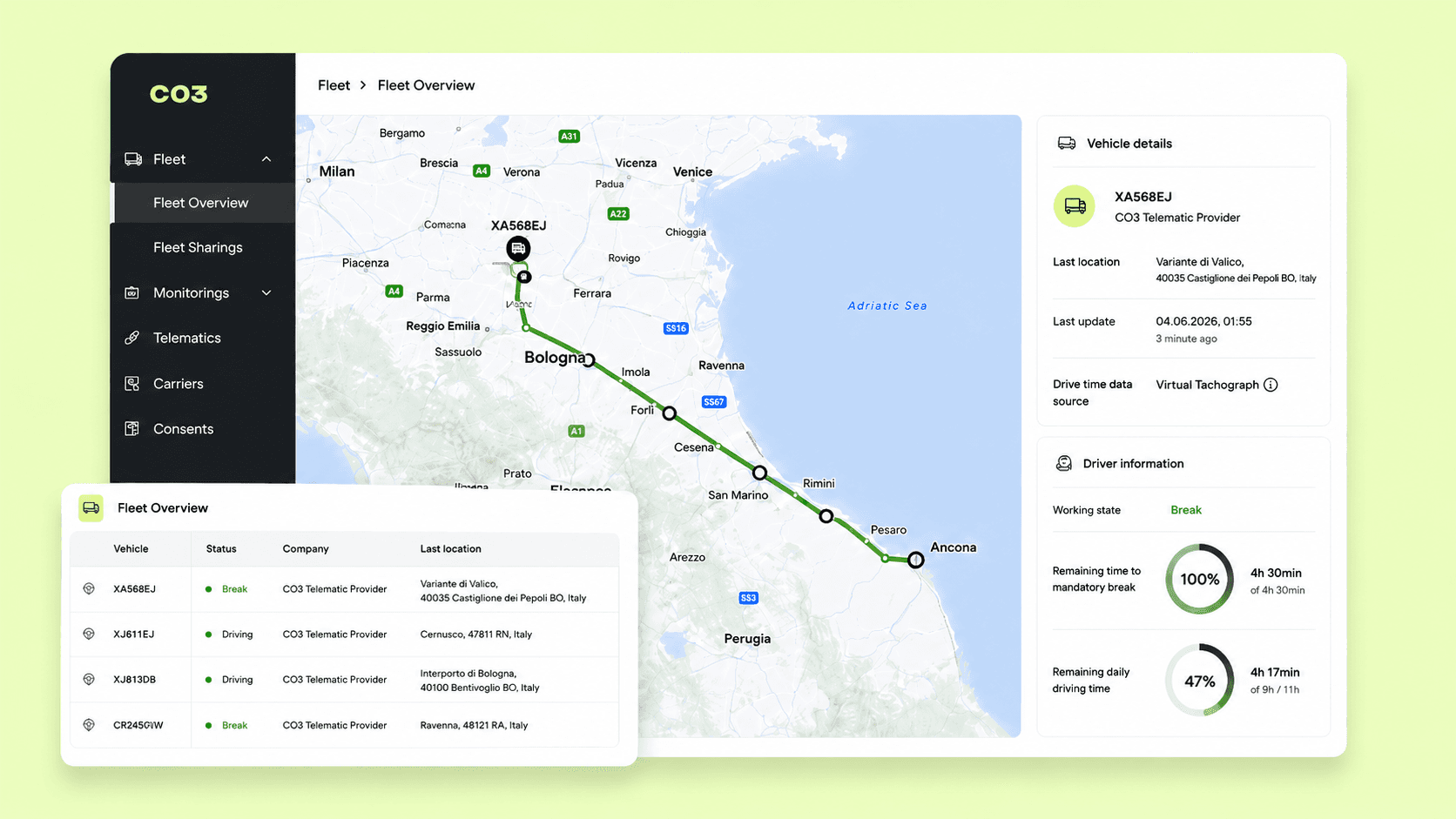
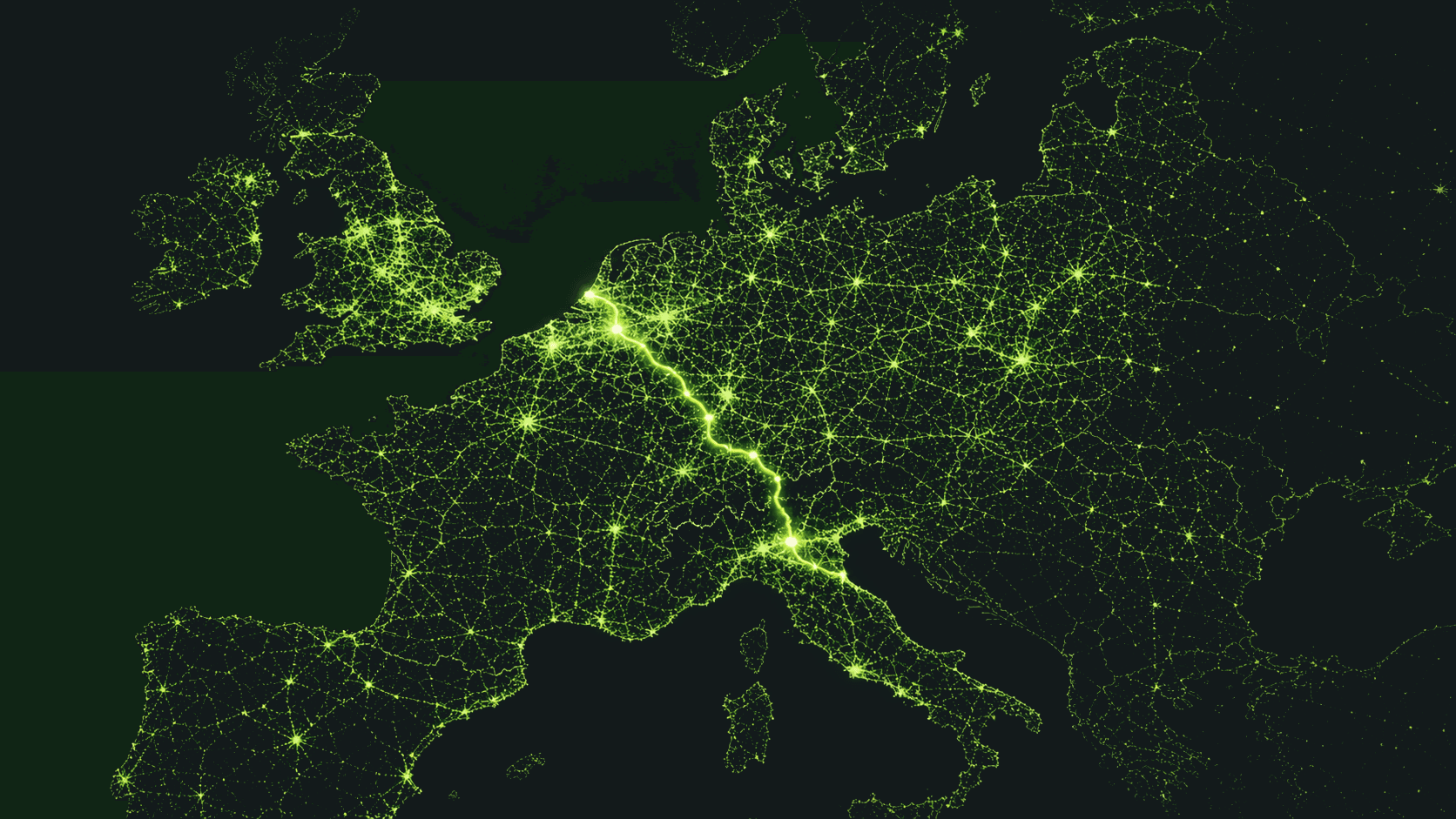
You need a single layer that pulls from every fleet management system, OEM feed and telematics provider across your fleet, including subcontractors, and turns them into one common format. CO3, for example, runs 500+ ready-made telematics integrations across Europe. The exact number matters less than the fact that without this layer, nothing further up works.
Layer 2 — Capture real fuel and activity data.
Measured fuel use, engine-on time, idle time, speed and position — from each truck, often enough to reconstruct what happened on each trip. This is what puts you at the top of the ISO 14083 “data quality” pyramid rather than the bottom.
Layer 3 — Match fuel burn to actual shipments.
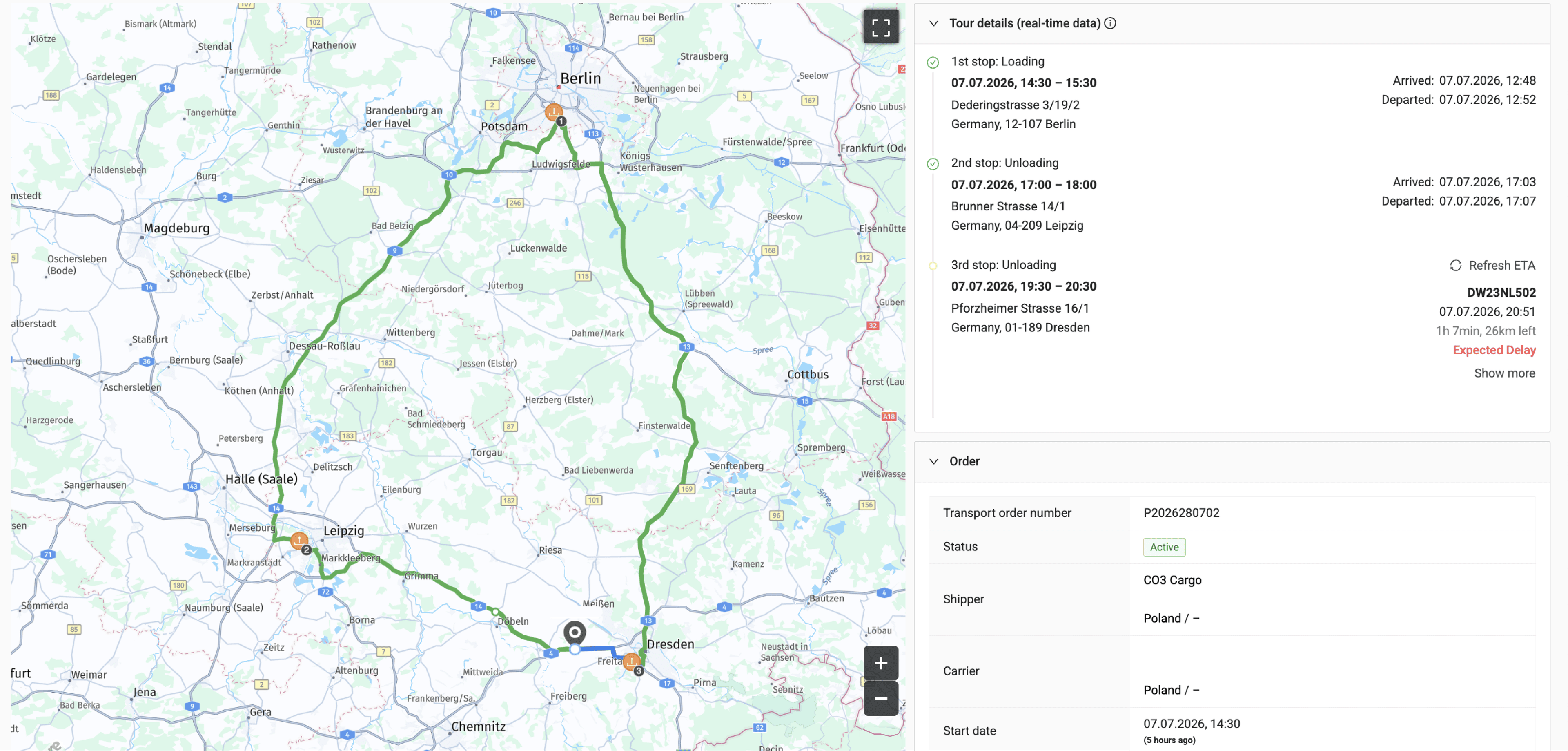
You need a reliable way to connect a window of fuel use to a specific shipment: detecting stops against loading and unloading points, and pulling the load weight from the TMS, a weighbridge ticket, a driver confirmation, or the delivery note. This is the layer where most home-grown systems collapse. In CO3’s model, each leg is mapped to a GLEC “Transport Chain Element” (TCE) and the system works out automatically which truck pulled which trailer on which leg — without you having to tell it in advance.
Layer 4 — Produce a report an auditor will accept.
Emissions per shipment, per lane, per customer, per vehicle, that add up cleanly to a Scope 1 total — plus the audit trail the auditor will ask for: the method, the emission factors, the share of primary vs. modelled data, and the allocation rules. A good API will return the method used for every single leg (for example PRIMARY, HYBRID or MODELLED) and a primaryDataShare figure at order level. That way, every gram of CO2 can be traced back to where it came from.
How CO3 does this today
CO3’s CO2 reporting is delivered through an API or a CSV export, calculated per leg and added up to order totals. For each leg, CO3 picks the best method it can, given the data available:
- PRIMARY — based on measured fuel or energy use from the vehicle.
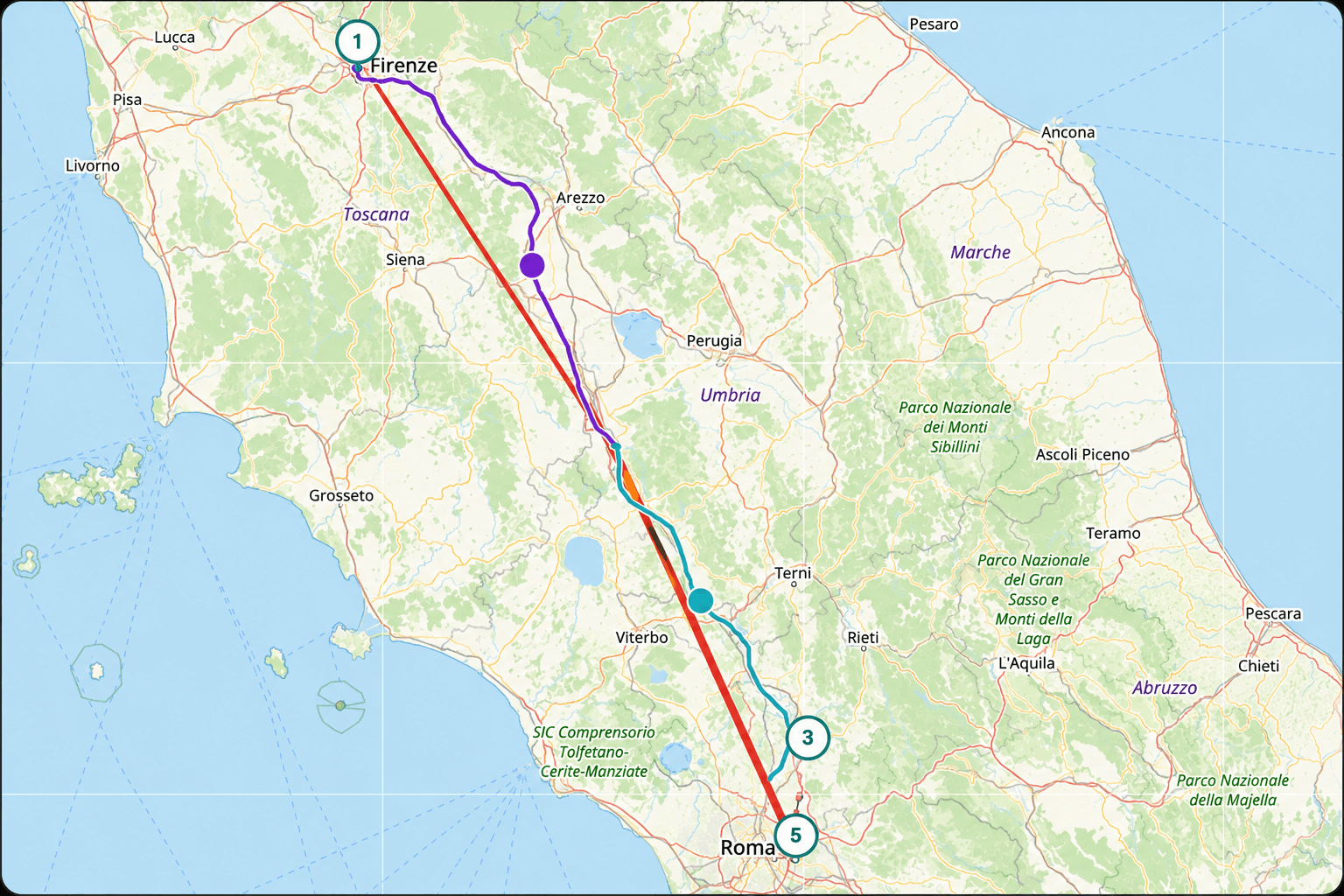
- HYBRID — real distance from telemetry, combined with default coefficients for the truck type.
- MODELLED — shortest feasible distance with an uplift, combined with default coefficients.
The method used is returned with every leg, alongside a primaryDataShare figure — so your customer’s CSRD report can show, transparently, how much of the number came from real measurement. Current scope is road-only, for completed orders. Live emissions on in-progress orders are on the roadmap but not in production today.
Getting to “primary data” without replacing your fleet systems
A fair objection from transport directors is: “We can’t re-equip our fleet just for CSRD.” True. Getting to primary data does not require replacing your telematics hardware, changing your TMS, or standardising on one vendor. It takes three steps, which can be done one at a time.
Step 1 — Check what data you already have. For every depot and every subcontractor, list: which telematics provider they use, whether the API gives you measured fuel, and whether stops and geofences are exposed. This simple inventory usually shows that 60–80% of fleets already have primary data available technically — it just isn’t being used.
Step 2 — Bring everything together in one platform. Feed all those systems into a single layer that handles the API, data-model and unit differences. This is the work a platform like CO3 does so your internal team does not have to.
Step 3 — Close the load-data gap. Work with your TMS (for shipment events and weights), your fuel-card provider (as a cross-check), and — where nothing else works — a lightweight driver confirmation of load weight at the end of each leg. This is the least exciting step and the one most often skipped. It is also the one that unlocks audit-grade allocation.
The result is that in one reporting cycle — typically 6 to 9 months — a carrier can move from near-100% default-factor reporting to 70–90% primary-data reporting, with the rest openly disclosed as modelled. That is the trajectory CSRD assurance wants to see.
A short checklist: are you CSRD-ready as a freight forwarder or fleet owner?
- A ten-minute self-check. Each “no” is worth a conversation internally.
- We can produce a CO2 number for one single shipment, not just a monthly total. Y / N
- For at least 70% of our volume, that number is based on measured fuel or electricity use. Y / N
- We can tell a customer or an auditor what share of our data is primary vs. default. Y / N
- Our method is written down, refers to ISO 14083 / GLEC, and lists the emission factors we use. Y / N
- We include subcontracted volume in our reporting, with a clearly described fallback method. Y / N
- We can deliver emissions data by API — not only as a PDF or a spreadsheet — to customers who ask. Y / N
- Our per-shipment numbers add up to the annual company Scope 1 total. Y / N
A freight forwarder answering “yes” to 6 or 7 of these is in a strong commercial position. A freight forwarder answering “yes” to 3 or fewer is probably losing tenders to one who answers 7 — without knowing why.
What to watch over the next 18 months
Four things worth keeping an eye on:
The simplified ESRS. A shorter, simpler version of the standards is expected in late 2026 for mandatory use from financial year 2027 onwards. Early drafts suggest Scope 3 category-level reporting stays, but with more flexibility on how it is aggregated. That reduces the short-term paperwork — but it does not reduce the pressure your shippers are putting on you.
ISO 14083 and GLEC converging. The two documents are moving closer together. Carriers should standardise on GLEC v3.x language in contracts and RFP responses, as it is aligned with ISO 14083.
The EU Green Claims Directive. This regulates what companies can say in their marketing about environmental performance — including phrases like “carbon-neutral transport”. Over time, the CO2 numbers on your customer invoices and the ones in your customers’ CSRD reports will have to match.
Digital transport documents (eCMR). As transport paperwork goes digital, tying emissions to a specific shipment gets easier — and a weak data story becomes visible to every customer by default. Carriers have roughly 18–24 months before this becomes the norm.
Closing thought
For freight forwarders and fleet owners, CSRD is not really a reporting exercise. It is a data-quality exercise with a reporting label on it. The freight forwarders who win the next round of tenders will not be the ones with the best-looking sustainability report — they will be the ones whose per-shipment CO2 number is built on real, measured data, traceable to a specific truck on a specific day.
That infrastructure is already available. It does not require ripping out your fleet systems. It requires connecting them.
See how CO3 aggregates 500+ telematics integrations into a single CSRD-ready emissions feed. Book a 20-minute platform walkthrough.
If you would like to learn more, please reach out to your respective account manager. We would be delighted to share a demo with you!
























.png&w=3840&q=75)










.png&w=3840&q=75)